Sometimes it feels like it’s Nvidia’s world, and we are all just living in it. As we brace for the firm’s latest earnings report coming Wednesday, we could say that Nvidia (NVDA) earnings — and more importantly, its forward guidance — have become much more than a par-for-the-course quarterly disclosure. They are now a referendum of sorts on the durability of the artificial intelligence (AI) theme.
With mega tech AI capital expenditure projected to cross a staggering $660 billion to $750 billion, according to estimates from firms like Goldman Sachs, CreditSights and Bloomberg, saying the stakes are high for Nvidia and the AI ecosystem is an understatement. It’s no wonder we can focus on little else this week.
See more: Capitalizing on the Nvidia Catalyst via Video Game Value Chains
Going into this week’s quarterly read into the state of Nvidia affairs, there’s plenty of other noise going on about AI’s state of affairs. Specifically, the ongoing chip shortage, demand outstripping supply, and concerns about valuations across the AI ecosystem.
Current View of the AI Investing Theme
What’s interesting is that advisor views on the opportunity set in AI continue to ebb and flow.
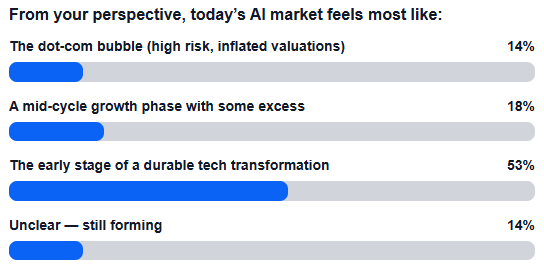
As an example, in a poll this week reaching over 500 advisors, we at VettaFi learned that most believe we are still early in the AI cycle. However, the dot-com era comparisons weren’t as prevalent as they were last year — despite the ongoing speed of tech innovation, the eye popping CapEx figures and concerns about valuations, as well as our collective obsession with the economic transformation that’s afoot, thanks to AI.

Source: VettaFi
Nvidia’s results today face a high bar to impress, as the market has grown accustomed to the “beat-and-raise” track record of the firm in recent quarters. There’s no question that AI is an evolving theme from an investment perspective, that’s today cross-sector and multi-industry, transitioning from initial excitement and hype to tangible innovation and revenue impact.
Investors continue to look for ways to access this theme, testing their convictions and betting on the future growth of this opportunity through both broad and narrow approaches, passive and active.
ETF Considerations
Consider Nvidia. Over 800 ETFs currently hold this stock, but they express the AI theme in different ways, and with varying degrees of diversification. .
If you want to play the immediate earnings volatility with maximum leverage, for example, single-stock and ultra-concentrated ETFs loom large. Funds like the GraniteShares 2x Long NVDA Daily ETF (NVDL), magnify the daily performance of Nvidia by 200%.
Chip-focused ETFs have been hugely popular, all of them heavily allocated to Nvidia. The VanEck Semiconductor ETF (SMH), for example, has Nvidia at over 17% of the portfolio. SMH is up about 140% in the past year. The fund has captured about $4.4 billion in net new money in 2026.
From there, investors have also leaned into software and generative pure-plays like the Roundhill Generative AI & Technology ETF (CHAT), the market’s only actively managed pure-play on generative AI. The fund implements a 50% revenue-purity screen, and Nvidia ranks high among top holdings representing over 7% of the portfolio. CHAT has picked up about $300 million in net inflows so far this year.
Approaches including the popular picks-and-shovels plays that capture the supply chain of AI have also resonated. There are many ETFs in this category, like the Invesco AI and Next Gen Software ETF (IGPT), which focuses on the memory and hardware backbone required to run AI, and where Nvidia sits in the top 10 holdings (around 7% of the portfolio).
More broadly, funds like the ROBO Global Artificial Intelligence ETF (THNQ) capture the developers, enablers, and adopters of AI. Again, there are many ETFs that set out with similar mandates.
In the case of THNQ, the strategy considers source of revenue, market and technological leadership, as well as capital investment in its security selection, working to make the portfolio “forward-looking” as the theme evolves. Nvidia sits at about 2% of the diversified portfolio.
As VettaFi Research Analyst Rafael Silva recently said, capturing the AI opportunity set is about identifying “leading players, whether they’re developing the tech or implementing it.”
Finally, there are also factor/style strategies and traditional sector exposures where Nvidia and AI are key drivers of performance. The growth-focused Alger Concentrated Equity ETF (CNEQ) is a great example of an actively managed growth fund that’s captured the AI theme really well, with a 30-holdings basket led by a 14.5% allocation to Nvidia.
The State Street Technology Select Sector SPDR ETF (XLK) is a sector example, where a broad sector approach is highly tied to Nvidia, which leads allocation with a 15% weighting in the portfolio. XLK is up over 50% in the past year.
As we look to Nvidia’s Q1 results, and the firm’s forward guidance, to assess our exposure to the AI theme and to a company that may be found across several ETFs in our portfolios, we remain reassured that whether through narrow or broad approaches, there are plenty of ETF choices to invest in this theme.
For more news, information, and analysis visit the Artificial Intelligence Content Hub.
Originally published on ETF Trends
vettafi.com is owned by VettaFi LLC (“VettaFi”). VettaFi is the index provider for THNQ, for which it receives an index licensing fee. However, THNQ and ROBO are not issued, sponsored, endorsed, or sold by VettaFi. VettaFi and its affiliates have no obligation or liability in connection with the issuance, administration, marketing, or trading of THNQ and ROBO.
A message from Advisor Perspectives and VettaFi: Discover something new! Click here to register for our upcoming webcasts.
Read more commentaries by VettaFi