The push for international equities diversification continues amid shifting global macroeconomic conditions. These days, investors have more options when it comes to international exposure. Given the current market uncertainty, they may want to put quality at the forefront of their decision-making process.
That said, a fund that provides broad exposure like the iShares Core MSCI EAFE ETF (IEFA) may not be sufficient. While it can serve as a fund for core international equities exposure, an emphasis on quality is available with a fund such as the American Century Quality Diversified International ETF (QINT). While both funds target developed markets, their strategies are inherently different.
Key Takeaways:
-
Traditional market-cap weighting leaves international allocations exposed to financially vulnerable giants, as ETFs like IEFA automatically funnel the most capital into the largest companies regardless of fundamental health.
-
QINT avoids value traps by tracking a multi-factor index that evaluates quality, growth, and valuation, dynamically shifting style weights in 5% monthly increments to insulate against market cycles.
-
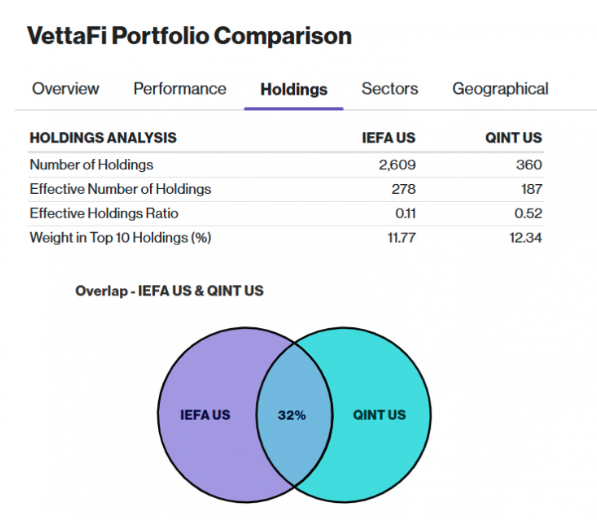
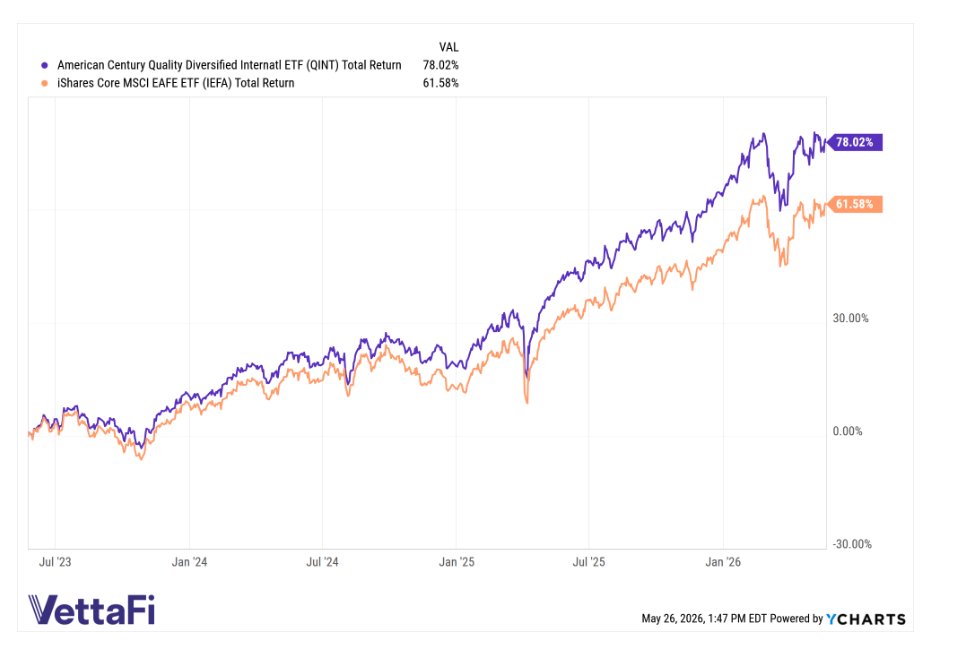
Despite holding fewer total stocks, QINT maintains a far higher effective holdings ratio of 0.52, ensuring balanced diversification that powered its outperformance over three years.
See More: ETF of the Week: American Century Quality Diversified International ETF (QINT)
IEFA: Unfiltered Exposure
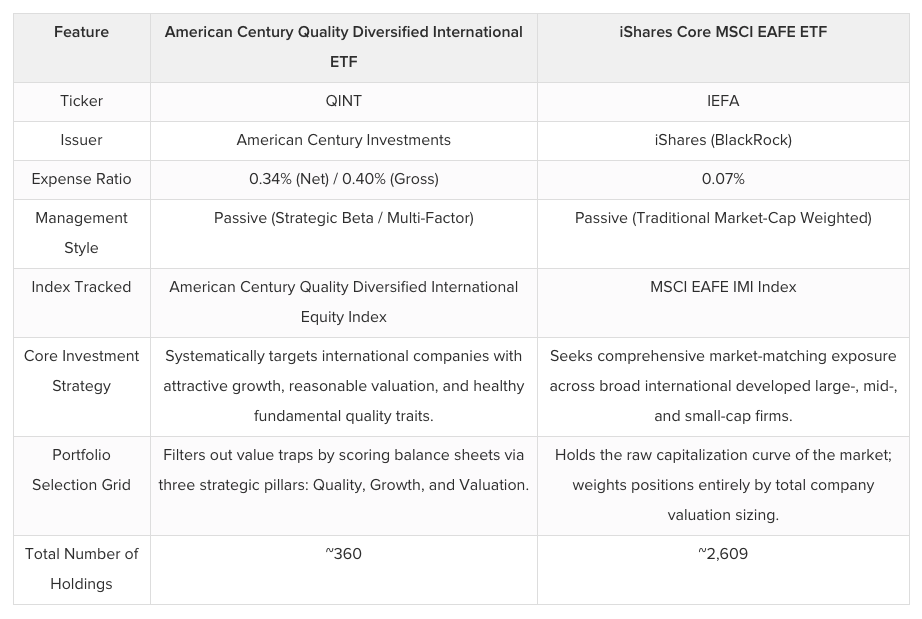
For investors looking for simple developed markets exposure at a low cost, IEFA is a suitable portfolio addition. By tracking the MSCI EAFE IMI Index, the fund casts a wide exposure net across developed market geographies. For cap diversification, it provides exposure to large-, mid-, and small-cap companies, which also explains its over 2,600 holdings. Of course, a highlight is that it does all of this with an expense ratio of just seven basis points.
Because it uses a market cap-weighted approach, however, it can come with limitations for those seeking differentiated exposure. This is especially so when regarding factor tilts. Because weight is determined entirely by market value, IEFA inherently allocates the most capital to the largest companies and countries, irrespective of their underlying financial health. If an international region experiences a structural slowdown, or if a massive multi-national corporation suffers from deteriorating profitability, the constraints of IEFA’s passive index means it must absorb those losses. Nonetheless, IEFA provides highly efficient access to international beta, but as mentioned, a tilt towards quality requires a differentiated approach.
QINT: Quality and Factor Filtering
Potentially overstretched valuations isn’t something exclusive to domestic equities, particularly megacap tech names. International equities are also susceptible, making quality a beneficial factor to all parts of the globe. With that, QINT provides this level of exposure by tracking the American Century Quality Diversified International Equity Index. This index screens for companies, large- and midcap, that exhibit attractive quality, growth, and valuation fundamentals.
By assessing these fundamental metrics, the index systematically re-weights or weeds out non-profitable or overly leveraged enterprises that naturally weigh down market cap-weighted models. To mitigate style risk related to quality and growth, the fund dynamically shifts allocations in 5% monthly increments — weighting 55% toward whichever style demonstrates superior risk-adjusted returns — to create a core global holding that can weather various market cycles.
Because of its tilt towards quality, there won’t be too much parity when analyzing the holdings of both QINT and IEFA. That said, there’s only a 32% holdings overlap between the two, which underscores the divergence in their portfolio construction. While IEFA boasts over 2,600 holdings, its exceptionally low effective holdings ratio of 0.11 demonstrates greater market cap concentration.

Balanced Outperformance
Conversely, QINT contains far fewer holdings at 360, but features a higher effective holdings ratio of 0.52. This indicates that its constituent weights are distributed far more equitably across the fund’s portfolio. Even though both funds maintain similar top-10 concentrations, QINT’s multi-factor, systematic index design builds a more balanced allocation that prevents individual multinational giants from monopolizing the fund’s performance.
Speaking of performance, QINT has also been the standout fund in comparison. The fund produced a total return of almost 80% the last three years, versus the 62% in IEFA.
Core Efficiency vs. Strategic Factor Tilt
As mentioned, the funds will serve different purposes depending on investors’ portfolio objectives. Again, IEFA is an ideal low-cost option for portfolios that simply require broad international equities exposure.
On the other hand, QINT functions as a strategic choice for investors who believe that market-cap weighting leaves portfolios overexposed to overvalued companies whose fundamentals don’t align with their share prices. By opting for an index that emphasizes quality, QINT provides a systematic filter that seeks out resilient cash flows and strong balance sheets — characteristics vital to capturing quality and growth through various regional economic cycles.
For more news, information, and strategy, visit ETF Trends.
VettaFi LLC (“VettaFi”) is the index provider for QINT for which it receives an index licensing fee. However, QINT is not issued, sponsored, endorsed, or sold by VettaFi, and VettaFi has no obligation or liability in connection with the issuance, administration, marketing, or trading of QINT.
Originally published on ETF Trends
A message from Advisor Perspectives and VettaFi: Discover something new! Click here to register for our upcoming webcasts.
Read more commentaries by VettaFi