The Future Arrives Unevenly
Membership required
Membership is now required to use this feature. To learn more:
View Membership BenefitsWarsh and Trump
The Historical Pattern
What Tyler Cowen Said
Gains in Productivity – Joe Lonsdale
Sidebar: On Data Centers and Adversarial Interests
Horseshoe Jacobins
The Longer View
Your Portfolio in a Changing Future
Boston and ???
In 1712, an ironmonger named Thomas Newcomen built a machine in Dudley, England that changed the world. Not immediately. Not obviously. The Newcomen engine was crude, inefficient, and mostly used to pump water out of coal mines. Nobody standing next to it would have recognized they were watching the beginning of the Industrial Revolution. They just saw a machine pumping water.
What is unusual about today, and I mean genuinely unusual, historically unusual, is that the people building the equivalent of Newcomen's engine today know exactly (or think they do) what they are building. They are not just pumping water. They “know” the vast potential. At the recent Strategic Investment Conference, Tyler Cowen on the structural side and Joe Lonsdale on the operational side, one thinking about AI and its consequences and how to navigate it, and the other building it, both compared what is coming to the Industrial Revolution. Without hedging.
Three weeks after SIC 2026, I find myself genuinely optimistic, and clear-eyed about the obstacles in front of us. The inflation problem is real. The debt is real. The geopolitical pressures are real. I will have more to say about all of that next week. But this week I want to talk to you about tech and what several speakers at SIC said about where all this is going. But before that, a word on the Fed, Warsh, and the possibility of a new financial regime. And why we can’t separate the two seemingly disparate subjects from each other.
The future is already here. It is just not evenly distributed yet.
Read more: Past Performance is Not Indicative of Future Results
Warsh and Trump
My good friend René Aninao of CORBU, who is as wired into the thinking of serious monetary policymakers (including the new chairman) as anyone I know, came to SIC with a provocative thesis: the entire philosophy of post-2008 central banking may be entering a rollback phase.
Since 2008, the Federal Reserve has operated under a set of assumptions that would have been unrecognizable to Walter Bagehot or Paul Volcker. Forward guidance as a primary tool. Permanent balance sheet expansion as the default response to any stress. The central bank as a perpetual crisis manager rather than a last resort. That is the Bernanke/Yellen/Powell regime, and we are living with the rather severe unintended consequences. The low interest rate, QE (infinity), balance sheet expansion regime created a distortion in asset markets and is the basis for much of the income and wealth disparity that has developed in the last 17 years. Bernanke explicitly said he was targeting asset prices in order to create a wealth effect. The very people who mocked trickle-down economics under Reagan practiced an extreme version that resulted in trickle up.
René's point is that Warsh may be the first Fed chair in a generation who intends to reverse that regime. Not just tighten policy. Reverse the philosophy. Back to something that Greenspan and Volcker would recognize. He was blunt about the promise, and the stakes:
"I think he's going to come through in the clutch by exerting independence… If he doesn't… I think it's over for the leadership of the United States."
The political precondition for this to work, and it’s not a small one, is Trump's cooperation, or at least his noninterference. Which brings us to last Friday.
At Warsh's swearing-in ceremony in the East Room of the White House — the first such ceremony held there in more than 20 years, itself a deliberate signal of institutional weight — Trump said this publicly:
“I want Kevin to be totally independent. I want him to be independent and just do a great job. Don’t look at me; don’t look at anybody. Just do your own thing— and do a great job.”
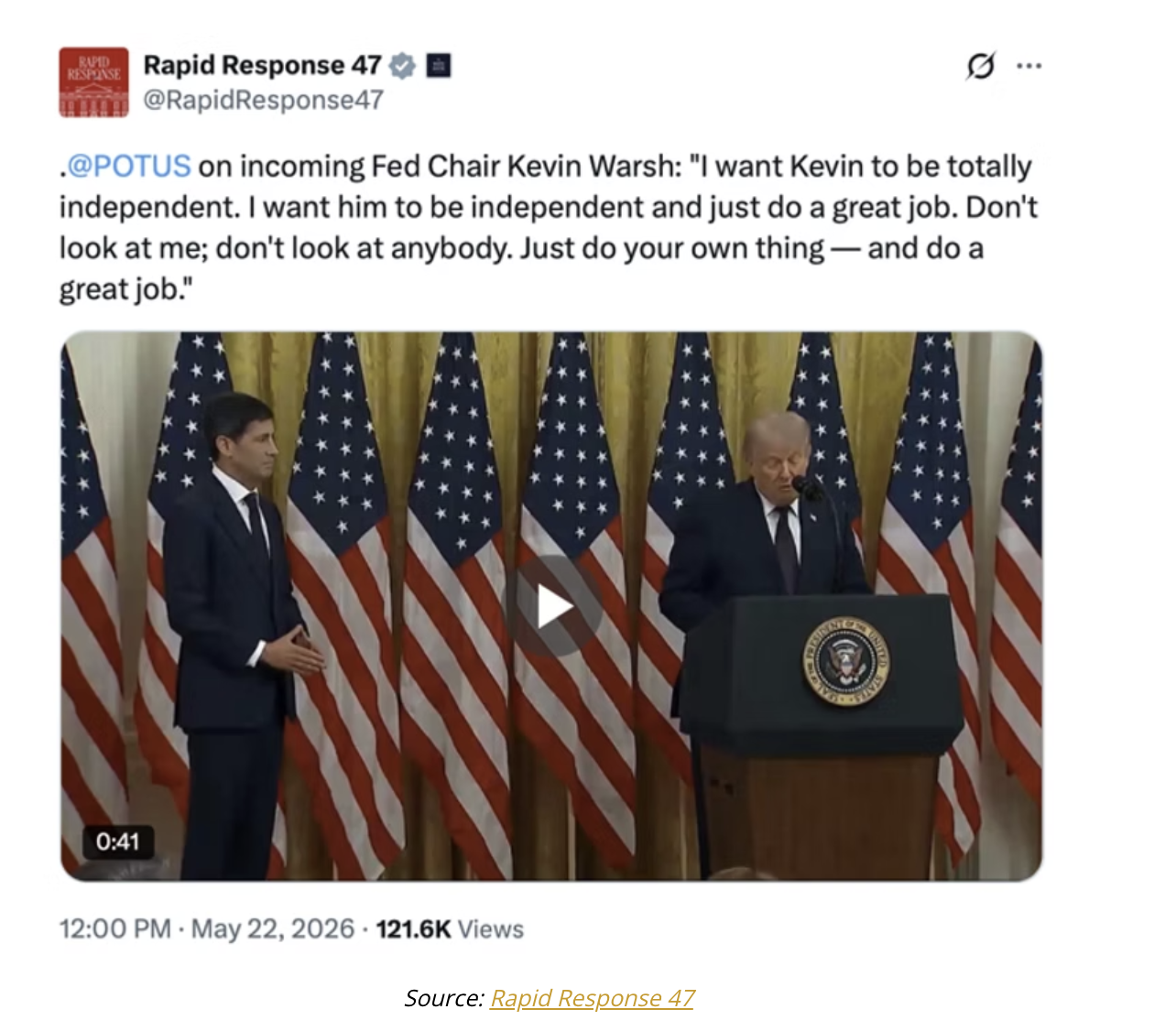
René's read, shared in a client note this week: the president knows inflation is his existential political problem, even if he would never say so publicly. He knows that a strong, independent Fed chair is the only credible solution. He knows, because voters have a long memory when it comes to inflation, and that the worst outcome for him politically is a Fed that appears to be doing his bidding rather than its job.
The Historical Pattern
René also made a point in his note that I think is worth underlining. Every great Fed chair in the historical pantheon shares one common characteristic. They restored price stability and institutional credibility after protracted episodes of excess overseen by their predecessors. Volcker inherited Burns's inflation. Greenspan inherited Volcker's credibility and sustained it. What Warsh has inherited is something more complex, an entire institutional apparatus that has drifted far from its original mandate. The timing, shall we say, is not ideal.
Rolling that back, if that is indeed what Warsh intends, will be harder than raising rates. It will mean ending forward guidance as a crutch. Restoring market discipline. Re-establishing a clear separation between Fed and Treasury functions. Rebuilding price discovery in bond markets that have been distorted for fifteen years. Shrinking the Fed's footprint in ways that will feel uncomfortable to markets that have come to depend on the backstop. And he will be opposed by many market participants, who learned to game the system, and by much, if not most, of the staff at the Eccles building. Mild-mannered Kevin Warsh is as revolutionary spirit as it gets in monetary policy.
If René is right, and the swearing-in ceremony suggests the political precondition may be in him, we may witness the groundwork being laid for the first serious attempt to exit the post-2008 central banking regime.
That changes the calculus rather dramatically. A more stable and credible Fed matters more than people realize right now, because what is coming technologically will require stable financial conditions to fully materialize.
Which brings me to the main event.
What Tyler Cowen Said
Tyler Cowen has been writing Marginal Revolution since 2003, one of the most consistently interesting economics blogs on the internet. Fifteen books. His books are spot on. Endowed chair at George Mason.
At SIC he opened with a simple provocation: the next 20 years will be genuinely different from anything that has come before.
"There will be a cataclysmic change in how we produce things, what jobs are like, what humans have a comparative advantage at. I think this will be a revolution roughly comparable to the Industrial Revolution starting in the 18th century. That is, it will change virtually every part of our lives."
The most interesting part of his presentation was about who wins and who loses. The race, it turns out, is not to the swift or the strong.
"The high returns will go not to people who follow the rules, but to people who take initiative. So, there will be a whole new set of companies mostly managed and run by AIs, and there will be a small number of human entrepreneurs who oversee the entire company."
The premium is shifting, from credentials to initiative, from rule-following to judgment, from the well-worn path to the road not yet paved.
"The kid who used to go to Cornell and become, say, a partner in a law firm, now will work in some other sector, maybe the energy sector, which is due to grow a lot. And that kid will live in Houston, and instead of earning a million and a half dollars a year, will earn $300,000 a year."
He invoked Pareto's Circulation of Elites, the observation that elite status is never permanent, that societies constantly churn who sits at the top. AI, as Tyler said, is about to accelerate that churning radically.
I am 76 years old. I have been deeply involved in longevity and biotech research for more than 20 years. (My own interest in this subject is, I admit, not entirely academic.) Tyler said at SIC that he thinks within 30 to 40 years, most of what kills us today will no longer kill us. I told him I was thinking more like 10 to 15. The amount of time you give this depends heavily on how old you are and how urgently you need it to arrive.
The pace of biomedical progress in just the last five years is unlike anything in the prior 50 years combined. AI is accelerating drug discovery at a rate that would have seemed like science fiction when I started writing about this.
"If you have kids or better yet grandkids, the chance that those kids and/or grandkids live to a hundred, I think is really very strong. They're probably not going to die of cancer."
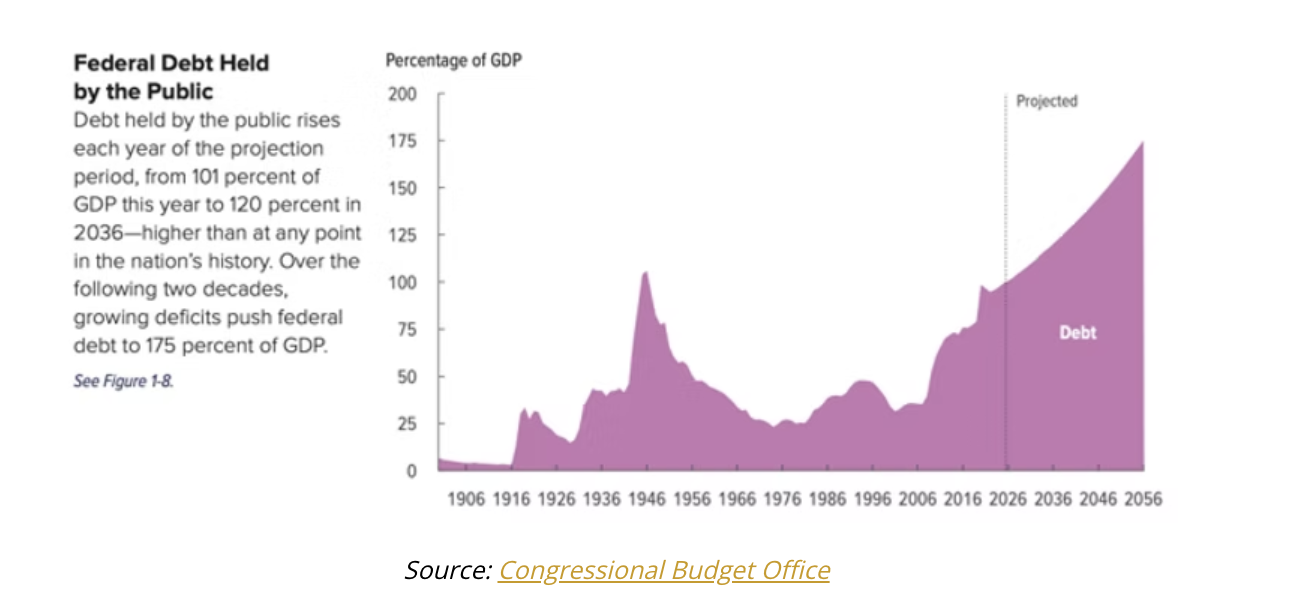
And on the debt, Tyler made a point that deserves more attention than it has gotten. The fiscal math changes dramatically if AI delivers even modest productivity gains:
"If AI contributes only half a percentage point of productivity growth to what we had been doing, the US debt to GDP ratio then converges. By one estimate, it converges to about 124%, which isn't ideal, but it's much better than going off crazy to 200%."
He was not being utopian. He was being arithmetical. We do not need robots running everything. We just need to do a bit better than we have been. Half a percentage point. That is the margin between fiscal crisis and Muddle Through.
The baseline trajectory, without that half a percentage point, looks like this:
If what Tyler said at SIC is keeping you up at night, he has also written a practical guide in The Free Press, seven specific steps to protect your career from AI disruption. I read it twice. The link is here. Let me summarize those seven steps. It is worth reading, and sharing with your kids and your grandchildren.
-
Principle one: Look for messy jobs.
- Principle two: Be wary of work from home.
- Principle three: Be proficient with AI tools.
- Principle four: Work in the biomedical sector.
- Principle five: Run experiments.
- Principle six: Gather data.
- Principle seven: Get a hands-on job in the energy sector.
The bottom line is there will not be mass unemployment. Nor are your career prospects doomed. There will be plenty of jobs but many will just be different than the ones we have had in the past. This is not unlike what has happened many times in the past, except that it will come much, much faster.
Tyler says: “There will be more leisure time, more economic output, and thus more money to spend. Just as we prefer human chess players to their computer counterparts, so are we likely to continue to look to humans in the arts as well.”
Ignore the doomsayers and embrace the changes. Early adopters will benefit the most. And I will personally get to find out if AI is going to challenge financial writers.
Gains in Productivity – Joe Lonsdale
Joe Lonsdale helped start Palantir before founding 8VC, where he has since launched more than two dozen companies, half a dozen of which are already billion-dollar enterprises. He has a particular focus on defense technology, healthcare, and making government, as he puts it, less stupid. That latter focus is a tough mission. At SIC he made the Industrial Revolution parallel directly, and from the ground level, not the theoretical one.
The critics of the Industrial Revolution era were not wrong about the disruption. The coal plants were ugly. The displacement was real. People had legitimate complaints about what was happening to their communities and their livelihoods. And yet within one generation, the working class was twice as wealthy in real terms. Twice.
Joe's view is that we are at the same inflection point:
"Within one generation in real terms, the working class [back then] was twice as well off, twice as wealthy... I think it's going to be twice as well off over the next generation with what this does at least. And it's much cleaner too."
Twice as well off in one generation. That is not a rounding error. That is transformation.
Where is he seeing it? Programmers first. Then everything data-heavy and repetitive. Healthcare billing alone, $280 billion in annual spend, most of it a Byzantine manual process, is being automated at scale. About half the wages in the services economy are tied to areas already seeing productivity double or triple.
His core philosophical point, and I think it gets lost in most AI coverage, is that this is not a zero-sum redistribution:
"The world's positive sum. So, if you can create more value, there's no natural cap. It's not like we're going to stop at the capacity and productivity output of what we have before. If you can create more, you'll create more."
Sidebar: On Data Centers and Adversarial Interests
I think about that when I hear the protests against data centers, the noise about water usage, electricity costs, and the campaigns to stop construction. Joe made a point too important to ignore. Russia spent years funding European green parties to prevent fracking and keep Europe energy-dependent. Today he sees China pursuing a similar strategy around American data center construction. The adversarial interest is not random, and we should not let it succeed. The scale of what is at stake is not abstract. Here is what global data center electricity demand looks like between now and 2030:
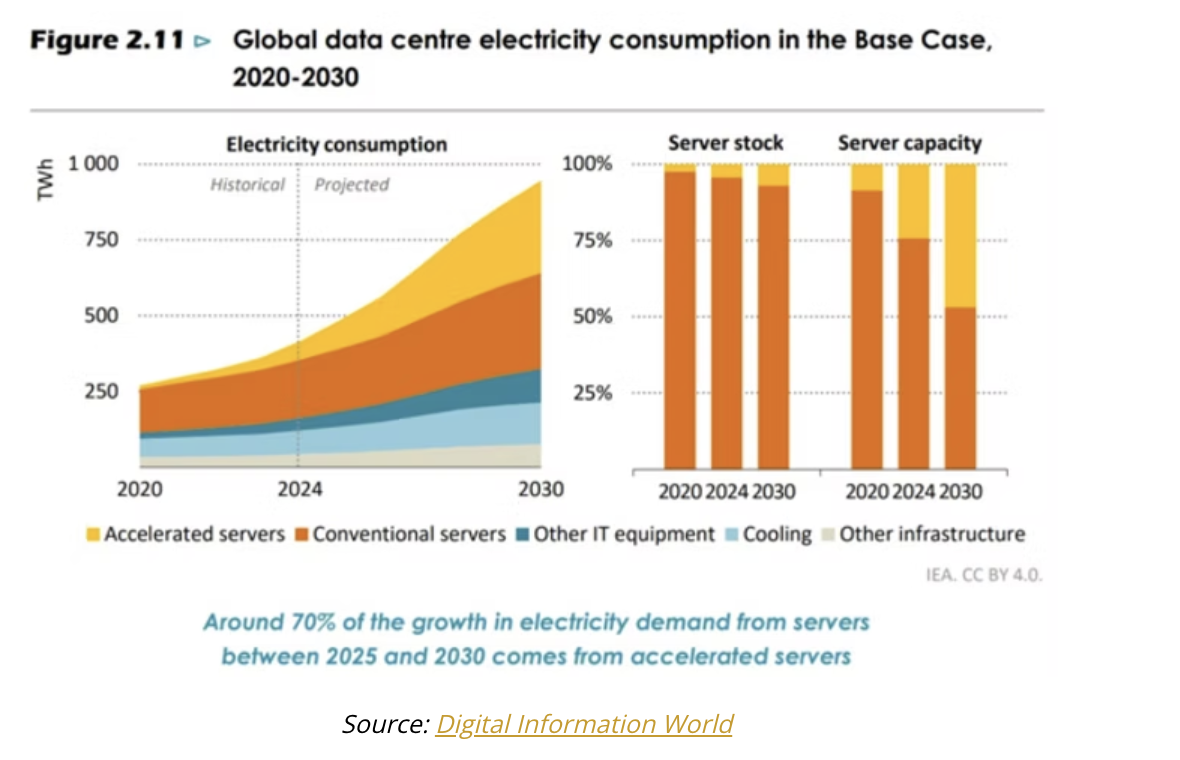
Further, most of the “criticism” (read hysteria) surrounding AI centers is just wrong. AI is not a water sink. Counties that allow AI to develop see their property taxes go down. And high-paying local jobs increase.
Horseshoe Jacobins
Joe Lonsdale was recently slandered by Nick Fuentes, often described as far right. I wish people would stop saying that. He is not far right. He is simply a nut job. He has nothing to do with serious conservative policies and thinking.
In his world, everything is the fault of the Jews. In his latest screed, it seems that promoting Western civilization and values is now a Jewish conspiracy. Promoting efficient government is a Jewish conspiracy. In fact, any time that someone of the Jewish persuasion is involved in a project, that project must be seen as part of the Jewish conspiracy.
I have less tolerance for racism in general and anti-Semitism in specific than I do for socialism. The letter is just bad economic thinking, which is destructive enough. Anti-Semitism and other forms of racism are simply evil in human form.
(Personally, I’ve always thought it was the Episcopalians. There are far more Episcopalians [Anglicans] so their influence must be greater. And they are much better at hiding their deep influence. Note sarcasm.)
Joe wrote a reply called “Horseshoe Jacobins.” Joe is referring to the observation that the far left and the far right are virtually indistinguishable in their underlying philosophies and so we have a horseshoe. The center is at the top of the horseshoe and the bottom parts are being magnetically/philosophically drawn to each other. While they say different words, the underlying nihilistic Marxist philosophical rhetoric is the same.
Joe is one of the great patriots in our country and puts his money where his mouth is. His Cicero Institute, which you should support, is involved in 24 states changing laws on the ground floor. Since their founding in 2021, 656 pieces of legislation were informed by Cicero research, and 195 of those were signed into law. In Texas, vocational education is now funded based on outcomes, not merely providing a service. Surprisingly, if you reward creating jobs as an outcome, you get more jobs. They have done the same thing with homelessness and many other issues on a bipartisan basis around the country.
His Substack linked above contains his brilliant podcasts with tech and other interesting leaders from a wide range of personalities. But it is a positive and deeply transformative work. You should subscribe to his Substack. You can find out about the Cicero Institute here, and you should join me in supporting it.
The Longer View
Every major technological revolution has opened with a phase of dislocation, political turbulence, and backlash before its benefits were broadly shared. The Industrial Revolution gave us skilled textile workers smashing frames and looms in protest at being turned into interchangeable hands. Electrification arrived with talk of "devil's fire" in the walls and headlines about wires as a new source of death and disaster. The internet carried its own moral panics — violent video games, corrupting chatrooms, social media as a machine for ruining kids and dissolving community. In each case, the critics saw the disruption clearly and misread the direction.
During the Q&A at SIC, Tyler was asked about his biggest concern for the future. His answer was not about AI taking jobs or geopolitical conflict. It was about the psychological and political reaction to change:
"That AI will change the world so much that people will feel disoriented and freaked out, and politically they will react in very negative ways."
That is the real risk. Not the technology. The human response to the technology.
I am not dismissing the disruption. I wrote about it in the last two letters and have written about it for years. The labor market is weaker than the headlines suggest. The inflation problem is real. Warsh is walking into a difficult situation. None of that has changed.
But the task for investors, and frankly for all of us, is to hold both things simultaneously: the genuine disruption is real, and the direction of travel is nonetheless toward a better world. René, Tyler, and Joe are describing the same world from three different vantage points, the institutional, the structural, the operational. The throughline is the same. The next global order will be built by the societies that get their foundations right. Just like our Founding Fathers did.
That’s not the same as getting the politics right, or the right economic policies. What will matter is our response to the coming Fourth Turning crisis.
That requires more equanimity than most people can manage. But we have done hard things before. We will do them again. I remain, as always, an optimist about where this ends up, just not necessarily about how we get there.
The future arrives unevenly. But it arrives.
Your Portfolio in a Changing Future
As I’ve written, The Bahnsen Group is my personal money manager, in large part because they are better at it than I am and if, God forbid, something happens to me, Shane (my wife) is taken care of. They are a big part of my plan to get through what I think of as the coming crisis with my portfolio and lifestyle intact.
You should read David’s Dividend Café, which gives you a weekend recap every Monday, short daily commentaries and updates on the markets, and then the Friday Dividend Café, which is some of the most philosophically astute content that I read anywhere. I think David is one of the truly outstanding investment analysts in the country, and there is a reason he is on TV almost every day on some business show. You can subscribe to Dividend Café here.
If you would like to know more about dividend investing and talk to one of their associates from one of their 10 offices around the country, you can click on this link. Ask the associate to send you my white paper on why I am letting The Bahnsen Group manage my personal portfolio. I also did several videos with David, and they will send you the links. David has also rewritten and completely updated his book on dividend investing, which in my opinion is the best on the topic out there. I have written the foreword. When you talk to one of their associates tell them that you would like a copy of the book when it is out in a few months.
I can’t stress enough how you need to learn more about their strategy and how they combine it with alternative investments to smooth out your portfolio. I believe it is the best opportunity to get through what I think is the coming crisis.
Boston and ???
I will be traveling to Boston next weekend. I will be there for an Inner Circle meeting as well as meeting my partners Ed D’Agostino and Olivier Garrett. We will be huddled on Sunday planning out the future of Mauldin Economics. I mentioned embracing change above. If we are going to stay relevant, and we certainly intend to, we’re going to have to embrace a lot of change. Seriously, if you have some thoughts on that please let me know. The surveys we ask you to do every now and then? They are important in our planning process.
My old and very dear friend, George Gilder, is going to come to Boston to be with us for a few days. I am really excited to be with one of my great friends and mentor, and getting to share that relationship with the Inner Circle.
My deadline looms, so it is time to hit the send button. You have a great week and thanks to those who sent kind words about my hand problem. It is healing nicely after some intensive medical care. It just reminded me how fragile we all are.
Your passionate and optimistic analyst,
John Mauldin
A message from Advisor Perspectives and VettaFi: Discover something new! Click here to register for our upcoming webcasts.
Membership required
Membership is now required to use this feature. To learn more:
View Membership BenefitsSponsored Content
Upcoming Virtual Events View All












