The Muni Brief: NYC’s Pied-à-Terre Tax
Learn more about this firmMembership required
Membership is now required to use this feature. To learn more:
View Membership BenefitsNYC’s Pied-à-Terre Tax: A Signal Worth Watching, Not a Solution
New York City is facing one of the most significant fiscal challenges in recent memory. The NYC Comptroller has projected a $2.2 billion budget shortfall for FY2026, growing to a $10.4 billion gap in FY2027 (Source: New York City Comptroller, January 2026). That is a two-year deficit of roughly $12.6 billion.
Into that context steps the pied-à-terre tax.
What Is The Pied-à-Terre Tax?
The proposal would levy an annual surcharge on condos, co-ops, and 1-3 family homes valued above $5 million where the owner maintains a primary residence outside New York City. Governor Hochul estimates approximately 13,000 properties would qualify. The city projects $500 million in annual revenue (Source: New York State Government, April 2026).
Even at the $500 million headline figure, the pied-à-terre tax covers less than 5% of the projected two-year gap. At the more realistic $340 to $380 million range, the contribution is smaller still.
NYC Budget Gap: Potential Revenue Falls Short
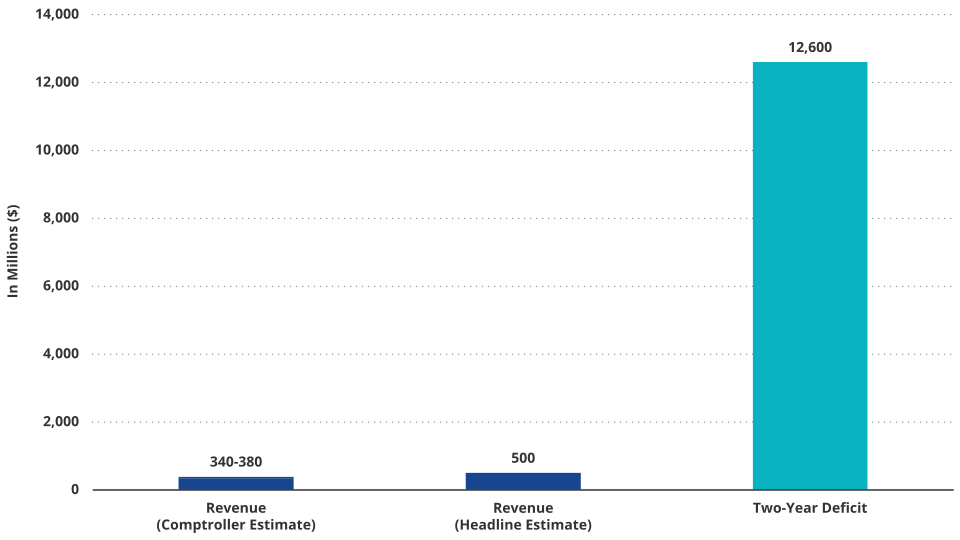
Source: NYC Comptroller Office as of 01/16/26.
What The Pied-à-Terre Tax Tells Muni Investors
This is not a deficit solution. It is an incremental revenue measure in a city that is reaching for every available lever.
For muni investors, NYC remains one of the largest and most liquid issuers in the market, with GO bonds and agency paper touching virtually every corner of the muni universe. The incremental yield delivered by NYC issues remains valuable as a portfolio building block.
Final Thoughts
Since this commentary was drafted, Mayor Mamdani has released his FY2027 executive budget, closing the near-term gap with a combination of state aid, pension amortization extensions, and approximately $2.8 billion in one-time measures. The pied-à-terre tax remains part of that plan. The Comptroller projects outyear gaps of $7.1 billion in FY2028, growing to $9.8 billion by FY2030. The structural challenge remains intact.
To receive more Municipal Bonds insights, sign up in our subscription center.
By James Colby
Originally published May 19, 2026
For more news, information, and strategy, visit the Beyond Basic Beta Content Hub.
IMPORTANT DISCLOSURES
Please note that VanEck may offer investment products that invest in the asset class(es) or industries included herein.
This is not an offer to buy or sell, or a recommendation to buy or sell any of the securities, financial instruments or digital assets mentioned herein. The information presented does not involve the rendering of personalized investment, financial, legal, tax advice, or any call to action. Certain statements contained herein may constitute projections, forecasts and other forward-looking statements, which do not reflect actual results, are for illustrative purposes only, are valid as of the date of this communication, and are subject to change without notice. Actual future performance of any assets or industries mentioned are unknown. Information provided by third party sources are believed to be reliable and have not been independently verified for accuracy or completeness and cannot be guaranteed. VanEck does not guarantee the accuracy of third party data. The information herein represents the opinion of the author(s), but not necessarily those of VanEck or its other employees.
The yields and market values of municipal securities may be more affected by changes in tax rates and policies than similar income-bearing taxable securities. Certain investors incomes may be subject to the Federal Alternative Minimum Tax (AMT) and taxable gains are also possible.
All investing is subject to risk, including the possible loss of the money you invest. As with any investment strategy, there is no guarantee that investment objectives will be met and investors may lose money. Diversification does not ensure a profit or protect against a loss in a declining market. Past performance is no guarantee of future results.
© Van Eck Associates Corporation.
The principal risks of investing in VanEck ETFs and mutual funds include, but are not limited to, sector, market, economic, political, foreign currency, world event, index tracking, active management, social media analytics, derivatives, blockchain, commodities and non-diversification risks, as well as fluctuations in net asset value and the risks associated with investing in less developed capital markets. VanEck ETFs may also be subject to authorized participant concentration, no guarantee of active trading market, trading issues, passive management, fund shares trading, premium/discount risk and liquidity of fund shares risks. VanEck ETFs or mutual funds may loan their securities, which may subject them to additional credit and counterparty risk. ETFs or mutual funds that invest in high-yield securities are subject to subject to risks associated with investing in high-yield securities; which include a greater risk of loss of income and principal than funds holding higher-rated securities; concentration risk; credit risk; hedging risk; interest rate risk; and short sale risk. ETFs or mutual funds that invest in companies with small capitalizations are subject to elevated risks, which include, among others, greater volatility, lower trading volume and less liquidity than larger companies. Please see the prospectus of each Fund for more complete information regarding each Fund’s specific risks.
Investing involves risk including possible loss of principal. Bonds and bond funds will decrease in value as interest rates rise. An investor should consider the investment objective, risks, charges and expenses of a fund carefully before investing. To obtain a prospectus and summary prospectus, which contain this and other information, call 800.826.2333 or visit vaneck.com. Please read the prospectus and summary prospectus carefully before investing.
This website is published in the United States for residents of specified countries. Investors are subject to securities and tax regulations within their applicable jurisdictions that are not addressed on this website. Nothing on this website should be considered a solicitation to buy or an offer to sell shares of any investment in any jurisdiction where the offer or solicitation would be unlawful under the securities laws of such jurisdiction, nor is it intended as investment, tax, financial, or legal advice. Investors should seek such professional advice for their particular situation and jurisdiction.
All investing is subject to risk, including the possible loss of the money you invest. As with any investment strategy, there is no guarantee that investment objectives will be met and investors may lose money. Diversification does not ensure a profit or protect against a loss in a declining market. Past performance is no guarantee of future results.
666 Third Avenue | New York, NY 10017© 2026 VanEck. VanEck®, VanEck Access the opportunities®, and the stylized VanEck design® are trademarks of Van Eck Associates Corporation.
A message from Advisor Perspectives and VettaFi: Discover something new! Click here to register for our upcoming webcasts.
© VanEck
Membership required
Membership is now required to use this feature. To learn more:
View Membership BenefitsSponsored Content
Upcoming Virtual Events View All












