Building resilient portfolios in markets delivering mixed messages can be a challenging affair. In our ongoing engagement with the retail and advisor community at VettaFi, we hear first-hand just how investors are tackling that challenge this year.
And what a year it’s been. At this moment, a somewhat surprisingly steady jobs market and an earnings season that beat all expectations seem to paint a rosy picture about economic growth that has the S&P 500 flirting with record highs. That stands in contrast to the sticky inflation and concerns about geopolitical risk helping pressure consumer sentiment to record lows.
Appetite for high growth opportunities such as AI, space, and defense-related themes continue to find traction. At the same time, diversification, income generation and a focus on risk management picks up steam.
As we head into what’s expected to be a blockbuster SpaceX IPO and the next Federal Reserve meeting (June 16-17) under new leadership, we find that growth optimism is tempered by caution and a keen eye for strategic opportunities, many expressed through ETFs. (The ETF market is on pace for a $2-trillion-inflow year with nearly $900 billion already in the books.)
Consider the insights we’ve gathered from advisors and retail investors in the past month, through several polling surveys.
On Top-Level Portfolio Construction Focus
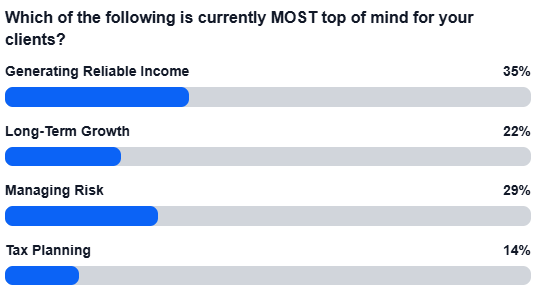
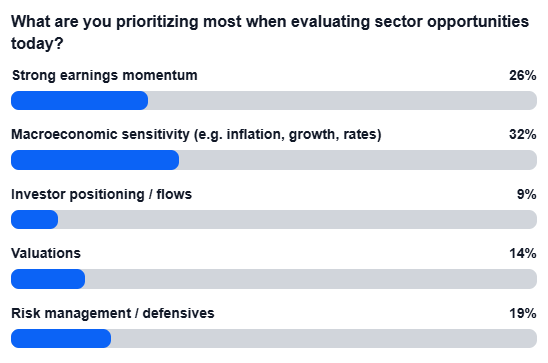
Managing risk and generating income, both as cash-flow effort as well as a defensive measure, ranked high. Meanwhile, a focus on macroeconomic conditions grew sharper as a driver in sector allocation decisions. The era of chasing growth seems to be pivoting to an era of increased attention to quality and macro sensitivity.

On the AI Theme
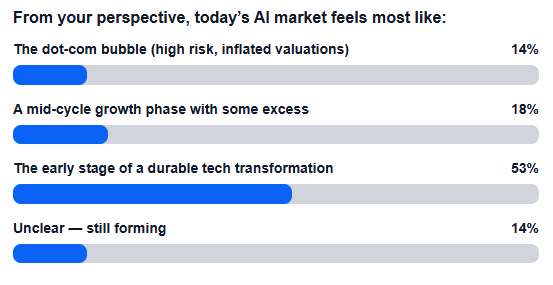
This high growth thematic opportunity has seen a hot run and ongoing comparisons — warning calls — about previous high growth cycles. Despite that, advisors still see much of this opportunity set ahead of us, not behind.
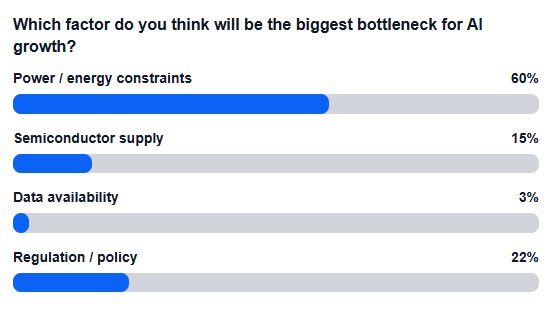
Among the AI theme, the interest in the infrastructure buildout story continues to grow. Energy remains a key area of focus as one of the most critical bottlenecks — aka, opportunities — ahead. Notably, in a separate survey, energy ranked as the highest sector to which advisors were interested in increasing allocation.
ETFs offering broad tech and narrowly focused AI and energy infrastructure exposure have been benefiting from investor demand. Funds like the VanEck Semiconductor ETF (SMH) and the iShares Semiconductor ETF (SOXX) have taken in more than $8.5 billion in combined assets this year. The new-to-market Roundhill Memory ETF (DRAM) has seen $12.7 billion in net inflows. The ROBO Global Robotics & Automation Index ETF (ROBO) and ROBO Global Artificial Intelligence ETF (THNQ), some of the pioneers in the category, continue to gather assets. The list goes on.
Income Generation Is a Diversified Pursuit
ETF investors have feasted on cash-like exposure through ultra-short bond funds and money market bond funds in recent years. Fresh expectations of potentially higher rates ahead could support demand for that segment of the bond ETF market for now.
The CME FedWatch Tool currently shows a 96% likelihood that the Federal Reserve will hold rates steady at its meeting next week, my colleague Jennifer Nash recently reported. However, markets are currently pricing in a 25 basis-point hike by the end of 2026. We ended last year with the 2-year note at 4.17%, its highest level since February 2025.
The iShares 0-3 Month Treasury Bond ETF (SGOV) is the year’s most popular fixed income ETF, taking in a net of $25 billion in fresh net assets year-to-date. The ProShares GENIUS Money Market ETF (IQMM) has picked up $21 billion in the same time frame. The list goes on.
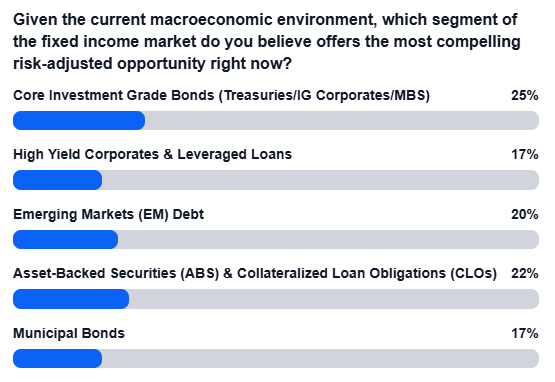
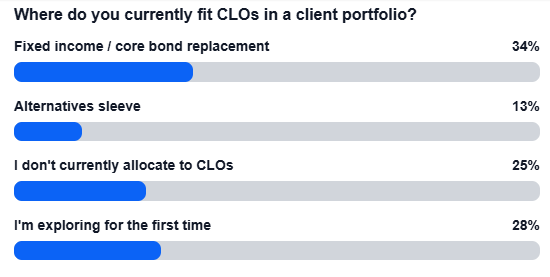
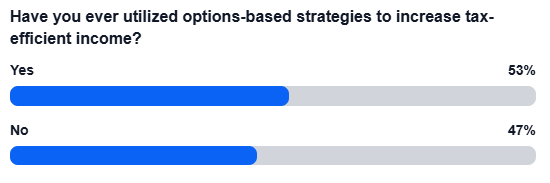
That said, there’s a growing concern about the impact of inflation on cash-like allocations. Asset managers like J.P. Morgan have been warning that cash continues to become a drag on purchasing power as core inflation remains sticky. The path to generating income increasingly includes a diverse mix of fixed income assets, like CLOs and options-based ETFs.
CLO ETFs, for example, have taken in nearly $10 billion in combined net new assets this year. Funds from different providers, including PGIM, Janus Henderson, iShares and ETF newcomer Reckoner Capital, have all found traction.
Appetite for options income has been equally noteworthy. As an example, among the largest ETFs, the JPMorgan Equity Premium Income ETF (JEPI) and the JPMorgan Equity Premium Income ETF (JEPQ) have taken in over $9.7 billion in combined net assets so far this year. The NEOS Nasdaq 100 High Income ETF (QQQI) and the NEOS S&P 500 High Income ETF (SPYI), shelling out double-digit distribution rates, have gathered nearly $8 billion.
Advisor insights into income generation in polling surveys we’ve conducted over the past month reinforce these trends.
Looking Ahead
As we brace for what comes next, we will continue engaging with the ETF investing community about how they navigate markets.
In fact, up next, we are hosting our Midyear Market Outlook Symposium on June 25, with experts from several asset management firms including Invesco, WisdomTree, Fidelity, PIMCO, Calamos, Amplify ETFs and many more joining us. Come talk markets with us! Register here.
VettaFi LLC (“VettaFi”) is the index provider for ROBO and THNQ, for which it receives an index licensing fee. However, ROBO and THNQ are not issued, sponsored, endorsed, or sold by VettaFi, and VettaFi has no obligation or liability in connection with the issuance, administration, marketing, or trading of ROBO or THNQ.
Originally published on ETF Trends
A message from Advisor Perspectives and VettaFi: Discover something new! Click here to register for our upcoming webcasts.
Read more commentaries by VettaFi