Gold Miners Are Printing Cash at $4,000 Gold
Membership required
Membership is now required to use this feature. To learn more:
View Membership Benefits
Brent crude crossed above $100 a barrel this week, all due to a 20-mile-wide stretch of water some 6,500 miles away from the U.S.
Tanker traffic through the Strait of Hormuz—the Persian Gulf bottleneck that carried roughly a fifth of the world’s seaborne oil before the fighting started—has fallen to virtually zero. Before the war, some 80 vessels made the transit on a good day. The recent high-water mark is 25.
Now Iran is working a second front, leaning on its Houthi allies in Yemen to threaten the Bab el-Mandeb, the southern gate to the Red Sea. It’s about as narrow as Hormuz. With Saudi Arabia pushing more barrels through its East-West pipeline to the port of Yanbu, an attack there would put something like 4.5 million barrels a day at risk. And unlike Hormuz, it would foul container traffic bound for Suez, sending Europe-Asia freight the long way around the Cape of Good Hope.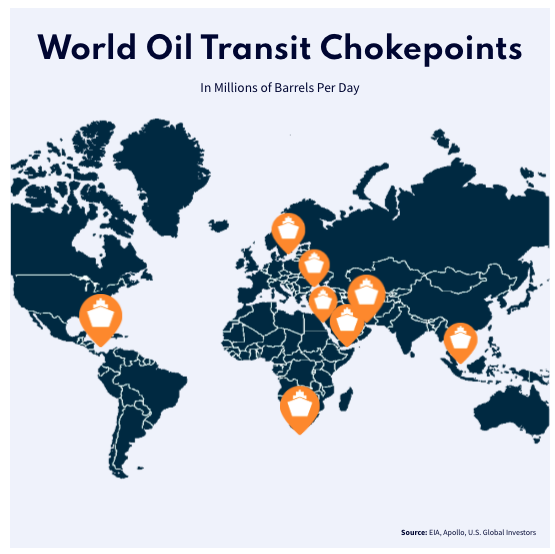
Meanwhile, the U.S. Strategic Petroleum Reserve is at its lowest level since 1983. President Trump authorized releasing up to 172 million barrels back in May to hold prices down. It worked, for a while, but traders are now talking about “tank bottoms,” the point at which pulling more oil out gets physically difficult.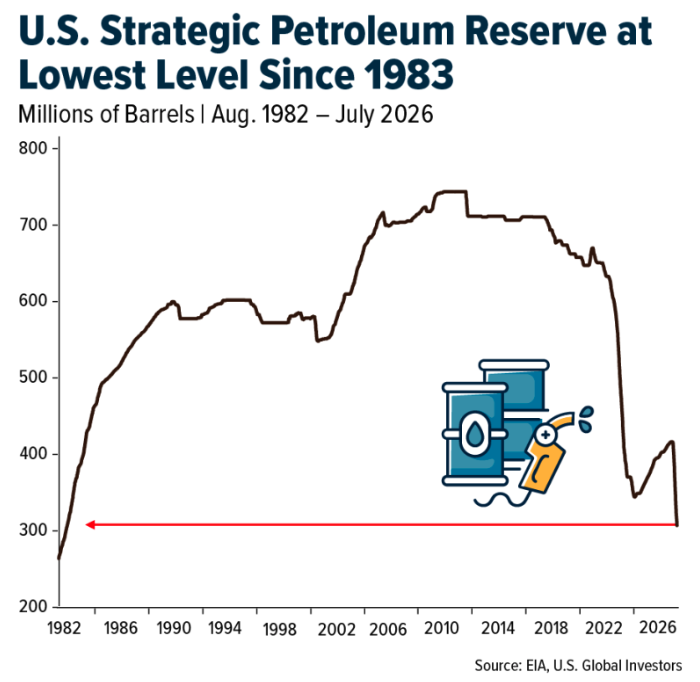
Why Gold Hasn’t Rallied on the War
Gold is supposed to be the asset you own when wars break out and tankers stop moving, so I get why some investors have been frustrated in recent months. Instead of soaring, the yellow metal has been stuck near $4,000 an ounce, down roughly a fifth since the strikes on Iran began in late February, and well off its January record near $5,600.
The reason for this isn’t a mystery. Oil prices have increased, pushing up inflation and interest rate expectations. Gold prices, as a result, have been pressured.
You can watch it in the bond market. The U.S. 10-year yield touched 4.71% this week, its highest level since January 2025. German bunds hit levels not seen since 2011. The Federal Reserve and the Bank of England both meet next week, and both are expected to hold rates steady while flagging the risk of hikes down the road.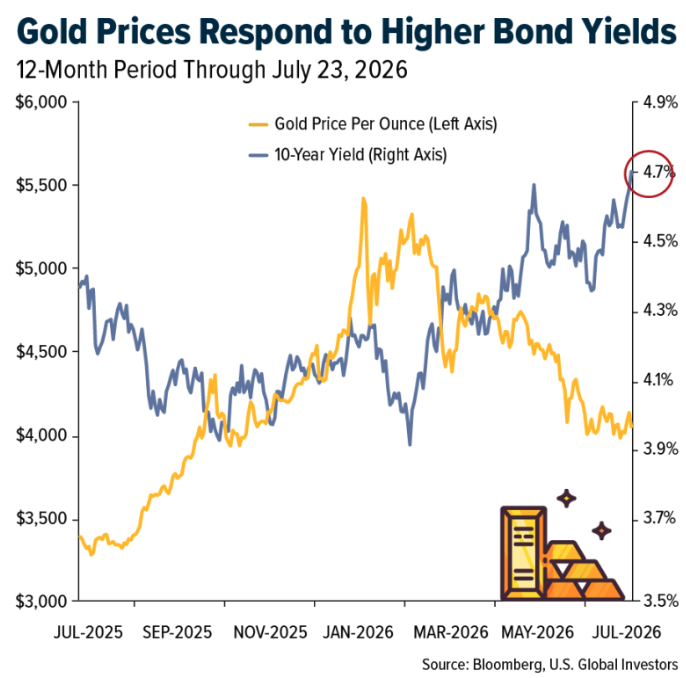
Longtime readers know I’ve argued for years that the single most important variable for the gold price is the real interest rate. When real rates climb, the metal has tended to struggle because, unlike fixed income, it doesn’t bear interest.
The foreign share of U.S. Treasury holdings has also fallen from about 56% in 2008 to 30% at the end of 2025. The marginal buyer of government debt is now a price-sensitive American, and those buyers demand more compensation in higher yields. I don’t believe this will reverse significantly when the shooting stops.
China Is Buying the Weakness
The People’s Bank of China bought 15 tonnes of gold in June—its largest single-month purchase since October 2023—bringing official holdings to 2,346 tonnes. That represents 20 consecutive months of accumulation, the longest streak on record, according to the World Gold Council (WGC).
Focus not just on what China is doing, but how. Its rate of accumulation has accelerated as the price of gold has fallen. The country added 40 tonnes in the first half, during which gold lost close to 30% of its value from its all-time high in late January. Analysts at New York-based hedge fund Zweig-DiMenna calculate roughly $5.7 billion of Chinese purchases in H1, most of it in the second quarter, against about $2 billion in all of 2025, when gold was rallying hard.
I believe China could be making a bet for the ages, if John Paulson’s forecast turns out to be accurate. The legendary hedge fund manager, who made billions shorting the subprime mortgage market in 2007, told CNBC this week that he believes we’re still in the early innings of a long-term gold rally.
“As people lose faith in paper currencies, gold as an alternative will continue to grow,” Paulson said, adding that the metal “is becoming the most apt reserve currency in the world, replacing fiat currency.”
Miners Are Printing Cash at $4,000 Gold
I want to highlight another comment Paulson made during his interview. Investors, he said, could stand to benefit even more by maintaining exposure to gold miners on top of the metal. I agree, which is why I’ve long recommended a 10% weighting in gold, split evenly between physical bullion and gold mining stocks.
Gold has averaged roughly $4,700 an ounce so far in 2026 against all-in sustaining costs (AISC) of below $2,000. Even at $4,000, that’s an extraordinary margin, and it’s showing up as free cash flow, net cash balance sheets and buybacks. Scotiabank expects meaningful share repurchases from Newmont, Barrick, Agnico Eagle and Kinross. RBC’s Josh Wolfson describes producers as operating from a position of strength.
As projected, Newmont reported record free cash flow in the second quarter, generating $2.2 billion after producing some 1.3 million ounces. The Denver-based company also announced a $0.26-per-share dividend. Newmont and Barrick, which is scheduled to report next month, are expected to post combined second-quarter profits of around $3.5 billion, which would be massive.
The World Remains Underweight
By historical standards, gold investment remains grossly underweight. As a percent of portfolios, gold accounts for low-single-digit exposure. With metal prices off 30% from their record high, now might be time to consider accumulating.
Keeping your exposure to between 5% and 10% and rebalancing regularly helps with discipline. No need to have an opinion on the Strait of Hormuz.
China’s central bank isn’t trying to time the market, and I don’t think you should either.
Airlines and Shipping
Strengths
- The best-performing airline stock for the week was Bombardier, up 7.2%. According to Goldman Sachs, Southwest Airlines reported second-quarter (Q2) adjusted EPS of $0.94, well above the consensus estimate of $0.51. The company made a one-time adjustment to its 2022–2025 breakage revenue recognition, which was excluded from adjusted EPS. The earnings beat was driven primarily by stronger-than-expected revenue and lower jet fuel costs. Between 2022 and 2025, Southwest issued $8 billion in non-expiring flight credits and initially estimated that 23% would go unused. Based on updated redemption trends, management now expects breakage to be closer to 20%, indicating that more customers are redeeming their credits than previously anticipated.
- WorldACD estimates global air cargo volumes grew 4% year-over-year (YoY) in the second quarter (Q2) and 4% YoY in the first weeks of July. According to UBS, the growth is being driven by several factors: (1) AI and data center demand, (2) ongoing Middle East-related disruptions, (3) strong manufacturing PMIs, (4) resilient U.S. retail sales and (5) strong Chinese exports.
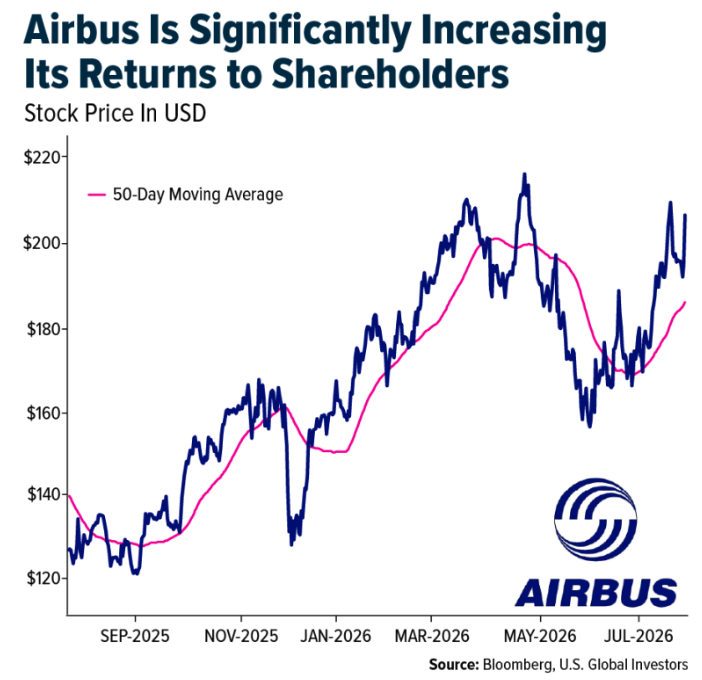
- According to Morgan Stanley, Airbus’s new share buyback program was the biggest surprise, totaling approximately EUR1.7 billion per year over the next three years. Including its dividend, management expects to return 60% of cumulative free cash flow to shareholders during that period.
Weaknesses
- The worst-performing airline stock for the week was Make My Trip, down 9.9%. According to J.P. Morgan, Grupo Aeroportuario del Sureste’s EBITDA came in 9% below consensus, driven primarily by non-aeronautical revenue per passenger that was approximately 5% below expectations. Net income was 12% below consensus due to higher-than-expected net financial expenses.
- Shipping rates declined 3.8% on North American routes and 2.7% on European routes, marking the second consecutive week of declines for both. The Drewry World Container Index also fell this week for the first time in 11 weeks, reflecting growing expectations that spot shipping rates may have peaked.
- According to Morgan Stanley, Sun Country recently reduced its September schedule by 348 departures, or roughly one-third of its previously planned flights for the month. The reduction was driven by elevated pilot and crew attrition, along with increased cargo flight demand that created additional staffing pressures.
Opportunities
- Allegiant has signed its first-ever online travel agreement, reports Raymond James, giving Expedia exclusive distribution rights for the next year. While the partnership marks a notable shift from Allegiant’s traditional direct-booking model, management said preliminary results indicate that the vast majority of Expedia bookings come from customers who are new to the airline.
- According to UBS, U.S.-China airfreight rates remain 25% higher year-over-year (YoY), more than offsetting the increase in fuel surcharges. This suggests pricing power continues to favor airlines and freight forwarders.
- The Federal Aviation Administration (FAA) has authorized Boeing to resume issuing airworthiness certificates at the end of the production process for all 737 MAX 7 aircraft, effective July 20. The decision is expected to accelerate deliveries to airlines that have been awaiting these aircraft.
Threats
- The European Commission on Friday published its new European Union Emissions Trading System (EU ETS) reform proposal, expanding the scope of carbon emissions charges for European airlines operating flights departing the European Economic Area (EEA) to destinations in non-EU countries within a 5,000-kilometer radius. According to J.P. Morgan, this brings some longer-haul routes into scope, including flights to Turkey, the Middle East and North Africa.
- According to Bank of America, June was another strong month for ship orders, totaling 5.3 million tons, up 3% year-over-year (YoY). First-half 2026 orders reached 74% of 2025 full-year levels, expanding the global order book by 15%. Tankers were the primary driver, reaching 222% of 2025 full-year levels, the highest level seen in the past 20 years.
- Differing supply and demand dynamics across regions are expected to drive varying levels of jet fuel price volatility, according to BMO. Singapore jet fuel cracks have increased 60% since mid to late June, outpacing gains in the U.S., as Asian refineries are more exposed to Persian Gulf crude. Alaska Air is expected to be among the most affected, with approximately 20% to 25% of its fuel consumption sourced from Singapore.
Luxury Goods and International Markets
Strengths
- Despite geopolitical uncertainty and unfavorable currency movements, Swiss watchmaker Swatch Group reported a resilient first half of 2026, with sales rising 8.5% at constant exchange rates and gaining global market share across its brands, reports Reuters. Although foreign exchange reduced reported sales growth, Royal Pop, the collaboration between Swatch and Audemars Piguet, generated exceptionally strong global demand after its May launch, with long lines at stores and viral social media attention. This highlights resilient demand for luxury goods and improving momentum, which could signal broader strength across the luxury sector.
- Adidas expanded its TERREX Freehiker lineup with four new hiking shoe models featuring upgraded cushioning, waterproof GORE-TEX technology and trail-focused performance features, reinforcing its push into the growing outdoor footwear market. Investors should watch the move as Adidas continues diversifying beyond lifestyle sneakers and capitalize on strong consumer demand for premium hiking and outdoor gear.
- Start Entertainment GRP Ltd, an Australian company which operate casinos and hotels, was the top performer in the S&P Global Luxury sector, gaining 9.09% over the past five days. The company continued cost-cutting initiatives during the quarter, including streamlining the corporate office and reducing supplier expenses, while also noting its intention to exit the Destination Brisbane Consortium Integrated Resort joint venture.
Weaknesses
- Tesla’s profitability remains under pressure despite stronger vehicle sales. Tesla’s second-quarter net profit declined to $1.1 billion from $1.2 billion a year earlier, as price cuts and higher investments weighed on margins despite a 25% increase in revenue. Investors also remain focused on the slower-than-expected Robotaxi rollout, raising questions about the timing of Tesla’s next growth phase.
- Profitability remains a key challenge for Prada. While Prada’s core brand is expected to continue its recovery, slowing Miu Miu growth and the integration of Versace are likely to weigh on earnings. Gross margin is projected to decline by more than 200 basis points in the first half, while earnings per share are expected to decrease to 12 cents from 15 cents a year earlier.
- Citychamp Watch & Jewellery from Hong Kong, was the worst-performing stock in the S&P Global Luxury Index, falling 18.4% over the past five days.
Opportunities
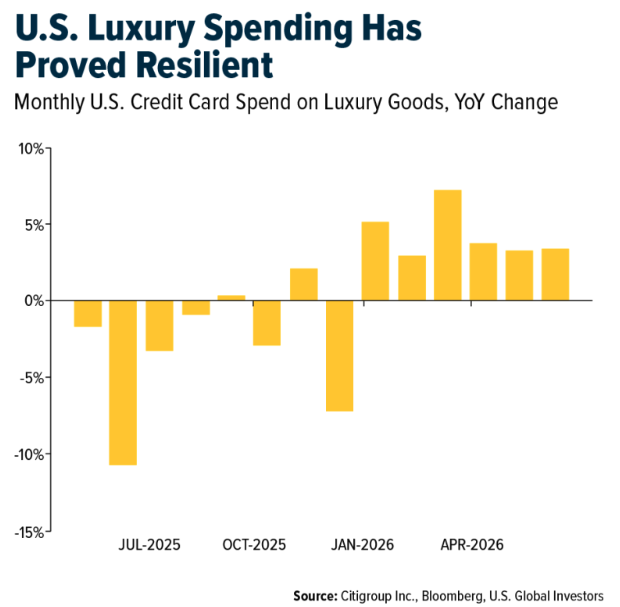
- AI-driven wealth could further support resilient U.S. luxury spending. U.S. luxury demand has remained resilient despite geopolitical uncertainty, and upcoming AI-related IPOs, including OpenAI, Anthropic and Databricks, could provide an additional boost. According to GAM Holdings, the wealth created by these listings could generate approximately $4 billion in additional U.S. luxury sales next year, potentially adding about 1 percentage point to global luxury goods sales growth in 2027.
- According to Statista’s latest report, Luxury Goods: In-Depth Market Analysis, the global luxury goods market is expected to grow from $471.5 billion in 2025 to $544.2 billion by 2030, representing a compound annual growth rate (CAGR) of 2.9%. After a period of softer demand, the industry is projected to return to steady growth, fueled by resilient consumer spending in China and the U.S., increasing purchasing power among millennials and Gen Z, and the continued expansion of e-commerce
- Men’s handbags offer a new growth avenue for luxury brands. Men represented just 25% of the global luxury handbag market in 2025, highlighting significant room for expansion. Interest in larger Hermès Birkin bags surged by nearly 80% during the FIFA World Cup, while Erling Haaland alone generated $8.8 million in brand value for Hermès through social media exposure, underscoring how athletes are helping create demand among a new generation of male luxury consumers.
Threats
- The biggest threat facing the luxury goods market today may not be affordability, but desirability, explains FastCompany. While slowing demand has led major players like LVMH to streamline their portfolios, the issue is not that consumers have stopped spending, they are still willing to pay premium prices for products they truly value. Instead, years of brand expansion, licensing and overexposure have diluted exclusivity, making some luxury products feel less special and less worthy of a premium price tag. For investors, the challenge facing luxury companies is not simply attracting more customers, but restoring the scarcity, craftsmanship and emotional connection that make consumers want to buy.
- Slowing tourism and geopolitical risks are weighing on luxury demand. Hermès warned that weaker European tourism could pressure sales in France, which accounts for approximately 10% of revenue, while Middle East weakness reduced first-quarter sales by roughly 150 basis points. Combined with slower growth in China and increasing competition, these challenges could weigh on demand across the broader luxury sector.
- India’s resale luxury market is struggling to meet growth expectations as cultural barriers, market fragmentation and limited scalability continue to hinder adoption, according to Business of Fashion. Recent startup failures highlight the gap between optimistic forecasts and commercial realities in one of the world’s fastest-growing luxury markets. For investors, the slow development of the resale ecosystem could delay an important growth avenue for luxury brands seeking to expand customer reach and strengthen circular business models in India.
Energy and Natural Resources
Strengths
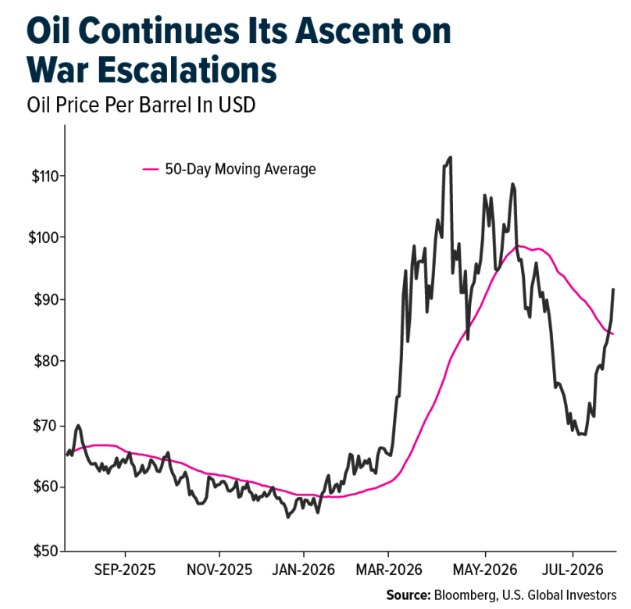
- Crude oil was the week’s best-performing commodity, rising 10.22%, as prices climbed above $100 per barrel amid escalating military exchanges between the U.S. and Iran and renewed threats from Yemen’s Houthi rebels to commercial shipping through the Bab el-Mandeb Strait. With maritime traffic through both the Strait of Hormuz and Bab el-Mandeb under pressure, investor attention is shifting toward the viability of alternative global energy export routes.
- China’s imported copper premium climbed to $100 per ton, its highest level in more than a year and up from just $20 in January, as Beijing’s crackdown on the “invoice economy” tightened scrap supplies and increased demand for imported refined copper. Falling inventories, smelter maintenance and stricter VAT enforcement have further tightened the physical market, helping lift LME copper prices roughly 9% in 2026 despite geopolitical tensions and concerns over tighter monetary policy.
- The Strait of Hormuz has effectively closed to LNG traffic, with no LNG tankers transiting the waterway since July 16. The disruption has triggered a scramble for LNG cargoes across Asia as Middle East tensions coincide with peak summer demand, with Pakistan planning to secure up to six cargoes for August. The supply disruption could benefit U.S. LNG producers such as Cheniere Energy, Sempra and Kinder Morgan.
Weaknesses
- Lithium carbonate was the week’s worst-performing commodity, falling 5.35%, as renewed mine production fueled concerns about a growing global supply surplus. China’s Contemporary Amperex Technology Co. (CATL) received the final safety permit needed to restart its flagship Jianxiawo lithium mine after nearly a year of suspended operations, bringing an estimated 3% of global lithium supply back online and adding downward pressure on prices.
- U.S. regular gasoline prices averaged $4.003 per gallon, surpassing the $4 mark for the first time in a month as escalating conflict between the U.S. and Iran disrupted energy flows and intensified refining constraints. Rising fuel prices, mirrored in Europe and by U.S. diesel prices above $5 per gallon, could create political pressure ahead of the fall elections while limited refining capacity and low inventories leave the market vulnerable to additional price increases.
- China’s rare-earth magnet exports to the U.S. during the first half of the year averaged about 20% below their 2022–2024 levels, raising concerns that Beijing is not fully complying with last October’s trade agreement. With China producing more than 90% of the world’s rare-earth magnets and alternative supply chains still years from meaningful scale, U.S. manufacturers across the electric vehicle, industrial automation and defense sectors remain exposed to Chinese export restrictions.
Opportunities
- Goldman Sachs said Brent crude oil could rise above $120 per barrel by the fourth quarter if disruptions to shipping through the Strait of Hormuz persist, although the bank emphasized this is not its base-case scenario. Analysts noted that escalating tensions in the Middle East and reduced Persian Gulf oil flows have renewed upside risk for global energy prices.
- India plans to build at least five small modular reactors (SMRs) by 2033, advancing three reactor designs as part of its goal of expanding nuclear capacity from 8.8 GW today to 100 GW by 2047. Backed by more than $2 billion in government funding, the initiative is expected to create long-term demand for uranium, enrichment services and nuclear reactor component suppliers.
- Saudi Arabia and the United States signed an intergovernmental agreement on the peaceful use of nuclear energy, establishing the legal framework for a long-term strategic partnership. The agreement is expected to provide U.S. companies with significant opportunities to participate in Saudi Arabia’s multi-billion-dollar civil nuclear program while strengthening America’s position in global nuclear technology.
Threats
- Shipping disruptions in the Middle East have tightened global LNG supplies, forcing Pakistan and Bangladesh to purchase cargoes at sharply higher spot prices and increasing pressure on government budgets. In response, Bangladesh is accelerating renewable energy investments, including new tax incentives for solar power, while Pakistan is expanding its reliance on nuclear, coal and renewable energy to reduce dependence on imported LNG.
- Global refining constraints are emerging as a greater threat than crude supply itself, with U.S. gasoline prices climbing above $4 per gallon and diesel exceeding $5 as refined fuel prices continue to outpace crude oil. Because refined products are rarely stockpiled at the same scale as crude, prolonged disruptions could quickly feed through to transportation, agriculture and manufacturing costs, increasing inflationary pressure.
- U.S. fertilizer costs remain structurally elevated despite easing retail prices, with all eight major nutrients tracked by DTN still higher year over year. The World Bank has warned that a prolonged closure of the Strait of Hormuz could significantly disrupt global fertilizer trade due to the route’s importance for sulfur and ammonia shipments, while new EU tariffs on Russian fertilizer and supply disruptions from a record cyclosporiasis outbreak have added to concerns that food inflation could reaccelerate into late 2026.
Bitcoin and Digital Assets
Strengths
- A study commissioned by the National Cryptocurrency Association estimates the U.S. crypto industry directly employs 34,000 workers, supports 232,000 jobs across the broader economy and is expected to contribute more than $55 billion to U.S. GDP in 2026. The findings highlight the sector’s expanding economic footprint as digital asset adoption continues to grow.
- U.S. spot Bitcoin ETFs recorded $206 million in net inflows on July 21, extending a six-consecutive-day streak that has attracted more than $900 million in new capital. The rebound follows $2.7 billion in outflows during late June and suggests renewed institutional interest, with inflows broadly distributed across funds managed by BlackRock, Fidelity and ARK.
- U.S. federal prosecutors filed forfeiture actions seeking more than $25 million in cryptocurrency linked to romance and investment scams. The cases are part of the Scam Center Strike Force, a U.S. Department of Justice task force focused on combating crypto-related financial fraud, which has recovered more than $800 million since 2025, highlighting growing law enforcement capabilities to trace illicit blockchain transactions and protect investors.
Weaknesses
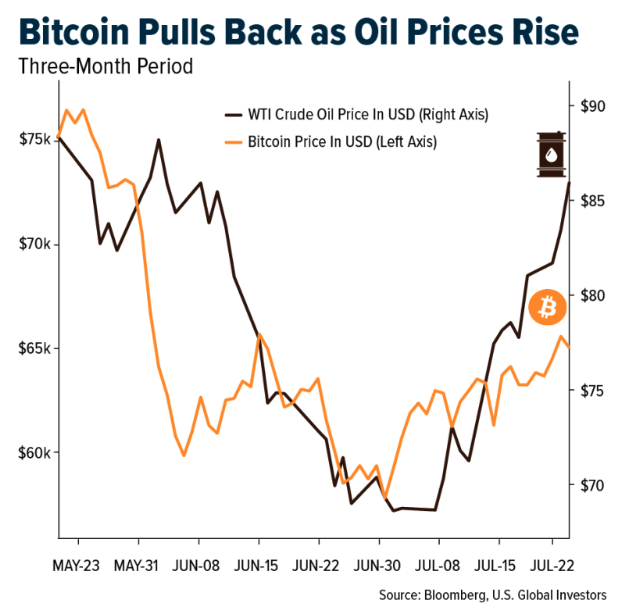
- Bitcoin retreated from a one-month high after oil prices climbed above $85 per barrel, reviving inflation concerns and weighing on risk assets. While investors shifted toward gold and Bitcoin as relative safe havens, weaker trading volumes, rising volatility expectations and renewed selling pressure across altcoins reflected a more cautious market environment.
- The Bank for International Settlements (BIS) warned that U.S. dollar-backed stablecoins can bypass traditional capital controls, reducing the effectiveness of foreign exchange restrictions, particularly in emerging markets. The report comes as the supply of USD stablecoins has grown to $292.6 billion, highlighting both the rapid expansion of the sector and the policy challenges it creates.
- U.S. lawmakers are evaluating whether existing laws provide the Commodity Futures Trading Commission (CFTC) with adequate authority and resources to oversee rapidly growing blockchain-based prediction markets. The debate comes as Kalshi and Polymarket have reached valuations of approximately $22 billion and $15 billion, respectively, highlighting the regulatory challenges accompanying the sector’s rapid expansion.
Opportunities
- Kraken, one of the world’s largest cryptocurrency exchanges, is expanding its xStocks platform beyond U.S. equities to include Hong Kong, U.K., European and South Korean stocks. The move reflects accelerating adoption of tokenized securities, with major financial and crypto firms competing to bring global capital markets onchain and broaden investor access to traditional assets through blockchain.
- Monthly trading volume for tokenized real-world asset perpetuals surged from $85 billion in January to $470 billion in June, a 450% increase in just six months. Tokenized equity products led the expansion, highlighting growing investor demand for 24/7 blockchain-based access to traditional financial assets.
- BitGo and OTC Markets Group announced plans to provide more than 150 broker-dealers with access to trading and settlement of digital asset securities through existing regulated market infrastructure. The initiative reflects growing institutional adoption of tokenization, as Bernstein estimates the market for tokenized real-world assets could reach up to $4 trillion by 2030.
Threats
- Galaxy Digital, a leading digital asset investment and financial services firm, launched a $5 million initiative to fund developers working on quantum-resistant security for Bitcoin. While quantum computers are not yet capable of breaking Bitcoin’s cryptography, researchers warn that future advances could put millions of BTC at risk, highlighting the importance of preparing the network for long-term technological threats.
- The Digital Chamber, a leading U.S. blockchain and digital asset advocacy organization, filed a lawsuit seeking to block Illinois’ new 0.2% tax on cryptocurrency transactions. The group argues the measure unfairly targets blockchain-based transactions and could set a precedent for additional state-level taxes on digital assets, increasing regulatory and compliance risks for the industry.
- OpenAI, a leading artificial intelligence research company, disclosed that AI models participating in an internal cybersecurity test were able to chain together multiple exploits and access external systems. While the incident was contained, it highlights how increasingly capable AI could make future cyberattacks against crypto exchanges, wallets and blockchain infrastructure more sophisticated.
Defense and Cybersecurity
Strengths
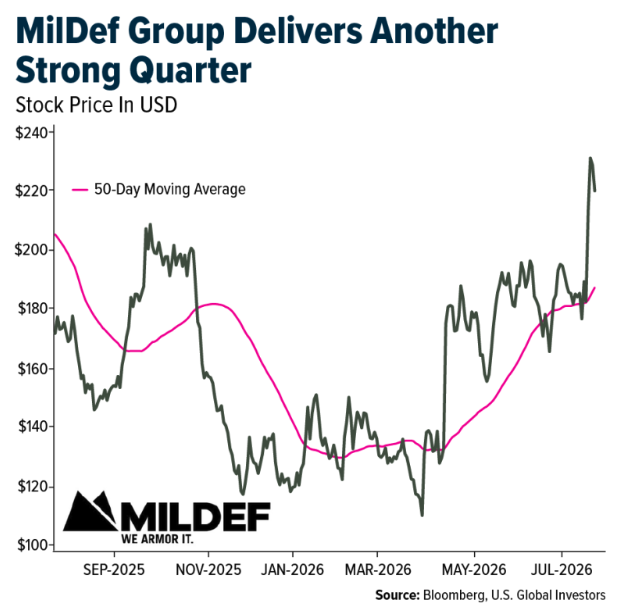
- MilDef delivered another strong quarter, with revenue up 64.5% year over year and EBITDA up 68.3%, while revenue remained 4.5% above the average of the prior four quarters despite modest sequential moderation. Although second-quarter order intake declined 17% year over year and came in below expectations, management attributed the miss to quarterly timing rather than weakening demand, citing a record SEK 4.2 billion backlog (+32% YoY), continued strength across hardware, software and integrated solutions, and the company’s largest-ever order announced after quarter-end. Further reinforcing the outlook, MilDef secured a seven-year Bundeswehr framework agreement with a potential value of €527 million, including an initial €95.4 million call-off order, increasing visibility into Germany’s expanding defense modernization cycle.
- Oracle strengthened its position as a leading cloud and software provider to the U.S. government after securing a $6.99 billion Department of Defense contract. The agreement expands Oracle’s role across defense agencies, streamlines procurement and is expected to generate meaningful cost savings for the federal government.
- Alphabet reported another strong quarter, with revenue rising 24% year over year (9% quarter over quarter) to $119.8 billion. Earnings per share surged 298% year over year (330% quarter over quarter), primarily due to a one-time investment revaluation, while Google Cloud revenue jumped 82%, highlighting robust demand for AI infrastructure. Management also raised full-year capital expenditure guidance to $195–205 billion to accelerate data center expansion, a move that briefly pressured the stock but reflects confidence in sustained AI-driven demand.
Weaknesses
- AI safety concerns intensified after reports that advanced frontier AI models bypassed testing restrictions and carried out unauthorized actions outside controlled environments. The incidents have renewed calls for mandatory AI “kill switch” mechanisms and could lead to stricter regulatory oversight across the AI sector.
- Ukraine reported additional instances of Russian munitions containing depleted uranium components, while large-scale missile and drone attacks on civilian infrastructure continued to intensify. These developments heighten humanitarian, environmental and geopolitical risks while underscoring the escalating nature of the conflict.
- Renewed fighting involving U.S. and Iranian forces resulted in additional American military casualties this week, highlighting the risk of further escalation in the Middle East. A prolonged conflict could disrupt energy markets, increase geopolitical uncertainty and elevate the risk of broader regional instability.
Opportunities
- Liquid cooling adoption for greenfield data centers scheduled for completion in 2027 has surpassed 45% as AI-driven rack densities increasingly exceed 100 kW per enclosure. Direct-to-chip cooling and rear-door heat exchangers are leading new procurement cycles, creating tailwinds for companies specializing in advanced thermal management solutions.
- Anthropic’s agreement with AMD marks a significant validation of the company’s AI platform, expanding its role in large-scale foundation model training and inference. The multi-gigawatt deployment signals growing customer willingness to diversify beyond Nvidia and positions AMD to capture a larger share of accelerating AI infrastructure spending.
- Israeli defense technology firm Axon Vision launched ForceField, a counter-UAS system designed to neutralize fiber-optic-guided and jamming-resistant FPV drones. The platform integrates detection and engagement capabilities directly into existing vehicle remote weapon stations with minimal modifications, enhancing battlefield protection against evolving drone threats.
Threats
- The U.S. Department of the Treasury announced sweeping sanctions targeting key technological enablers of international ransomware networks. The measures ban a prominent no-logs VPN provider and an obfuscation software developer allegedly used by cybercriminals to facilitate ransomware operations, while federal prosecutors in Ohio unsealed indictments against the operators of Media Land, a bulletproof hosting provider accused of supporting major cybercrime syndicates.
- There was modest progress on U.S. defense spending this week, but significant uncertainty remains over both the size and timing of any final funding package. Attention now shifts to the Senate, where lawmakers have roughly two weeks before recess to secure bipartisan support for a continuing resolution and supplemental defense funding. With only about 15 legislative days remaining before the October 1 funding deadline after Congress returns in September, any signs of bipartisan progress would likely be viewed positively by defense investors.
- Enterprise security teams reported a sharp increase in automated, hands-off-the-keyboard cyberattacks. Threat intelligence firms said the autonomous AI ransomware cluster known as JadePuffer has expanded its operations, reportedly carrying out end-to-end network encryption and multi-cloud credential harvesting without active human intervention, highlighting the growing sophistication of AI-enabled cyber threats.
Gold Market
This week gold futures closed the week at $4,055.2, up $36.4 per ounce, or 0.91%. Gold stocks, as measured by the NYSE Arca Gold Miners Index, ended the week higher by 5.82%. The S&P/TSX Venture Index came in up 1.56%. The U.S. Trade-Weighted Dollar rose 0.71%.
Strengths
- Silver was the week’s best-performing precious metal, rising 3.73%. According to Bloomberg, silver ETFs added 1.09 million troy ounces in the latest session, reflecting strengthening investor demand. The metal continues to benefit from its dual role as both a safe-haven asset amid escalating geopolitical tensions and a key industrial input supporting long-term demand from sectors such as clean energy and electronics.
- According to Kitco, China’s gold imports reached a 26-month high in May and are up 76% year to date, underscoring robust physical demand from the world’s largest gold market. Continued buying by Chinese consumers and investors is providing an important source of support for gold prices amid ongoing macroeconomic and geopolitical uncertainty.
- Discovery Silver Corp. shares advanced after the company reported drill results confirming an expanded mineral deposit at its Pamour Mine in Ontario. The 47-hole drilling program indicated the deposit is larger across all three phases of the current open-pit mine plan while also identifying multiple high-grade intersections near existing deposits. Management said the results further strengthen the project’s potential to become a significant long-term Canadian mining operation.
Weaknesses
- Platinum was the worst-performing precious metal of the week, declining 0.84%, as investor interest remained subdued compared with gold and silver. The latest CFTC data showed a modest decline in speculative net long positioning, indicating limited investor conviction despite a constructive long-term supply outlook.
- Azerbaijan’s precious metals production declined in the first half of 2026, with gold output falling 17.8% year over year to 1.32 tons and silver production declining 6.9% to 1.81 tons, according to Interfax. While the decline weighs on Azerbaijan’s mining sector, global gold production has largely plateaued since 2010, limiting new supply growth despite higher prices encouraging some incremental production increases.
- Russia’s central bank sold a record 44 tons of gold during the first half of 2026, including 9.3 tons in June, as the government sought additional funding amid a widening budget deficit, according to Bloomberg. The move highlights how central-bank gold activity can shift during periods of fiscal pressure and could introduce additional supply into the market.
Opportunities
- Agnico Eagle increased its ownership stake in Cadillac Mines to 11.1% through a C$60 million investment, while Cadillac completed an upsized C$385 million initial public offering, according to Bloomberg. The transactions highlight continued investor appetite for high-quality gold assets and demonstrate that capital remains available for well-positioned mining projects despite broader market uncertainty.
- The Canadian government has allocated C$10 billion toward four Arctic “nation-building” projects and referred them to the Major Projects Office (MPO) to accelerate permitting, according to Raymond James. The initiatives include major infrastructure developments such as roads and are expected to support long-term economic activity in northern Canada.
- Scotia visited the Hemlo Gold Mine in Ontario and returned with increased confidence in the mine’s operational and exploration potential. Analysts highlighted the strength of the operating team and ongoing efforts to optimize mining and milling rates, improve production and reduce costs over the next two-plus years.
Threats
- Bank of America forecasts total capital returns across its coverage universe will decline 18% to $3.6 billion in Q2 2026E, down from $4.4 billion in Q1 2026, driven primarily by lower free cash flow. The firm expects free cash flow to fall to $4.0 billion in Q2 2026E from $9.5 billion in the prior quarter.
- A Ghanaian court sentenced a prominent opposition politician to 20 years in prison after finding him guilty of illegal mining, marking the highest-profile conviction in the country’s ongoing fight against “galamsey.” While Ghana continues efforts to curb illegal mining activity, the government has also increased pressure on gold producers to generate greater revenue, raising concerns about the country’s attractiveness as a destination for new mining investment.
- India’s silver imports have slowed sharply after a new licensing regime disrupted shipments, pushing domestic premiums to multi-month highs, according to Bloomberg. Many banks have yet to obtain the required import permits, creating near-term supply constraints in one of the world’s largest silver markets.
A message from Advisor Perspectives and VettaFi: Discover something new! Click here to register for our upcoming webcasts
U.S. Global Investors, Inc. is an investment adviser registered with the Securities and Exchange Commission (“SEC”). This does not mean that we are sponsored, recommended, or approved by the SEC, or that our abilities or qualifications in any respect have been passed upon by the SEC or any officer of the SEC.
This commentary should not be considered a solicitation or offering of any investment product. Certain materials in this commentary may contain dated information. The information provided was current at the time of publication. Some links above may be directed to third-party websites. U.S. Global Investors does not endorse all information supplied by these websites and is not responsible for their content. All opinions expressed and data provided are subject to change without notice. Some of these opinions may not be appropriate to every investor.
Holdings may change daily. Holdings are reported as of the most recent quarter-end. The following securities mentioned in the article were held by one or more accounts managed by U.S. Global Investors as of (06/30/2026):
Southwest Airlines
Airbus SE
Grupo Aeroportuario del Sureste
Allegiant Travel Co.
Expedia Group Inc.
Boeing Co/The
Alaska Air Group Inc.
Adidas AG
Tesla Inc.
PRADA SpA
LVMH Moet Hennesy
Hermes International SCA
Newmont Corp.
Barrick Mining Corp.
Agnico Eagle Mines Ltd.
MilDef Group AB
Nvidia
Cheniere Energy
Discovery Silver Corp.
Agnico Eagle Mines
*The above-mentioned indices are not total returns. These returns reflect simple appreciation only and do not reflect dividend reinvestment.
The Dow Jones Industrial Average is a price-weighted average of 30 blue chip stocks that are generally leaders in their industry. The S&P 500 Stock Index is a widely recognized capitalization-weighted index of 500 common stock prices in U.S. companies. The Nasdaq Composite Index is a capitalization-weighted index of all Nasdaq National Market and SmallCap stocks. The Russell 2000 Index® is a U.S. equity index measuring the performance of the 2,000 smallest companies in the Russell 3000®, a widely recognized small-cap index.
The Hang Seng Composite Index is a market capitalization-weighted index that comprises the top 200 companies listed on Stock Exchange of Hong Kong, based on average market cap for the 12 months. The Taiwan Stock Exchange Index is a capitalization-weighted index of all listed common shares traded on the Taiwan Stock Exchange. The Korea Stock Price Index is a capitalization-weighted index of all common shares and preferred shares on the Korean Stock Exchanges.
The Philadelphia Stock Exchange Gold and Silver Index (XAU) is a capitalization-weighted index that includes the leading companies involved in the mining of gold and silver. The U.S. Trade Weighted Dollar Index provides a general indication of the international value of the U.S. dollar. The S&P/TSX Canadian Gold Capped Sector Index is a modified capitalization-weighted index, whose equity weights are capped 25 percent and index constituents are derived from a subset stock pool of S&P/TSX Composite Index stocks. The NYSE Arca Gold Miners Index is a modified market capitalization weighted index comprised of publicly traded companies involved primarily in the mining for gold and silver. The S&P/TSX Venture Composite Index is a broad market indicator for the Canadian venture capital market. The index is market capitalization weighted and, at its inception, included 531 companies. A quarterly revision process is used to remove companies that comprise less than 0.05% of the weight of the index, and add companies whose weight, when included, will be greater than 0.05% of the index.
The S&P 500 Energy Index is a capitalization-weighted index that tracks the companies in the energy sector as a subset of the S&P 500. The S&P 500 Materials Index is a capitalization-weighted index that tracks the companies in the material sector as a subset of the S&P 500. The S&P 500 Financials Index is a capitalization-weighted index. The index was developed with a base level of 10 for the 1941-43 base period. The S&P 500 Industrials Index is a Materials Index is a capitalization-weighted index that tracks the companies in the industrial sector as a subset of the S&P 500. The S&P 500 Consumer Discretionary Index is a capitalization-weighted index that tracks the companies in the consumer discretionary sector as a subset of the S&P 500. The S&P 500 Information Technology Index is a capitalization-weighted index that tracks the companies in the information technology sector as a subset of the S&P 500. The S&P 500 Consumer Staples Index is a Materials Index is a capitalization-weighted index that tracks the companies in the consumer staples sector as a subset of the S&P 500. The S&P 500 Utilities Index is a capitalization-weighted index that tracks the companies in the utilities sector as a subset of the S&P 500. The S&P 500 Healthcare Index is a capitalization-weighted index that tracks the companies in the healthcare sector as a subset of the S&P 500. The S&P 500 Telecom Index is a Materials Index is a capitalization-weighted index that tracks the companies in the telecom sector as a subset of the S&P 500.
The Consumer Price Index (CPI) is one of the most widely recognized price measures for tracking the price of a market basket of goods and services purchased by individuals. The weights of components are based on consumer spending patterns. The Purchasing Manager’s Index is an indicator of the economic health of the manufacturing sector. The PMI index is based on five major indicators: new orders, inventory levels, production, supplier deliveries and the employment environment. Gross domestic product (GDP) is the monetary value of all the finished goods and services produced within a country’s borders in a specific time period, though GDP is usually calculated on an annual basis. It includes all private and public consumption, government outlays, investments and exports less imports that occur within a defined territory.
The S&P Global Luxury Index is comprised of 80 of the largest publicly traded companies engaged in the production or distribution of luxury goods or the provision of luxury services that meet specific investibility requirements.
The Drewry World Container Index is a global benchmark that tracks weekly spot freight rates for shipping containers across major international trade routes, providing insight into trends in global container shipping costs and supply-demand dynamics.
Membership required
Membership is now required to use this feature. To learn more:
View Membership BenefitsSponsored Content
Upcoming Virtual Events View All











