Advisor Perspectives welcomes guest contributions. The views presented here do not necessarily represent those of Advisor Perspectives.
Companies generating a lot of free cash flow generally represent attractive investment opportunities over time. Free cash flow is surplus cash generated by a company’s operations, after spending on operational expenses and capital expenditures have been taken out. Free cash flow increases a company’s ability to invest in future growth, and it is essential for paying dividends and conducting share repurchases. It also gives high-quality companies increased flexibility to pursue these corporate initiatives without becoming overly dependent on access to the capital markets.
Free cash flow also provides a more accurate representation of a company’s operating fundamentals and future prospects than earnings-per-share, which can be manipulated by accounting treatments. As such, free cash flow is one of the most important metrics to examine when evaluating a company.
High free cash flow generation has always been a hallmark of successful companies. A common measure of free cash flows is free cash flow yield, which is calculated as the ratio of free cash flow per share to price per share. In this article, we will focus on free cash flow yields.
The companies with the highest free cash flow yields— the “Kings” of free cash flow—have historically outperformed companies with lower free cash flow yields. That said, the Kings are currently experiencing what may be one of their longest and most drastic periods of underperformance in the last 50 years. Would investors be well served to consider allocating funds to high free-cash-flow-yielding equities today? We believe so.
As we will explain, the long-term historical performance of the Kings indicates that these companies’ recent underperformance, relative to other stocks, is aberrant and is unlikely to continue.

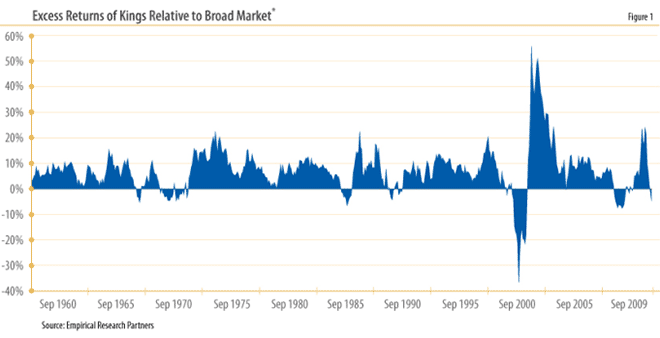
* The broad market, as measured by Empirical Research Partners, consists of the largest 750 stocks by market cap plus the constituents of the S&P 500 not already included in the largest 750. Returns are based on 12-month forward basis. The most recent period depicted by this chart, therefore, started September of 2009.
Long Live the Kings
The Kings have a long history of outperforming the market, as illustrated in Figure 1. The graph depicts the performance of the highest quintile of free-cash-flow-yielding stocks relative to the broad market over the past 50 years on a rolling 12-month forward basis.1 Performance was calculated for each 12-month time period from the beginning of each month during the 50-year time frame. We define the broad market as the largest 750 stocks by market cap plus the constituents of the S&P 500 Index not already included in the largest 750.
While it may not be surprising that the Kings have historically outperformed the market, it may come as a surprise that they have done so in 86% of the 12-month periods during the 50-year time frame. During the past 50 years, the Kings have had only eight periods of underperformance, which lasted on average just 11.3 months. Their average 12-month excess return has been 7.1%. When you consider that outperforming the market even 55% of the time is generally considered a winning strategy, the allure of investing in the Kings becomes clear.
The most recent forward 12-month data, which covers the period that ended August of this year, illustrates the Kings’ recent sharp reversal from positive to negative excess returns (see Figure 1). The forward 12-month excess return of the Kings has collapsed from its peak of +23.9% for the twelve-month period that ended February 2010 to its most recent level of -4.7%, nearly 12% below the historical excess return average of 7.1%.
To better understand the recent relative performance of the Kings, look at the past eleven months. (Figure 1 shows performance based on 12-month forward basis returns, so it does not include the performance of the past 11 months). The average monthly excess return of high cash flow companies during the past eleven months was -0.33%, which falls well below the historical average monthly excess return of 0.52%. The length and the depth of the Kings’ underperformance imply that we are experiencing what may prove to be one of their starkest periods of underperformance. The historical infrequency with which cash flow Kings trailed the broad market and the nature of the Kings’ recent underperformance suggests that the companies may be overdue to once again outperform the broad market.
Why the Kings are underperforming
In the wake of the 2008 financial crisis, corporate America accumulated more than $1.84 trillion in cash on its collective balance sheet. During the crisis, companies were rewarded for holding significant cash reserves. Since the U.S. has emerged from the depths of the financial turmoil, however, this no longer seems to be the case. The following factors are also at play:
- Investors believe that current free cash flow yields are unsustainably high because corporate earnings will decline in a worsening economy.
- Investors are frustrated by the growing stockpile of cash on corporate balance sheets and believe it indicates that management teams are growing skeptical about the trajectory of the economic recovery. In other words, company managers may believe a lack of attractive investment opportunities for their cash exists. Similarly, investors may suspect that company executives are hoarding cash because they fear that a weak economy may make financing through capital markets or banks difficult, creating a need for enterprises to self-finance operations.
- Investors are uncertain about the severity and timing of potential changes in tax policies, including dividend taxation.
What the future holds
We believe free cash flow generation is a telling indicator of high-quality companies. We maintain a positive view regarding future corporate profit growth and believe that current free cash flow yields are sustainable. High-quality growth franchises should continue to expand in 2011 and reward their shareholders in numerous ways.
Signs are evident that these sophisticated capital allocators are beginning to loosen their purse strings and put their cash to work through capital investments to fund organic growth, increased dividends, share repurchases, and acquisitions. These activities benefit shareholders and are a clear indication that corporate America sees growth opportunities ahead.
In addition to enriching shareholders directly through cash payments that augment organic growth, high free-cash-flow-yielding companies are more likely to be acquisition targets than other companies. It is clear that corporate managers also understand the benefits of owning the Kings, which further confirms the benefits to investors of evaluating stocks through a free cash flow lens.
1. 12-month forward basis performance implies performance that occurred during the 12-month period following a specified date. For example, the 12-month forward basis performance for September 1960 includes the period of time from the beginning of September 1960 until the end of August 1961.
The cream always rises to the top
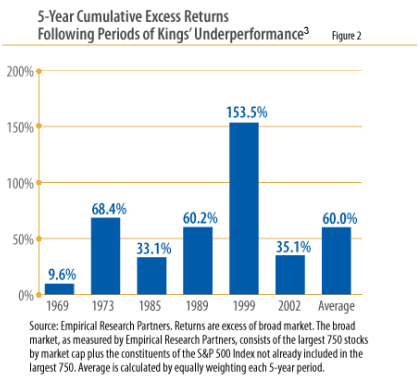
With so many questions swirling around our future, we are in extraordinary times. But one thing is irrefutable: If companies can generate large free cash flows, they will survive, thrive and deliver strong returns to their shareholders. History can help guide our expectations here too. Since 1969, each period of underperformance has been followed by the Kings outperforming the market by 60% on a cumulative basis (see Figure 2).2
When investors return to equities, they will seek out these high-quality companies that are poised for growth. Companies that are positioned for success and able to exploit high free cash flows will be very attractive targets for individual, institutional, and corporate investors alike.
David Vincent is a Vice President and Senior Investment Analyst with Fred Alger Management, a New York-based investment management firm.
Kevin Collins is a Senior Vice President and Client Portfolio Manager with Fred Alger Management, a New York-based investment management firm.
Additional Performance Data
Cumulative Returns Following Periods of Kings’ Underperformance
|
1-Year Data |
3-Year Data |
5-Year Data |
|
Kings |
Broad Market |
Excess |
Kings |
Broad Market |
Excess |
Kings |
Broad Market |
Excess |
1969 |
-23.6% |
-24.7% |
1.1% |
15.3% |
11.6% |
3.7% |
-5.0% |
-14.7% |
9.6% |
1973 |
-11.0% |
-15.3% |
4.3% |
40.4% |
1.1% |
39.3% |
79.5% |
11.1% |
68.4% |
1985 |
18.7% |
17.8% |
0.9% |
76.8% |
46.3% |
30.5% |
97.8% |
64.7% |
33.1% |
1989 |
-9.8% |
-10.7% |
0.9% |
61.8% |
40.4% |
21.4% |
118.9% |
58.8% |
60.2% |
1999 |
8.3% |
-3.2% |
11.5% |
69.6% |
-13.3% |
83.0% |
185.6% |
32.1% |
153.5% |
2002 |
45.0% |
41.8% |
3.2% |
117.2% |
84.2% |
33.0% |
159.2% |
124.1% |
35.1% |
Average |
4.6% |
1.0% |
3.6% |
63.5% |
28.4% |
35.2% |
106.0% |
46.0% |
60.0% |
Returns of Kings Relative to Broad Market
|
Kings |
Broad Market |
Excess |
1 Year |
6.9% |
11.6% |
-4.7% |
3 Year |
-4.9% |
-5.5% |
0.6% |
5 Year |
2.9% |
1.6% |
1.3% |
10 Year |
13.4% |
3.0% |
10.4% |
50 Year |
17.5% |
10.9% |
6.6% |
2. Calculated by geometrically linking returns during periods when high cash flow companies outperformed the broad market.
3. The performance of the broad market and of high cash flow companies for the five year periods reflected in Figure 2 are: 1969: -14.7%, -5.0%; 1973: 11.1%, 79.5%; 1985: 64.7%, 97.8%; 1989: 58.8%, 118.9%; 1999: 32.1%, 185.6%; 2002: 124.1%, 159.2%. The average return of the overall market for those periods was 46.09% and for high cash flow companies 106.0%.
The views expressed are the views of Fred Alger Management, Inc. as of September 2010. Fred Alger Management was founded in 1964. Empirical Research Partners is a broker-dealer that provides research on a variety of topics to institutional investors. Alger has used sources of information which it believes to be reliable; however, this publication is not intended to be and does not constitute investment advice. These views are subject to change at any time and they do not guarantee the future performance of the markets, any security or any funds managed by Fred Alger Management, Inc. |These views should not be considered a recommendation to purchase or sell securities. Individual securities or industries/sectors mentioned, if any, should be considered in the context of an overall portfolio and therefore reference to them should not be construed as a recommendation or offer to purchase or sell securities. References to or implications regarding the performance of an individual security or group of securities are not intended as an indication of the characteristics or performance of any specific sector, industry, security, group of securities or a portfolio and are for illustrative purposes only. |The S&P 500 Index is an unmanaged index generally representative of the U.S. stock market without regard to company size. Investors cannot invest directly in any index. Index performance does not reflect deduction for fees, expenses, or taxes. Investing in companies of all capitalizations involves the risk that smaller, newer issuers in which Alger invests may have limited product lines or financial resources or lack of management depth. |Investing in the stock market involves gains and losses and may not be suitable for all investors. Growth stocks tend to be more volatile than other stocks, as the prices of growth stocks tend to be higher in relation to their companies’ earnings and may be more sensitive to market, political and economic development.
Before investing, carefully consider a fund’s investment objective, risks, charges and expenses. For a prospectus containing this and other information about a fund, call us at (800) 992-3863 or visit us at www.alger.com. Read it carefully before investing. NOT FDIC INSURED. NOT BANK GUARANTEED. MAY LOSE VALUE.
Fred Alger & Company, Incorporated, Distributor. Member NYSE Euronext, SIPC.
Read more articles by David Vincent and Kevin Collins