Products that guarantee income for life can be useful for retirement planning, but many clients also want flexibility and control over their investments. Two products that can meet these objectives are variable annuities with guaranteed lifetime withdrawal benefits (VA/GLWBs) and deferred income annuities (DIAs).
These products have been separately discussed in recent articles in Advisor Perspectives, and this article provides a side-by-side comparison. In December, Wade Pfau analyzed VA/GLWBs in GLWBs: Retiree Protection or Money Illusion?, and I looked at that product in Income Annuities versus GLWBs: A Product Comparison back in January. I also analyzed DIAs in New Tools to Manage Longevity Risk, which appeared last month.
The VA/GLWB is the more popular of the two products, and I'll illustrate its features with a simple example that I’ll carry through the rest of the article. Our exemplar is a 65-year-old female who has $500,000 for her retirement. She could invest the $500,000 in a VA/GLWB and, based on typical guarantees, begin taking a 5% ($25,000 per year) lifetime-withdrawal benefit starting immediately. The withdrawals would reduce the account balance in the VA, and, if the account were depleted (by long life or poor investment performance), the guarantee would kick in and payments would continue for life. Although she would be investing the full $500,000 in the VA, she would retain control of her money and would have the flexibility to invest in a mix of stock and bond funds.
Most VA/GLWB products also contain income "ratchets." If account values increase above the amount of the initial deposit (because investment gains more than offset withdrawals), the withdrawal guarantee would increase to 5% of this higher account value. Such increases are likely to fall short of providing full inflation protection, but they are an added benefit.
The DIA is a newer and less popular option, but it offers another way to provide guaranteed lifetime income. With this product, the individual in the example would pay about $45,000 to purchase a lifetime income stream of $25,000 annually that begins 20 years hence, at age 85. That would leave the remaining $455,000 available for systematic withdrawals over the 20-year deferral period. By contrast, it would cost approximately $400,000 to purchase a single-premium immediate annuity (SPIA) to provide the $25,000 income with no deferral, and the cost would lock up most of her retirement savings.
Product particulars
For the VA/GLWB, I'll use the Vanguard product, which has total annual expenses averaging 1.54% (.95% for the GLWB rider and .59% for investment management and annuity charges). This product is priced for the direct market and suitable for fee-based advisors, so it carries much lower fees than commission-based products, whose annual fees average 3.5%. (Both high-fee and low-fee products typically offer the same 5% withdrawal guarantee for 65-year-olds, but the income ratcheting and projected account/bequest values will be reduced by higher fees.)
For the DIA, I'll use rates provided by Curtis Cloke of Thrive® Income, a company that provides DIA and SPIA quotes from multiple carriers. The rates provided by Thrive® Income are low-load, similar to the Vanguard VA/GLWB.
Assumptions
My comparison uses the following investment assumptions, most of which are based on data from the Ibbotson® SBBI 1926-2011:
- Bonds: 2.25% average annual return based on the March 23, 2012 10-year Treasury; 5.7% standard deviation
- Stocks: 8.55% average annual return, based on the 6.3% historical equity premium; 20.3% standard deviation
- Correlation for stocks and bonds: none, based on near-0% historical correlation
- Investment mix for the VA and regular investments: 65% Stocks, 35% bonds (the maximum stock percentage allowed in the Vanguard VA/GLWB)
- Investment expenses: 1.54% for VA fees total; 0.15% for regular investments not in a VA
For simplicity, all comparisons are pre-tax, but it’s worth understanding how taxes come into play. If the funds used are qualified, withdrawals and product payouts will be taxed at the same rate as ordinary income. If taxable funds are used, the analysis becomes more complicated. Funds held in taxable accounts and used for systematic withdrawals will be taxed on a current basis, but they receive the benefit of lower tax rates for dividends and capital gains. Funds invested in annuities (VAs or DIAs) will benefit from tax deferral, but payments that represent earnings will be taxed at ordinary rates. It's important for advisors recommending these products to know the tax rules in detail.
Based on the assumptions I describe above, Monte Carlo modeling of the Vanguard VA/GLWB shows that its guaranteed withdrawal amount would increase by an average of 1.54% per year. To match this product as closely as possible, I will use a DIA that would begin making payments of $33,938 ($25,000 inflated at 1.54% per year) 20 years hence, with payments continuing to increase at 1.54% each year thereafter. The cost of that DIA is $66,495, which leaves $433,505 for systematic withdrawals from regular investments for the 20 years until DIA payments begin.
Product comparison
For the DIA strategy and VA/GLWB, I've matched the initial $500,000 and the projected payments, which may take the form of withdrawals or product payouts. For the VA/GLWB, withdrawals will be taken from the $500,000 initial investment in the VA, and guaranteed payments will kick in if the VA account balance goes to zero. For the DIA strategy, systematic withdrawals will come out of regular investments, and the withdrawals will cease at 20 years, when the DIA payments begin.
There remains an important difference to consider in the guarantees offered by the two products, however. The GLWB provides the assurance of uninterrupted income for life, but with the DIA, there is a "gap" risk: The investments used for systematic withdrawal may deplete before DIA payments commence. This risk can be significant, and, based on the assumptions used in this example, there is close to a 30% chance of running out of funds before the end of the 20-year deferral period.
Of course, there is also a significant chance of dying before age 85. Adjusting for mortality, there is about a 20% chance of running out of money while still alive during the deferral period. For an individual who lacks the flexibility or other funding sources needed to cover the gap risk, the GLWB may be the better choice, regardless of the finer details of these calculations.
Projected account values
We can also compare these products in terms of projected account values (which turn into bequest values at time of death). I've used estimated geometric mean returns (to allow for variability) of 5.31% for regular investments and 3.93% for funds inside the VA. This table shows the present values of expected bequests , as well as the present value of not purchasing either product and just taking systematic withdrawals. All present values are based on a 5.31% discount rate.
|
Product Comparison--Present Value of Expected Bequests
|
|
Systematic Withdrawal |
VA/GLWB |
DIA Strategy |
PV Bequest |
$145,371 |
$90,066 |
$125,640 |
Difference versus Systematic Withdrawal |
|
-$55,305 |
-$19,731 |
Although the VA/GLWB provides the stronger guarantees (i.e., no gap risk), those guarantees cost about $35,000 more in present value than one would have using the DIA strategy. The DIA difference versus systematic withdrawal of $19,731 represents the DIA’s up-front cost of $66,495, less the present value of expected DIA payments. The analogous difference for the VA/GLWB mainly reflects the higher asset-based fees – 1.54% for the VA/GLWB versus 0.15% for regular investments. For a client with some flexibility in his or her ability to manage the gap risk, the DIA strategy is a less expensive way to obtain longevity protection. When using the DIA strategy, the assets held in regular savings escape the VA/GLWB fees.
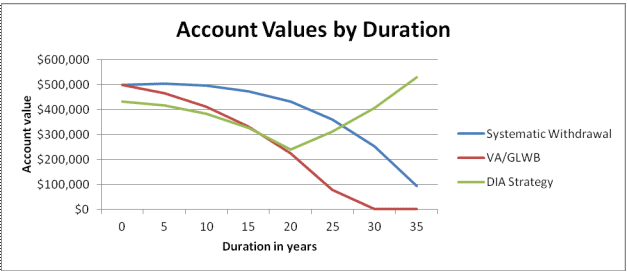
We can also better understand the comparison of these products if we examine how the projected account values (which represent the future value of a bequest) track over time.

For this particular client, under the assumptions I have used, the investment returns are not sufficient to offset the impact of withdrawals, so all products show projected declines during the first 20 years. The expanding difference between systematic withdrawal and the VA/GLWB reflects the cumulative impact of the higher fees on the VA/GLWB relative to assumed fees for regular investments. When the VA runs out of account value (projected at about year 30), the guaranteed withdrawals kick in, and the account holds at zero.
The DIA strategy starts with a lower account value than the VA/GLWB, but it compensates over time because the funds held in regular investments do not incur the VA/GLWB charges. At year 20, the DIA payments begin, so any funds remaining at that point will grow at the assumed return for regular investments, without being diminished by withdrawals. (Note that with the DIA strategy, funds are projected to hold positive over the 20-year deferral period, but there is still the risk that bad investment performance could push those values down into negative territory.)
Impact of the equity premium
The prior analysis assumes that the equity premium of stock returns over bond returns will continue at the historical 6.3%.based on the SBBI data. That is a crucial assumption, and it is also very questionable, so it's worth doing a quick check on the charts using lower assumed stock returns. The results below are based on a 4% equity premium, resulting in a geometric mean return of 3.81% for regular investments and 2.42% for VA funds. Present values are based on a 3.81% discount rate.
|
Present Value of Expected Bequests—Lower Equity Premium
|
|
Systematic Withdrawal |
VA/GLWB |
DIA Strategy |
PV Bequest |
$105,642 |
$76,740 |
$106,166 |
Difference versus Systematic Withdrawal |
|
-$28,902 |
$524 |
Both product strategies now do better relative to systematic withdrawal, and the DIA strategy actually beats systematic withdrawal by a small margin. This lower-return example demonstrates that longevity guarantees become more attractive if one expects poorer equity investment performance.
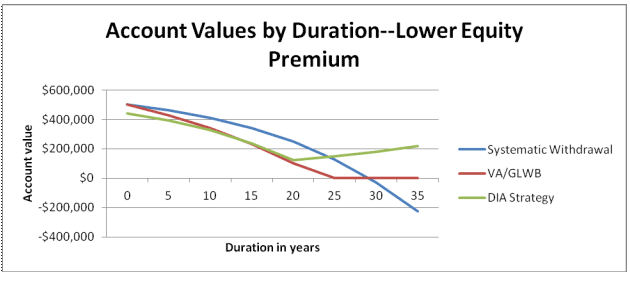
The chart below, showing account values by duration, exhibits similar shapes for the curves as the previous version, but all the values are lower, and systematic withdrawal bequest values are projected to go negative after year 30. If the individual were still alive at these longer durations, other funds would be needed to cover living expenses.
Conclusion
Based on the particular assumptions used for this example, a low-cost VA/GLWB (and I emphasize low-cost) is an effective way to generate guaranteed lifetime income for individuals who need the assurance of an uninterrupted baseline guarantee. The VA/GLWB provides liquidity and flexibility, plus the opportunity to enjoy some stock market upside. The principal drawback is that one cannot be certain of the projected income increases for the product, and such increases are unlikely to keep pace with inflation regardless.
For those who can handle some income risk, but still want longevity protection, the DIA provides an alternative with lower costs than the VA/GLWB. The DIA also offers lots of options in terms of deferred income, the length of deferral period, and the choice of flat benefits versus step-ups. Having these options is useful in customizing the product for particular client circumstances.
Read more articles by Joe Tomlinson