Rick Rieder and Russ Brownback argue that while most investors are focusing primarily on trade-related supply chain disruptions today, they need to continue to situate this turmoil in the more fundamental changes at play in technology and demographic trends.
Russ explains why the suddenly easier central bank policies could be key for emerging markets.
Low inflation may sound appealing, but as Russ explains, it has drawbacks for investors.
With stocks on a rollercoaster ride this year, Russ discusses the various potential hedges that could smooth the ride.
The firm’s senior decision makers debated the midyear market outlook last week in London. Jean shares the gist of our debates.
Russ discusses why growth is likely to continue to outperform value for a while.
Rick Rieder and Russ Brownback argue that there’s little benefit to “trading the news” today, as prices adjust instantly to highly-transparent information. Rather, investors would do well to follow long-term cash flows, of which the lion’s share is to be found in tech.
Markets are not too expensive, or too cheap. As Russ explains, that offers a clue into what could cause the next move.
Russ discusses why volatility has not been more severe, even though growth has softened.
Continuing the post-crisis trend, U.S. stocks have outperformed the rest of the world this year. Russ explains why.
Cyclicals rule. After getting trounced in Q4, year-to-date more cyclically oriented stocks and sectors have trounced “defensive”, less-cyclically exposed names. The trend has been even more pronounced during the past month.
Despite being up 25% from December 2018 lows, Russ discusses the factors that remain supportive of the energy sector.
Rick Rieder and Russ Brownback argue that despite the market turbulence witnessed in the past several months, as well as a dramatic policy reversal, we find ourselves at a moment of remarkable economic stability. That fact, along with greater policy accommodation and capacity, argues for healthy and sensible risk taking.
With growth soft, financial conditions are key for investors, Russ explains.
Russ discusses the divergence between rising stock prices and falling bond yields. What gives and can it continue?
The recent U.S. equity rally has coincided with a drop in volatility. But can that continue? Russ discusses.
Rick Rieder and Russ Brownback argue that as the conventional wisdom in policy and investment circles surrounding prospects for growth and inflation have shifted in 2019, so too have investment opportunities.
Russ explains the mystery of why gold is performing surprisingly well while stocks are rallying.
It’s not just stocks: bonds and commodities are up this year as well. Russ discusses whether than can continue.
Recent volatility has created opportunities to invest in high yielding leveraged credit closed-end funds trading at a discount to net asset value.
Russ discusses why energy, despite rallying – and outperforming -- this year, still looks like a value.
Markets have bounced back from December’s selloff. Russ discusses whether investors have shifted sentiment too quickly.
Rick Rieder and Russ Brownback argue that an evolving policy stance at the Fed is altering the risk/reward calculus for investors this year, although left-tail risks remain.
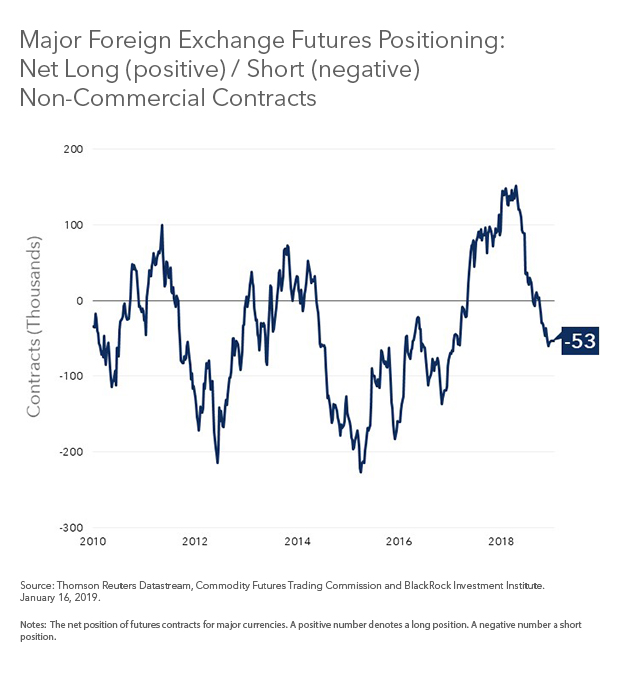
Russ discusses why the dollar has stabilized and what it means for markets.
After December’s rout, are stocks now reasonably valued? Russ’ answer may surprise you.
Rick Rieder argues that the Fed’s price stability mandate has been fulfilled and that today’s drivers of inflation…
Your employer works behind the scenes to review and improve your retirement plan. But are you getting the benefit of their latest and greatest? Paul talks about how to use your employer’s recommendations to evaluate your own plan.
Rick Rieder and Russ Brownback argue that slowing growth, peaking inflation and tightening financial conditions combine to make a strong case for a Fed policy rate hiking pause in early 2019.
It may seem like a poor environment for EM stocks, but they outperformed in the recent volatility. Russ explains why.
A collection of insights our Portfolio Solutions team gathered from working with thousands of advisors on close to ten thousand investment models in the past twelve months.
There are few signs of a recession, but slowing growth is having an impact. Russ explains why and what steps to take.
Unless oil prices collapse, energy stocks now appear to be cheap, as Russ explains.
After the October selloff, stocks got cheaper. But that might not be enough for a continued rebound, Russ suggests.
Contrary to conventional wisdom, Rieder argues that wage growth doesn’t lead to higher inflation, and in fact may even hold a dampening impact on inflation over time, which has important implications for how to judge monetary policy today.
Russ discusses why gold, not a popular asset class until recently, has become so as a hedge.
Rieder and Brownback argue that monetary policy restrictiveness, fading fiscal stimulus, and growing economic uncertainties leave markets more vulnerable today, and these risks are not to be toyed with.
Credit markets are still relatively supportive of stocks, but at the margins, less so. Russ discusses the implications.
Russ takes a look at whether stocks and bonds will move in sync again and what to do if they will.
Rieder and Brownback argue that today investors are confronted by massive shifts in the nature of the economy, alongside cyclical and policy uncertainties; making sense of it all is critically important.
Investors may be ready to abandon emerging markets, but as Russ discusses, the potential is there for a sizeable rebound.
While momentum stocks have prevailed since 2016, is quality about to have its day? Possibly, if volatility continues to rise, as Russ discusses.
As Russ discusses, we remain in a strong dollar environment, which continues to have consequences for the market.
In a future of lower expected price appreciation, investors should focus on the second leg of returns: income. ETFs make it incredibly easy to capture diversified sources of higher-yielding assets.
As yields increase, short-maturity bond funds can offer both higher income potential and a cushion against interest rate risk. Karen explains the mechanics, in part three of her Rising Rates series.
The flattening Treasury yield curve is getting a lot of attention, but there’s another flattening that is arguably of greater importance: the narrowing return gap between low- and high-risk assets. Jeff explains.
Data shows a solid economy, yet markets are acting like recession is around the corner. Russ explains why.
As Russ notes, in a world with few bargains, one stands out: Asia.
As Russ explains, dismal performance of emerging markets this year has make them look like a bargain again.
Value continues to look cheap, however predicting when it will begin to outperform is challenging. Russ suggests one potential catalyst: an unexpected acceleration in nominal economic growth.
Rieder and Brownback argue that as we depart the era of QE, where rising tides lifted all boats, the income component of total return becomes ever more vital to investor prospects.