Advisor Perspectives welcomes guest contributions. The views presented here do not necessarily represent those of Advisor Perspectives.
Innovation drives productivity growth, which in turn raises the standard of living for a nation's population. Accordingly, we support the theory that AI will benefit the economy and the population. We laid this bullish case out in "The AI Economy: Looking Beyond The Façade Part I." However, history has taught us that it is incredibly difficult to forecast the timing of the impacts of revolutionary technological innovations — such as AI — on the nation's corporations, citizens, and the broader economy.
Therefore, we follow our bullish case with a different perspective on how AI could negatively impact the economy, especially in the near term. Part two discusses the two biggest risks to the bullish case: how well the benefits of productivity are dispersed between corporate America and the broader population, and the Engels’ Pause, a prolonged period of disruption that precedes the widespread benefits of innovation.
Productivity Dispersion
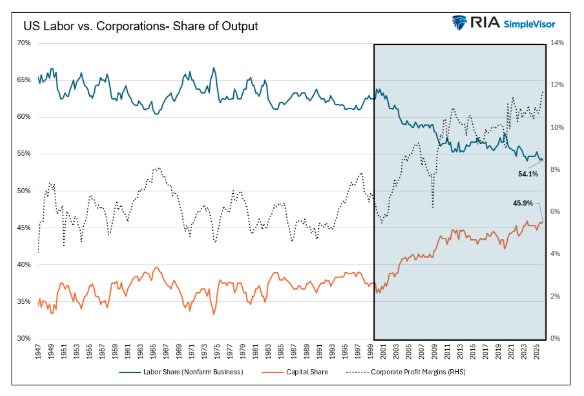
The graph below highlights our concern. Following World War II through the late 1990s, the economic output of labor versus corporations was reasonably balanced. In other words, the distribution of productivity benefits between workers and corporations remained aligned. However, the relationship began to break down in the late 1990s with the advent of the internet.
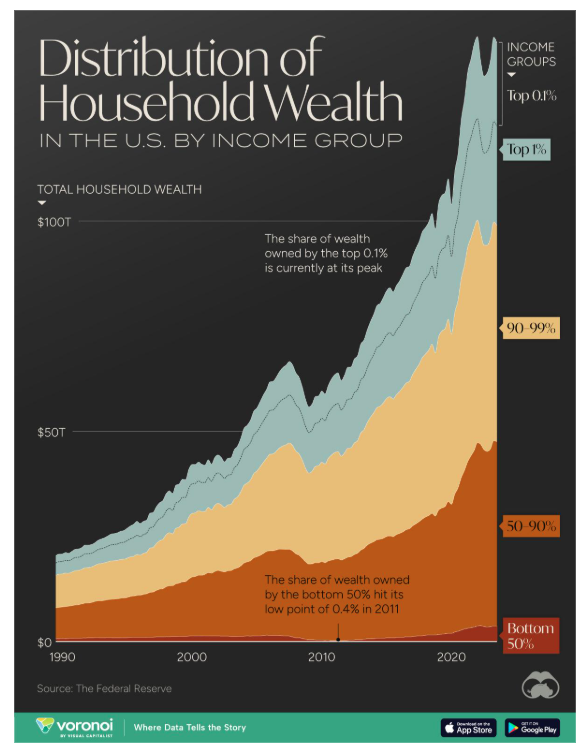
The internet accelerated automation, enabling corporations to arbitrage labor globally. The result, as shown above, was a shift of wage power away from labor toward corporations. As a result, many middle-skill jobs — such as travel agents, bank tellers, telephone operators, and data entry clerks — were either automated out of existence, offshored, or their wages were compressed. The jobs that remained became skewed toward high-skill, high-wage knowledge jobs, and low-skill, low-wage service work. The middle class was hollowed out, which helps explain the K-shaped economy and the growing wealth gap between the rich and poor.
The internet rewards scale. For instance, a software company can serve one million customers with the same marginal cost of serving one hundred. Platform businesses, such as Uber and Airbnb, can capture a good portion of an industry's transaction flow without owning physical assets. The economics of the internet era systematically favored capital over labor because value creation shifted toward assets that don't show up on a payroll.
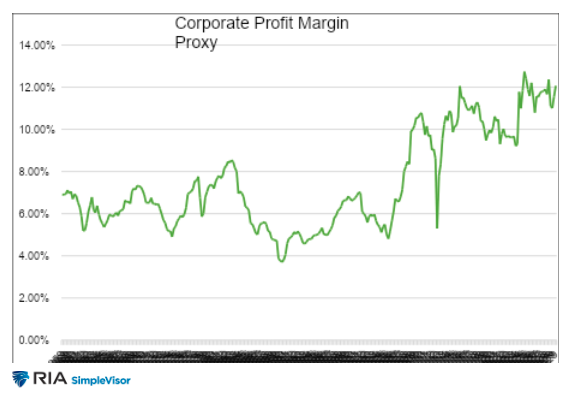
As we share below, between the late-1990s and today, corporate profit margins have roughly doubled, while labor's share of GDP has declined by nearly 10 percentage points. That gap continues to widen despite historically low unemployment. Such serves as a good reminder that job quantity and income share are not the same measure. Despite seemingly robust economic headlines, wealth is shifting away from most of the population.
AI and The Wealth Divergence
With advances in internet technology as our guide, we must question whether AI will further exacerbate divergent wealth trends.
The bullish case, as we outlined in part one, is that productivity gains eventually spread. That today's premiums paid to knowledge workers become tomorrow's baseline for all workers. Even amid growing wealth disparities, the internet’s productivity benefits allowed the tide of economic growth to lift all boats — though some more than others. History supports that view over long enough time horizons.
But the bear case is that AI is different from prior innovations in one important respect: adoption speed. The internet took roughly two decades to fully permeate the economy. AI is moving faster. It took the internet seven years to reach 100 million users, while ChatGPT captured 100 million users in only two months!
If corporations capture productivity gains from AI through cost reductions, margin expansion, and the automation of white-collar work, the share of output flowing to workers could contract at an even greater rate than it has.
The Engels’ Pause
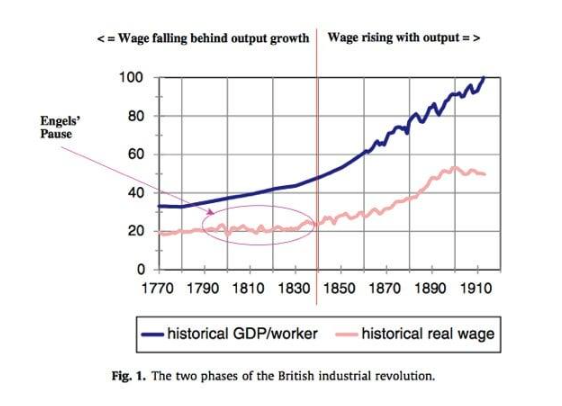
Engels’ Pause is named after Friedrich Engels, co-author of the Communist Manifesto. Engels documented the condition of the English working-class during Britain's Industrial Revolution. Between roughly 1790 and 1840, Britain experienced a sharp upturn in productivity. Textile mills, steam engines, and all sorts of mechanized production methods drove extraordinary gains in output and national wealth. GDP grew rapidly, and corporate profits soared. But for the most part, the living standards of most British workers declined as wages stagnated. The factories that made Britain the wealthiest nation were simultaneously impoverishing the people who worked in them.
It took Britain’s economy 50 years to absorb the productivity shock of the Industrial Revolution and broadly lift living standards. The 50-year Engel’s Pause period, during which the benefits of productivity were dispersed across the population, was detrimental to an entire generation.
Engels’ Pause Redux?
The parallels between Britain’s Industrial Revolution and the AI Revolution are uncomfortable.
AI will drive extraordinary gains in corporate output and national wealth, but currently the benefits are concentrated among a handful of technology companies, their shareholders, and a relatively small number of high-skill and executive workers. If AI automates white-collar work faster than labor markets can create replacement jobs and workers can be retrained, we could experience a modern Engels’ Pause: A prolonged period in which GDP and corporate profits climb while median wages stagnate and unemployment rises. Unlike the British blue-collar jobs of the 1800s, today's displaced workers would likely be stable, middle-class knowledge jobs.
The Investment Case
The bullish and bearish cases for AI's economic impact are not mutually exclusive. History suggests that both can be true simultaneously. Productive innovations that ultimately raise living standards broadly have frequently done so only after extended periods of disruption and concentrated gains.
Our base case remains that AI will prove net positive for the economy and for most of the population over time. The productivity gains are real, the capital investment is unprecedented, and history's verdict on innovation is consistent. But the timeline of how and when the benefits of AI innovation are distributed is far from known.
For investors, the timeline should play an integral role in managing their wealth.
If the bullish case unfolds, whereby productivity spreads rapidly, wages rise broadly, and AI creates more jobs than it displaces, the opportunity lies in owning the infrastructure and service companies best positioned to reap those gains. If the bearish case proves true, with corporate margins expanding at labor's expense, the economy could suffer even if GDP expands. Consumer-facing businesses and those unable to employ AI to keep up with the competition are at the greatest risk.
Either way, active exposure — whereby you discern between the current and potential winners and losers — will likely make more sense than a passive approach, where concentration on winners is limited.
Read more by Michael Lebowitz:
Michael Lebowitz is a portfolio manager with RIA Advisors and author for Real Investment Advice. For more information, contact him at [email protected] or 301.466.1204.
Join RIA Advisors and elevate your career within a deeply experienced team focused on innovation. Our collaborative environment is built on a foundation of advanced technology and effective investment models, designed to enhance your ability to serve clients and grow your practice. Benefit from a supportive culture that encourages professional development and fosters a forward-thinking approach. By joining our team, you’ll be part of a group dedicated to excellence and continuous improvement, empowering you to focus on building meaningful client relationships and pursuing your business ambitions. Discover the advantages of working with our accomplished advisory team by starting your conversation today.
A message from Advisor Perspectives and VettaFi: Discover something new! Click here to register for our upcoming webcasts.
Read more articles by Michael Lebowitz
 Advisor Perspectives welcomes guest contributions. The views presented here do not necessarily represent those of Advisor Perspectives.