It is almost impossible to put a price on security. But members of the North Atlantic Treaty Organization (NATO) are trying to do just that. The group’s meeting this week highlighted the fiscal costs of geopolitical uncertainty.
NATO was formed shortly after the Second World War, as the Soviet Union brought much of Eastern Europe under its control. Western European countries were still recovering from the significant damage done by the War; West Germany had been disarmed. As a result, the United States took the lead in providing finance and personnel to buttress the alliance.
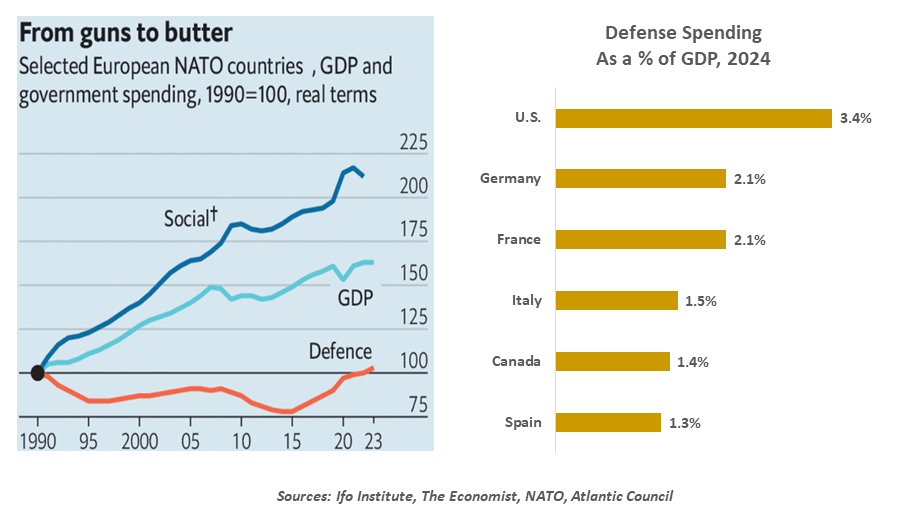
In the decades that followed, the disparity in defense spending between the U.S. and its major NATO allies grew, despite advancing economic prosperity. When the Berlin Wall fell, European countries declared themselves a “peace dividend” that was much larger than the one enjoyed by the United States.
The proximate threat to Europe was already rising when Russia invaded Crimea shortly after hosting the 2014 Winter Olympics. To respond, NATO members were required to bring defense spending to 2% of gross domestic product (GDP) within ten years. Most chinned that bar; there were a few notable exceptions.

The Trump Administration has been pressing Europe to take more financial responsibility for its own defense. The change of tone has already prompted Germany to amend its constitution to make more room for military spending. The European Union created a €150 billion arms fund, backed by Eurobonds. But that was only a start.
At this week’s NATO summit in The Hague, members agreed to increase their annual defense outlays to 5% of GDP over the next ten years. This will generate increments of economic growth and employment, but will require substantial amounts of additional spending at a time that quite a few member countries are facing fiscal challenges. Slow economic growth, rising interest costs, and aging populations are combining to increase annual budget deficits and aggregate amounts of national debt. Spain has already announced that it is unlikely to be compliant with the new standard.
Conflicts disrupt daily lives and economic activity, creating immeasurable costs. The investment being asked by NATO is substantial, but so are the social and economic returns that will be earned.
A message from Advisor Perspectives and VettaFi: To learn more about this and other topics, check out some of our webcasts.
© Northern Trust
Read more commentaries by Northern Trust