Stocks are Following the Market’s Playbook
Membership required
Membership is now required to use this feature. To learn more:
View Membership BenefitsSome of you reading this title might think this commentary is about September seasonality. Sure, seasonality is part of our playbook and is getting a lot of attention right now. We would not be surprised if volatility were to pick up some this month — even though seasonality isn’t as much of a concern during positively trending markets. The playbook we’re referring to is how the stock market has historically performed after recovering from big selloffs. It’s following that playbook closely.
The Breakout Playbook
Some of you may be surprised at how well stocks have done in recent months. The S&P 500 has gained more than 30% since its low on April 8, 2025, and is up 5% since the index fully recovered its early-year correction losses on June 27, 2025 (with a close of 6,144).
Now sitting near 6,500, above most Wall Street strategists’ year-end targets (the median target is 6,400, per Bloomberg) and above the high end of our fair value range (our bull case is 6,450), it may seem difficult to make a case for additional upside. But the accompanying study (also included in our Midyear Outlook 2025) indicates that stocks are just following their playbook and more gains are likely over the next several quarters.
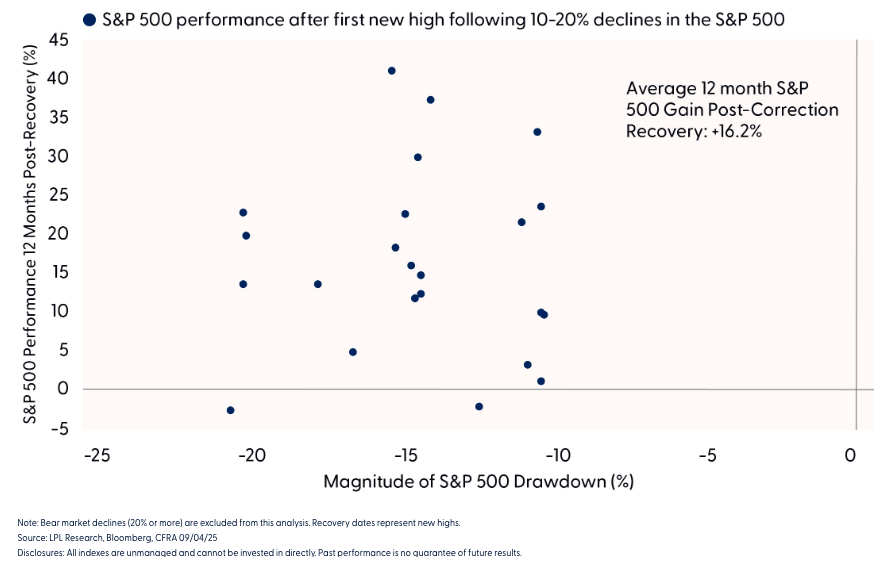
After recoveries from stock market corrections, with corrections defined as 10–20% declines in the S&P 500, double-digit gains over the subsequent 12 months have been commonplace. In fact, stocks rose double digits in 70% of the 23 corrections studied back to 1950, with average and median gains of 16.2% and 14.6% respectively. The S&P 500 was only down one year later in two cases: during the dotcom bust in 2000 and the pandemic in 2020. In other words, it takes a lot to derail a bull market that has broken out to new highs.
Double-Digit Returns Usually Follow Post-Correction Recoveries

This Bull May Still Have Legs
The current bull market will likely celebrate its third birthday in October. Since the bear market low on October 12, 2022, the S&P 500 has gained about 81% (89% including dividends). This compares to the average cumulative gain of 168% for entire bull markets historically (since 1950), and a median gain of 111%, suggesting this bull may have more room to run.
History also tells us that bull markets typically last more than three years — the historical average is 60 months (median 55 months). There has been variance around these averages, but seven out of eight bull markets that made it to their third birthday lasted more than four years, and six made it to five.
The chances that an economic shock ends this bull market in the near term are low, in our opinion. It takes a lot to trigger a bear market, e.g., the dotcom crash (2000), the COVID-19 pandemic (2020), or surging inflation and spiking interest rates (2022). We know the cliché — bull markets don’t die of old age — and we believe the odds are good that this bull has more life in it before it’s killed.
Erasing Bear Market Losses Has Left More Upside Historically
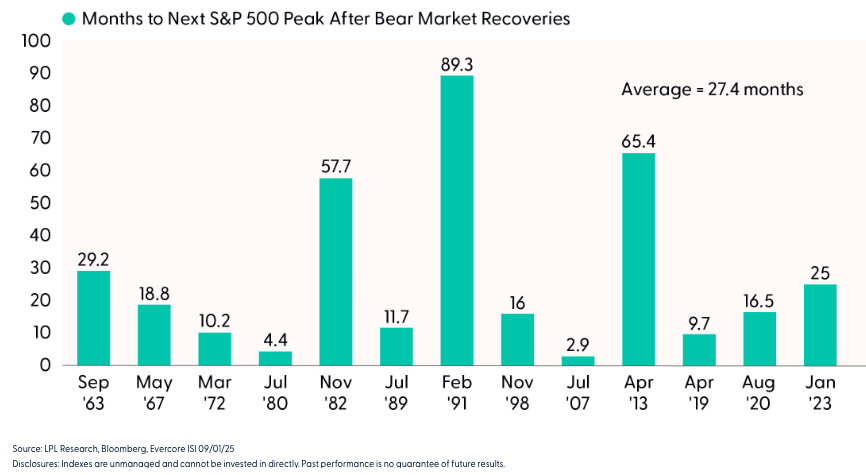
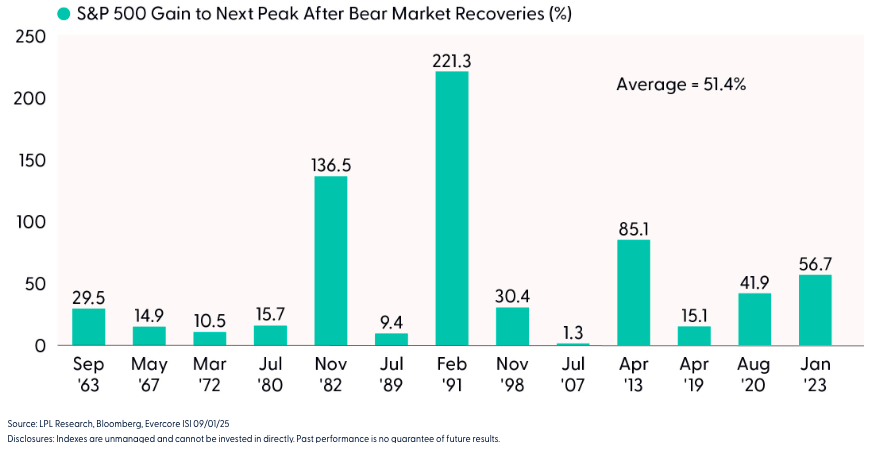
Another way to measure potential upside for this bull market from here is to consider the April–May 2025 sell-off a bear market, which it was on an intraday trading basis, with a more than 20% decline, and calculate remaining upside after those bear market losses were recovered. This is what we did in the “Bull Markets Often Run Another Year or Two After Bear Market Recoveries” and “This Bull Market Likely Has More Left in the Tank” charts, with help from our friends at Evercore ISI. Based on this historical perspective, since recovering from the April–May tariff scare decline (so-called “Liberation Day”) in late June, this bull market may have 27 more months and another 51% of upside before it’s over. That may be optimistic given the losses earlier this year were not as severe as most bear markets, so perhaps the median historical gain of 30% over 16 months post-recovery is a more reasonable bull case scenario.
Bull Markets Often Run Another Year or Two Following Bear Market Recoveries
This Bull Market Likely Has More Left in the Tank
Potential Catalysts to Keep This Bull Running
Stocks can drift higher without an identifiable catalyst, but the chances of a meaningful move higher from here are certainly better if some catalysts emerge. We would point to these possibilities:
- Resilient economy. Despite ongoing geopolitical tensions, lingering trade and tariff uncertainties, and a stalled job market, we expect the U.S. economy to avoid recession in the coming year. A growing economy has historically coincided mostly with positive equity returns, especially after Federal Reserve (Fed) rate cuts. As market participants become more confident that a recession will be averted, expect stocks to react positively.
- Moderating inflation and stable interest rates. Inflation has cooled significantly from its post-COVID-19 surge but remains elevated in some pockets. Even if it takes a few more months for price measures to turn lower from here, we still expect the Fed to embark on a series of rate cuts this year (two, maybe three) and next (another two or three potentially). A lower federal funds rate should help stocks, assuming the economy holds up and cuts don’t go far enough to spark renewed inflation fears.
- Fiscal policy tailwinds and deregulation. We expect business tax incentives and individual tax cuts totaling nearly 1% of U.S. gross domestic product in 2026 to help drive a pickup in economic growth after a soft patch the rest of this year. Deregulation could also help provide corporate America with a boost, lifting business investment broadly and increasing growth and profits for the financials sector.
- Strong AI-fueled growth in corporate profits. Earnings growth in the second quarter was excellent at 12% for S&P 500 companies in aggregate (check out our earnings season recap in “Earnings Season Delivers”). Admittedly a high bar, corporate America could continue to produce double-digit earnings growth through 2026 on the back of continued robust AI investment and productivity gains, alongside tax incentives and regulatory tailwinds. It won’t be easy for companies to fully offset tariff costs and expand margins, but it is well within the range of outcomes.
Given these potential catalysts for further gains, we would consider pullbacks more as buying opportunities than a signal to reduce risk.
Conclusion
It may seem like the stock market has come too far too fast, but it is just following the playbook. Recoveries from sizable market declines tend to be followed by more gains over a period of years. Volatility will come at some point, as it always does, especially given rich valuations. The seasonally weak period of September would be a logical time for a pullback. Inflation remains sticky, with more tariffs on the way. Job growth has stalled. AI investment could prove less fruitful than expected. And the possibility of a disruptive geopolitical shock cannot be dismissed. Nonetheless, we expect this bull market to keep running, powered by moderate but steady economic growth poised to pick up next year, Fed rate cuts and stable long-term interest rates as inflation normalizes, and the powerful ongoing AI capital investment cycle.
Asset Allocation Insights
LPL’s Strategic and Tactical Asset Allocation Committee (STAAC) maintains its tactical neutral stance on equities. Investors may be well served by bracing for occasional bouts of volatility given how much optimism is reflected in stock valuations, lingering tariff and inflation risks, and historical seasonal weakness. LPL Research advises against increasing portfolio risk beyond benchmark targets currently and continues to monitor trade negotiations, economic data, earnings, the bond market, and various technical indicators to identify a potentially more attractive entry point to potentially add equities on weakness.
STAAC’s regional preferences across the U.S, developed international, and emerging markets (EM) are aligned with benchmarks. The Committee still favors growth over value, large caps over small caps, and the communication services and financials sectors.
Within fixed income, the STAAC holds a neutral weight in core bonds, with a slight preference for mortgage-backed securities (MBS) over investment-grade corporates. The Committee believes the risk-reward for core bond sectors (U.S. Treasury, agency MBS, investment-grade corporates) is more attractive than plus sectors. The Committee does not believe adding duration (interest rate sensitivity) at current levels is attractive and remains neutral relative to benchmarks.
A message from Advisor Perspectives and VettaFi: Discover something new! Click here to register for our upcoming webcasts.
Disclosures
This material is for general information only and is not intended to provide specific advice or recommendations for any individual. There is no assurance that the views or strategies discussed are suitable for all investors or will yield positive outcomes. Investing involves risks including possible loss of principal. Any economic forecasts set forth may not develop as predicted and are subject to change.
References to markets, asset classes, and sectors are generally regarding the corresponding market index. Indexes are unmanaged statistical composites and cannot be invested into directly. Index performance is not indicative of the performance of any investment and do not reflect fees, expenses, or sales charges. All performance referenced is historical and is no guarantee of future results.
Any company names noted herein are for educational purposes only and not an indication of trading intent or a solicitation of their products or services. LPL Financial doesn’t provide research on individual equities.
All information is believed to be from reliable sources; however, LPL Financial makes no representation as to its completeness or accuracy.
All investing involves risk, including possible loss of principal.
US Treasuries may be considered “safe haven” investments but do carry some degree of risk including interest rate, credit, and market risk. Bonds are subject to market and interest rate risk if sold prior to maturity. Bond values will decline as interest rates rise and bonds are subject to availability and change in price.
The Standard & Poor’s 500 Index (S&P500) is a capitalization-weighted index of 500 stocks designed to measure performance of the broad domestic economy through changes in the aggregate market value of 500 stocks representing all major industries.
The PE ratio (price-to-earnings ratio) is a measure of the price paid for a share relative to the annual net income or profit earned by the firm per share. It is a financial ratio used for valuation: a higher PE ratio means that investors are paying more for each unit of net income, so the stock is more expensive compared to one with lower PE ratio.
Earnings per share (EPS) is the portion of a company’s profit allocated to each outstanding share of common stock. EPS serves as an indicator of a company’s profitability. Earnings per share is generally considered to be the single most important variable in determining a share’s price. It is also a major component used to calculate the price-to-earnings valuation ratio.
All index data from FactSet or Bloomberg.
This research material has been prepared by LPL Financial LLC.
Membership required
Membership is now required to use this feature. To learn more:
View Membership BenefitsSponsored Content
Upcoming Virtual Events View All










