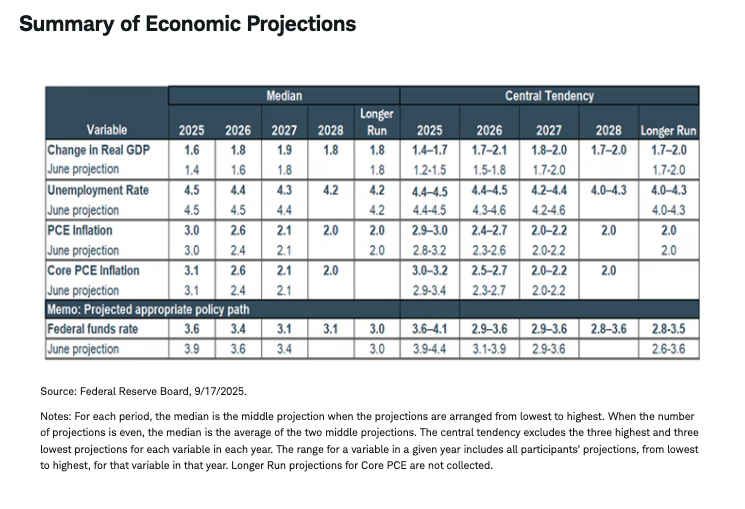
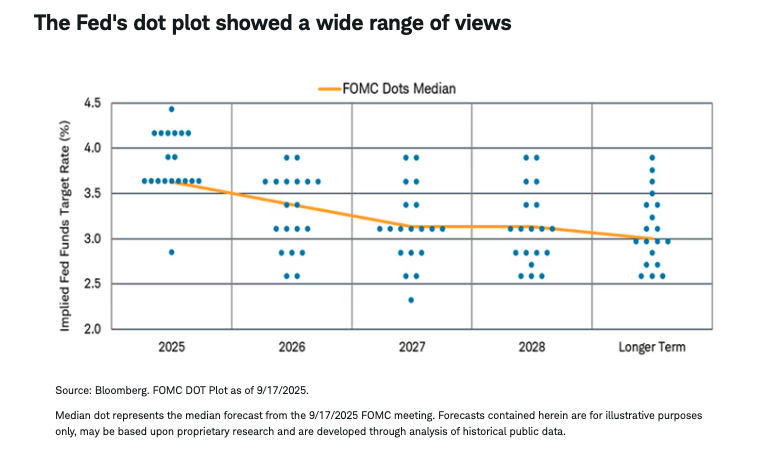
The Federal Open Market Committee (FOMC) delivered a 25-basis-point interest rate cut at its September meeting and left the door open to two more cuts this year. The cut was not a surprise, but there was plenty of information for the markets to digest. With a wide dispersion of projections about the path of interest rates among the members, it's hard to have confidence that the path of interest rates will follow the median projections. Consequently, after an initial drop in Treasury yields and the dollar, markets reversed.
Weakness in the labor market was the key driver for rate cuts
In its accompanying statement, the Fed indicated that it lowered the federal funds rate—the rate that banks charge each other for overnight loans—to a range of 4.0% to 4.25% in response to signs that the labor market is weakening. After the big downward revisions to the payroll figures earlier in the month, it's not surprising that the Fed is responding by easing monetary policy. Part of the Fed's mandate is to set interest rates at a level consistent with full employment. Fed Chair Jerome Powell indicated that the committee was trying to balance the risks in its dual mandate but also noted that there is no "risk-free path" for setting rates. He emphasized that the change in the labor market since the last meeting was the catalyst for the Fed to cut rates despite inflation remaining elevated.
In the Fed's quarterly Summary of Economic Projections, the median estimate suggests only a modest rise in the unemployment rate from its current level of 4.3% and then a decline in 2026 and beyond. Meanwhile, the inflation projections show the Fed won't hit its 2% target until 2028. Moreover, expectations for gross domestic product (GDP) growth were revised slightly higher. Our interpretation is that the Fed believes its rate cuts will help promote economic growth and employment, while delaying a decline in inflation.

Dot plot: Here, there and everywhere
The Fed's dot plot—which shows where various members project the federal funds rate to be over the next few years—illustrated a wide dispersion of views. One Fed member's dot for the end of this year is in the 4.25% to 4.5% range, where the federal funds rate was before the September 17th cut, suggesting that a nonvoting member disagreed with the decision to lower rates. Meanwhile, one member projected an additional 125 basis points (or 1.25%) in cuts this year. It's notable that without the one very low dot the median estimate for this year might not have declined from the June meeting. The median projection for 2026 only implies one more cut next year to a range of 3.25% to 3.5%, well above the sub 3% rate that the fed funds futures market is currently implying.
Where to from here?
It's hard to draw a clear signal from this Fed meeting. The signals from the Summary of Economic Projections were mixed and views of the FOMC members vary widely. What we do know is that the Fed is concerned about weakness in the labor market and will be watching those figures closely. However, with inflation still well above 2% and the economy overall in good shape, the market has probably priced in a more aggressive path of policy easing than is likely to materialize.
For bond investors, we continue to favor keeping average duration in the intermediate-term region of about five to 10 years. Staying in very short-term investments raises the potential for reinvestment risk while investing in very long-term bonds could risk a lot of interest rate volatility.
A message from Advisor Perspectives and VettaFi: Discover something new! Click here to register for our upcoming webcasts.
This material is intended for general informational and educational purposes only. This should not be considered an individualized recommendation or personalized investment advice. The investment strategies mentioned may not be suitable for everyone. Each investor needs to review an investment strategy for his or her own particular situation before making any investment decisions.
All expressions of opinion are subject to change without notice in reaction to shifting market, economic or political conditions. Data contained herein from third party providers is obtained from what are considered reliable sources. However, its accuracy, completeness or reliability cannot be guaranteed.
Past performance is no guarantee of future results.
Investing involves risk, including loss of principal.
Fixed income securities are subject to increased loss of principal during periods of rising interest rates. Fixed income investments are subject to various other risks including changes in credit quality, market valuations, liquidity, prepayments, early redemption, corporate events, tax ramifications, and other factors. Lower rated securities are subject to greater credit risk, default risk, and liquidity risk.
Currency trading is speculative, very volatile and not suitable for all investors.
The policy analysis provided by the Charles Schwab & Co., Inc., does not constitute and should not be interpreted as an endorsement of any political party.
Indexes are unmanaged, do not incur management fees, costs, and expenses and cannot be invested in directly. For more information on indexes, please see schwab.com/indexdefinitions.
The Schwab Center for Financial Research is a division of Charles Schwab & Co., Inc.
© Charles Schwab
Read more commentaries by Charles Schwab