The U.S. government shutdown is about to enter its second month. We did not rush to comment on it, because we didn’t think that it would have much of an economic impact. But the risk that lasting damage will be done is rising.
The current shutdown is the second-longest in history. It may already be the worst: unlike the 35-day impasse seven years ago, Congress hasn’t passed any of the 12 appropriations bills required to fund the government. The number of people and departments affected is more substantial this time around.
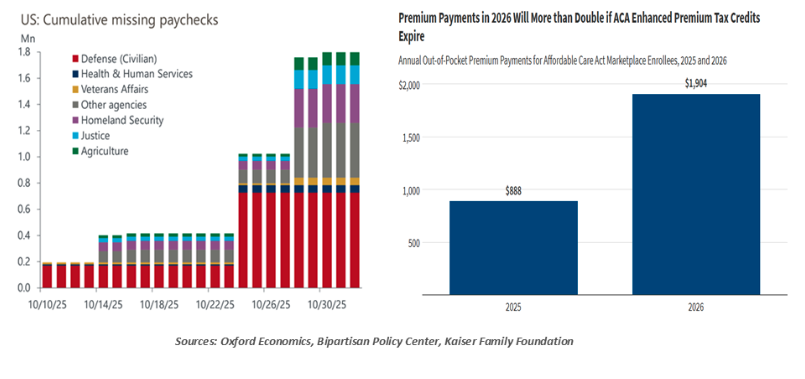
By the end of the month, 1.8 million federal workers will have missed a paycheck. When this has happened before, the impact on consumption was limited by the expectation that back pay would be forthcoming when the government reopened. That is not as readily apparent this time around; thousands of Federal employees have received layoff announcements since the shutdown began. There are also an estimated 5 million contractors who work for the federal government; their lost wages will almost certainly not be reimbursed.
There is active debate over what government workers should be doing, and how many of them are needed. But they perform some essential functions that are currently going unattended. Federal officials inspect agricultural products, support veterans and issue data that drives decision-making in the public and private sectors, to name just a few.

The impact of the shutdown goes beyond personnel. After November 1, Supplemental Nutrition Assistance Program (SNAP) payments will lapse. 42 million people rely on those benefits; while some states are considering ways to fill the gap, the Federal government has indicated that they will not be reimbursed. This will dampen consumption and create considerable stress for the families involved.
Democrats are seeking to sustain subsidies for 22 million Americans who purchase insurance under the Affordable Care Act (ACA). The sunset of this assistance, along with a significant escalation in medical insurance costs, will see ACA premiums jump substantially on November 1. The Kaiser Family Foundation estimates that this will result in an increase of about 4 million in the ranks of uninsured Americans, which create new cracks in the troubled U.S. health care system.
Oxford Economics has estimated that U.S. gross domestic product growth will be reduced by 0.1% to 0.2% for every week the shutdown continues. But there are significant cliff effects involved; the closure will become much more costly if a resolution is not reached soon. The level of public outcry over Congressional inaction will increase as more people are affected; for this reason, a number of analysts expect that the situation will be addressed in early November.
Unfortunately, the most likely Congressional action will be a continuing resolution, which merely extends funding at the prior fiscal year’s levels for a fixed period of time. This will reopen the government, but it will not resolve the points of contention that will ultimately need to be addressed. The debate will be deferred, not decided.
Financial markets have taken the shutdown in stride. American interest rates have not increased, the U.S. dollar hasn’t lost ground, and the S&P 500 continues to set record highs. Investors may have gotten used to periodic episodes like this one, but they cannot be helpful to the fiscal reputation of the United States.
I have a business trip coming up next week. Transportation Security Administration staff have not been paid since the end of September, and increasing fractions of them have been calling in sick. I am afraid that angry screeners plus angry travelers will equal an unpleasant airport experience.
Information is not intended to be and should not be construed as an offer, solicitation or recommendation with respect to any transaction and should not be treated as legal advice, investment advice or tax advice. Under no circumstances should you rely upon this information as a substitute for obtaining specific legal or tax advice from your own professional legal or tax advisors. Information is subject to change based on market or other conditions and is not intended to influence your investment decisions.
© 2025 Northern Trust Corporation. Head Office: 50 South La Salle Street, Chicago, Illinois 60603 U.S.A. Incorporated with limited liability in the U.S. Products and services provided by subsidiaries of Northern Trust Corporation may vary in different markets and are offered in accordance with local regulation. For legal and regulatory information about individual market offices, visit northerntrust.com/terms-and-conditions.
A message from Advisor Perspectives and VettaFi: Discover something new! Click here to register for our upcoming webcasts.
© Northern Trust
Read more commentaries by Northern Trust