2026 Outlook: Treasury Bonds and Fixed Income
Membership required
Membership is now required to use this feature. To learn more:
View Membership BenefitsKey takeaways
- We expect solid returns in fixed income markets in 2026, driven by central bank rate cuts in response to a weakening labor market.
- However, the bulk of returns will likely come from coupon income rather than price appreciation, as resilient economic growth and persistent inflation pressures may limit the drop in yields.
- The yield curve likely will remain steep due to the prospect of increasing supply in government, municipal and corporate bonds.
- Fixed income investors should consider focusing on high-quality-credit issuers and an intermediate-term duration, on average. Treasury Inflation-Protected Securities (TIPS) and municipal bonds are potential areas of opportunity.
Carried away
So far 2025 has been a good year in the fixed income markets. Every subcategory we track has posted positive returns year to date, with some in double digits. The combination of starting yields near 5% for investment-grade intermediate-term bonds1 and rate cuts by major central banks helped propel the markets higher.
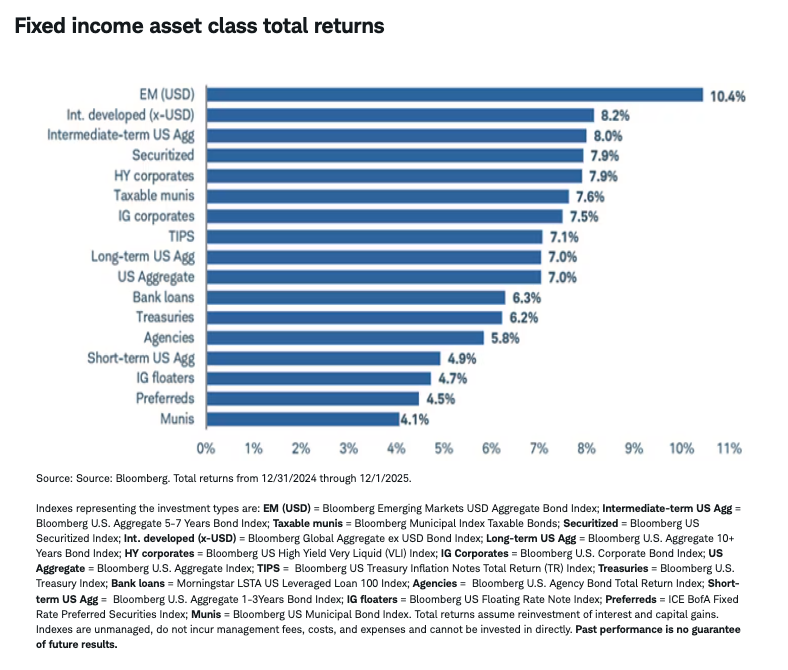
We expect 2026 to be another good year for fixed income investors. However, yields that are lower than where they were a year ago and less room for rate cuts by central banks likely will mean less-robust returns. Nonetheless, a bias toward easing by major central banks, positive real interest rates (yields adjusted for inflation) and steepening yield curves create a good backdrop for bond investors.
Federal Reserve outlook
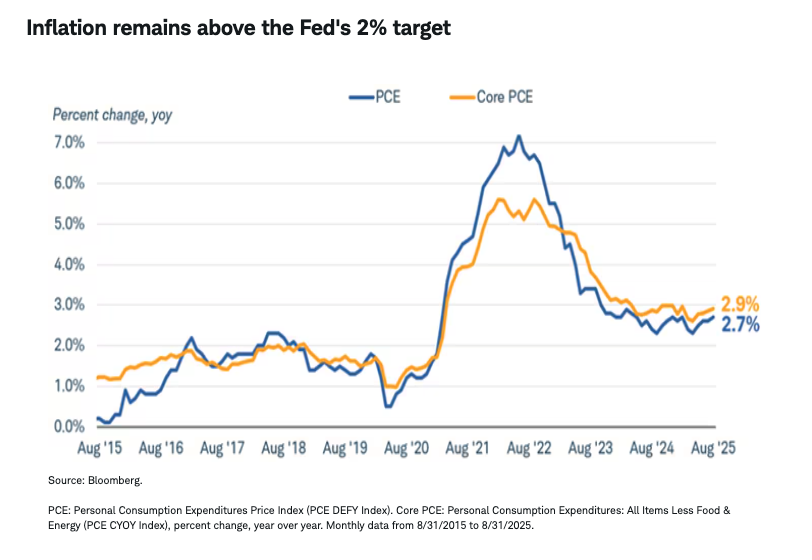
We expect the Federal Reserve to lower the target range for the federal funds rate to somewhere in the 3.0% to 3.5% range over the next year, implying two to three additional 25-basis-point rate cuts. A weakening trend in the labor market is the major factor driving the Fed to ease policy given that inflation has held above the Fed's 2% target for more than four years. The sharp slowdown in hiring over the past few months and rise in the unemployment rate are raising concerns among some Fed members about a slowdown in the labor market.
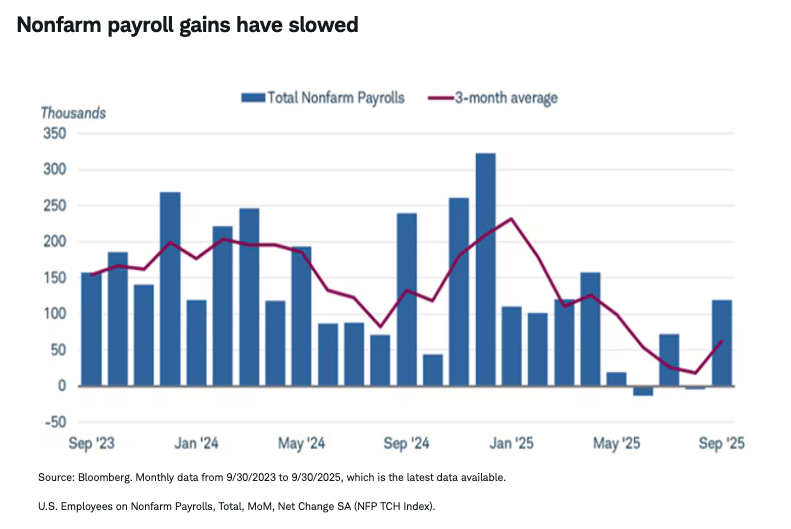
However, while hiring has slowed, the current unemployment rate, at 4.4% as of September 2025, is historically low and close to what has generally been considered full employment by many economists. Moreover, average hourly earnings were rising at a 3.8% year-over-year pace in September, according to the Bureau of Labor Statistics, which is higher than the pre-pandemic average.
Overall, the economy looks likely to remain resilient and inflation should persist near 3%, which is significantly above the Fed's 2% target. As we look into 2026, gross domestic product (GDP) growth is likely to remain supported by fiscal stimulus coming from the One Big Beautiful Bill Act, as well as by modestly easier financial conditions courtesy of recent Fed rate cuts. The tax cuts implemented by Congress tend to favor higher-income consumers and corporations, which should keep the economy growing at a rate slightly above the long-term trend of about 2% to 2.5%. Consequently, the Fed doesn't appear to have much room to lower the policy rate. We believe 3% is likely to be a floor.
Yield curve is likely to steepen
We expect the trend toward yield-curve steepening will continue. As the Fed lowers short-term interest rates in response to labor market weakness, intermediate- and long-term rates are likely to lag behind on inflation and supply concerns. Cutting rates with inflation above target risks stoking future inflation. That appears to be a risk that the Fed is willing to run given that inflation expectations are reasonably well contained.
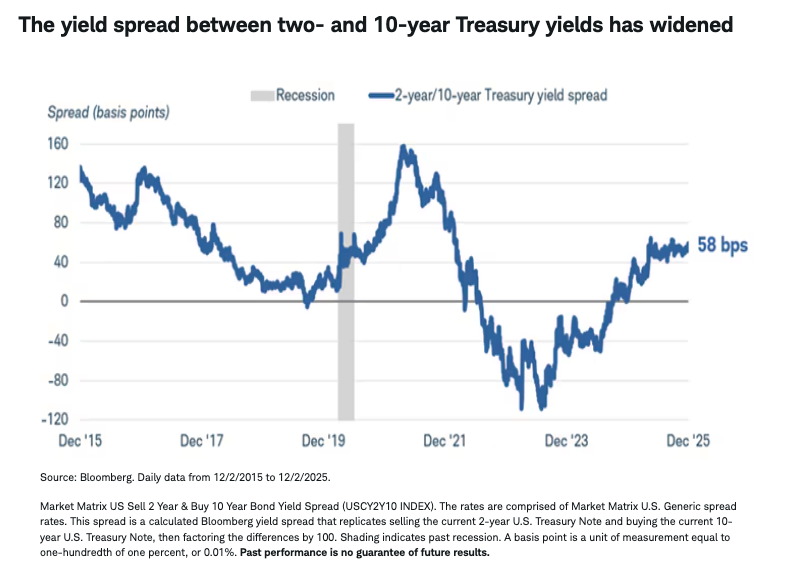
However, the prospect of an increasing supply of bonds is likely to keep long-term yields elevated despite Fed policy easing. Large and rising fiscal deficits and increasing issuance of U.S. Treasuries—as well as debt issuance in other major economies—means that more and more buyers need to step up to help fund government spending. Ten-year Treasury yields may not fall much below the 3.75% level even as the Fed cuts interest rates and there is a risk that they will move back up toward 4.5% at times.
Meanwhile, corporate and municipal bond issuance likely will increase due to ongoing investment in technology and tax incentives. Taken together, the rising supply of bonds will likely mean yields remain high to attract more buyers.
Risks abound
There are plenty of risks to our outlook. In the labor market, recent softness in hiring could prove temporary or simply reflect a shrinking pool of labor. If wage growth remains healthy, the Fed might hold off on more rate cuts as the labor market would be in balance. Inflation could surprise on the upside, eroding the case for rate cuts and potentially sending yields higher.
Downside surprises for yields include the potential for a recession to unfold due to a reduction in investor risk appetite that sends the stock market lower and reduces investment and economic growth.
Policy uncertainty is likely to continue. The unknowns around tariffs and trade policy appear to be largely behind us, but there is the potential for another standoff over budget issues as Congress remains deeply divided.
Finally, major developed market countries are facing increasing challenges due to high and rising deficits. Investor confidence in managing budgets is being tested. In some countries it has led to investor pushback and higher bond yields. Loss of confidence could manifest itself in bouts of volatility.
For investors: Base case and potential opportunities
Our "base-case" (the most likely or expected outcome) outlook calls for two to three rate cuts by the Fed in 2026 amid steady economic growth and ongoing inflation pressures. The outcome is likely to mean a steepening yield curve. In that environment, we favor keeping average duration in portfolios in the intermediate term (about five to 10 years) and staying in predominantly investment-grade-credit-quality bonds. The Bloomberg U.S. Aggregate Bond Index is a close proxy for that type of portfolio, with a yield-to-worst (the lowest return an investor can receive on a callable bond barring default) of 4.3% and average duration of six years as of December 2, 2025.
For investors in passive strategies, returns are likely to be in line with starting yields or slightly higher in our scenario. A shallower path of rate cuts or budget concerns could pull bond yields up and prices down, however, potentially resulting in lower returns.
In actively managed portfolios, a steep yield curve can allow for additional return through "carry" and "roll" strategies. Carry refers to the ability to sell a short-term lower-yielding bond and invest in intermediate- to long-term bonds, earning the difference in yield. Roll refers to managing a portfolio's duration to add capital gains. Carry strategies carry the risk of greater volatility if borrowing costs increase, while roll strategies can underperform if the slope of the yield curve doesn't evolve as expected. Investing in any sort of active strategy poses the risk that performance can differ—up or down—from the underlying benchmarks depending on the decisions of the portfolio managers.
For investors concerned about inflation, we believe TIPS are attractive. They have real (that is, inflation-adjusted) interest rates of 1.25% to 2.0%. That means investors will receive that yield plus the inflation rate over the life of the bond if held to maturity.
Municipal bonds can make sense for investors in higher tax brackets. They currently offer a good balance of attractive yields after considering taxes and stable credit quality. Many municipalities have built up their savings and are generally well positioned in case of an economic slowdown.
Overall, we expect 2026 to be another good year of returns for bond investors, but the range of potential outcomes remains wide. We continue to favor a middle-ground strategy—up in quality and intermediate-term average duration—that may help mitigate some of the risks while allowing for potentially attractive returns.
1 Source: Bloomberg U.S. Aggregate Bond Index, as of 12/31/2024.
A message from Advisor Perspectives and VettaFi: Discover something new! Click here to register for our upcoming webcasts.
This material is intended for general informational and educational purposes only. This should not be considered an individualized recommendation or personalized investment advice. The securities and investment strategies mentioned are not suitable for everyone. Each investor needs to review an investment strategy for his or her own particular situation before making any investment decisions.
Individual situations will vary. Not intended to be reflective of results you can expect to achieve.
All expressions of opinion are subject to change without notice in reaction to shifting market, economic or political conditions. Data contained herein from third party providers is obtained from what are considered reliable sources. However, its accuracy, completeness or reliability cannot be guaranteed.
Past performance is no guarantee of future results.
Investing involves risk, including loss of principal.
Fixed income securities are subject to increased loss of principal during periods of rising interest rates. Fixed income investments are subject to various other risks including changes in credit quality, market valuations, liquidity, prepayments, early redemption, corporate events, tax ramifications, and other factors. Lower rated securities are subject to greater credit risk, default risk, and liquidity risk.
Diversification and asset allocation strategies do not ensure a profit and do not protect against losses in declining markets.
International investments involve additional risks, which include differences in financial accounting standards, currency fluctuations, geopolitical risk, foreign taxes and regulations, and the potential for illiquid markets. Investing in emerging markets may accentuate this risk.
Preferred securities are a type of hybrid investment that share characteristics of both stock and bonds. They are often callable, meaning the issuing company may redeem the security at a certain price after a certain date. Such call features, and the timing of a call, may affect the security’s yield. Preferred securities generally have lower credit ratings and a lower claim to assets than the issuer's individual bonds. Like bonds, prices of preferred securities tend to move inversely with interest rates, so their prices may fall during periods of rising interest rates. Investment value will fluctuate, and preferred securities, when sold before maturity, may be worth more or less than original cost. Preferred securities are subject to various other risks including changes in interest rates and credit quality, default risks, market valuations, liquidity, prepayments, early redemption, deferral risk, corporate events, tax ramifications, and other factors.
Tax-exempt bonds are not necessarily a suitable investment for all persons. Information related to a security's tax-exempt status (federal and in-state) is obtained from third parties, and Charles Schwab & Co., Inc. does not guarantee its accuracy. Tax-exempt income may be subject to the Alternative Minimum Tax (AMT). Capital appreciation from bond funds and discounted bonds may be subject to state or local taxes. Capital gains are not exempt from federal income tax.
Treasury Inflation Protected Securities (TIPS) are inflation-linked securities issued by the US Government whose principal value is adjusted periodically in accordance with the rise and fall in the inflation rate. Thus, the dividend amount payable is also impacted by variations in the inflation rate, as it is based upon the principal value of the bond. It may fluctuate up or down. Repayment at maturity is guaranteed by the US Government and may be adjusted for inflation to become the greater of the original face amount at issuance or that face amount plus an adjustment for inflation. Treasury Inflation-Protected Securities are guaranteed by the US Government, but inflation-protected bond funds do not provide such a guarantee.
This information is not a specific recommendation, individualized tax, legal, or investment advice. Tax laws are subject to change, either prospectively or retroactively. Where specific advice is necessary or appropriate, individuals should contact their own professional tax and investment advisors or other professionals (CPA, Financial Planner, Investment Manager, Estate Attorney) to help answer questions about specific situations or needs prior to taking any action based upon this information.
Bank loans typically have below investment-grade credit ratings and may be subject to more credit risk, including the risk of nonpayment of principal or interest. Most bank loans have floating coupon rates that are tied to short-term reference rates like the Secured Overnight Financing Rate (SOFR), so substantial increases in interest rates may make it more difficult for issuers to service their debt and cause an increase in loan defaults. A rise in short-term references rates typically result in higher income payments for investors, however. Bank loans are typically secured by collateral posted by the issuer, or guarantees of its affiliates, the value of which may decline and be insufficient to cover repayment of the loan. Many loans are relatively illiquid or are subject to restrictions on resales, have delayed settlement periods, and may be difficult to value. Bank loans are also subject to maturity extension risk and prepayment risk.
Forecasts contained herein are for illustrative purposes only, may be based upon proprietary research and are developed through analysis of historical public data.
The policy analysis provided by the Charles Schwab & Co., Inc., does not constitute and should not be interpreted as an endorsement of any political party.
Indexes are unmanaged, do not incur management fees, costs, and expenses and cannot be invested in directly. For more information on indexes, please see schwab.com/indexdefinitions.
The Schwab Center for Financial Research is a division of Charles Schwab & Co., Inc.
Source: Bloomberg Index Services Limited. BLOOMBERG® is a trademark and service mark of Bloomberg Finance L.P. and its affiliates (collectively "Bloomberg"). Bloomberg or Bloomberg's licensors own all proprietary rights in the Bloomberg Indices. Neither Bloomberg nor Bloomberg's licensors approves or endorses this material, or guarantees the accuracy or completeness of any information herein, or makes any warranty, express or implied, as to the results to be obtained therefrom and, to the maximum extent allowed by law, neither shall have any liability or responsibility for injury or damages arising in connection therewith.
Membership required
Membership is now required to use this feature. To learn more:
View Membership BenefitsSponsored Content
Upcoming Virtual Events View All












