Value is Outperforming Growth of Late…
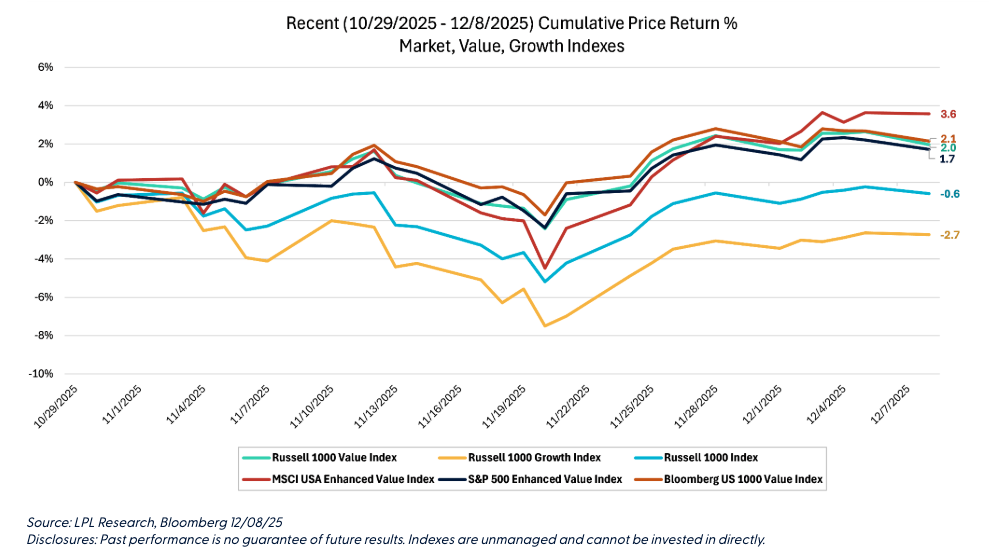
Value seems to be having a moment — over the last six weeks (from 10/29/2025 to 12/08/2025) value style and value factor indexes (a subtle but real nuance, as we will show) are outperforming representative broad market (represented by the Russell 1000 Index) and a representative growth style index (represented by the Russell 1000 Growth Index).

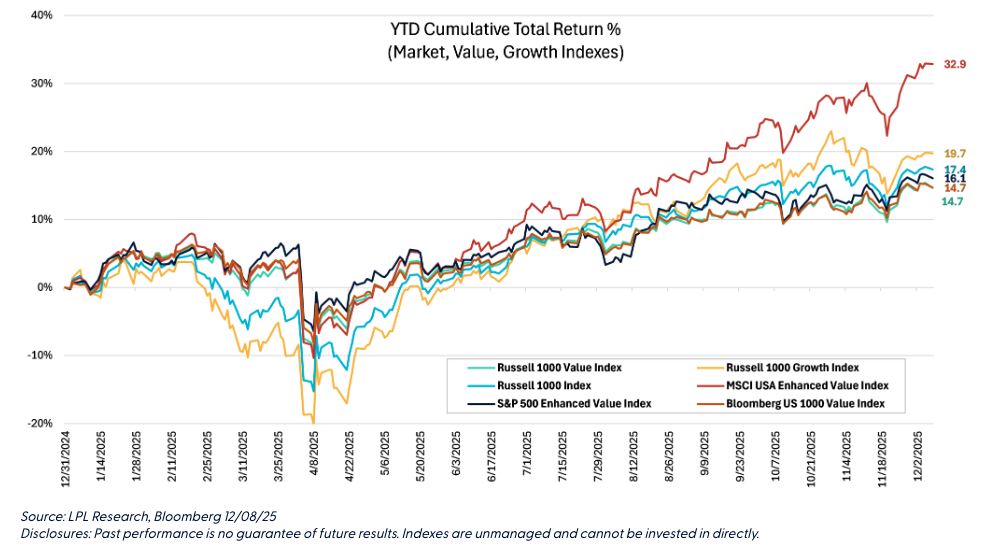
… But Growth is Still Winning the Year.
Year to date, however, the opposite is true for the value indexes studied except for one, the MSCI USA Enhanced Value Index, which is outperforming peers, representative broad market, and growth style indexes. Outside of the MSCI USA Enhanced Value Index, the other value indexes are underperforming growth by approximately 5-6% and underperforming the broad market by approximately 3-4%.
The MSCI USA Enhanced Value Index is the only index in our study that is “sector neutralized,” meaning that even though its goal is to create an index of stocks with low relative valuations (e.g., “value” stocks), it does so intra-sector. The outcome is that this index keeps sector weights approximately aligned with the market. This nuance explains most of the year-to-date outperformance, as many of the “cheap” stocks in the Information Technology sector are semiconductors, which have been beneficiaries of the artificial intelligence (AI) capital expenditure cycle. We highlight just how different this makes it look versus peers, but first we analyze the factor composition of various value indexes.
Pop the Hood. Value Strategies Have Plenty of Factor Variation.
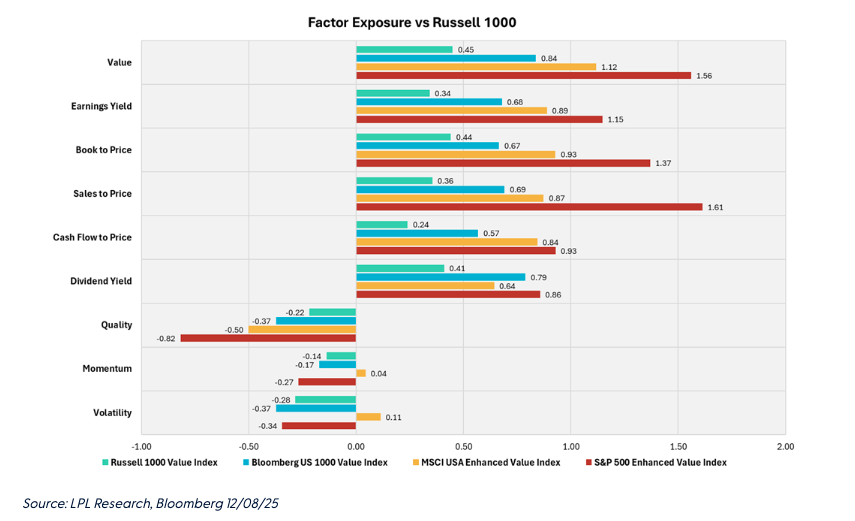
The factor exposures of the different value indexes show significant variation across various measures of value. It is interesting to us that the Russell 1000 Value, the perceived standard bearer and style benchmark pioneer/originator, has the least exposure to value factors, relative to others and compared to the market benchmark Russell 1000 Index. All value indexes in our study show negative exposure to the quality factor composite, and all but the MSCI USA Enhanced Value Index have negative exposure to the momentum factor composite and the volatility factor composite.
Quick thought on value strategies/indexes and their exposure to the momentum factor; momentum does not always bias towards growth. Momentum strategies do not incorporate style exposures or fundamentals generally — they seek exposure to stocks whose prices are going up relative to peers. Therefore, value strategies and indexes will have positive momentum exposures at times — specifically during and briefly after periods of sustained value outperformance. While this has not been a common feature of markets recently, we last saw sustained value outperformance in 2022, during the post-pandemic rate hiking cycle.
Value Strategies Typically Favor Similar Sectors.
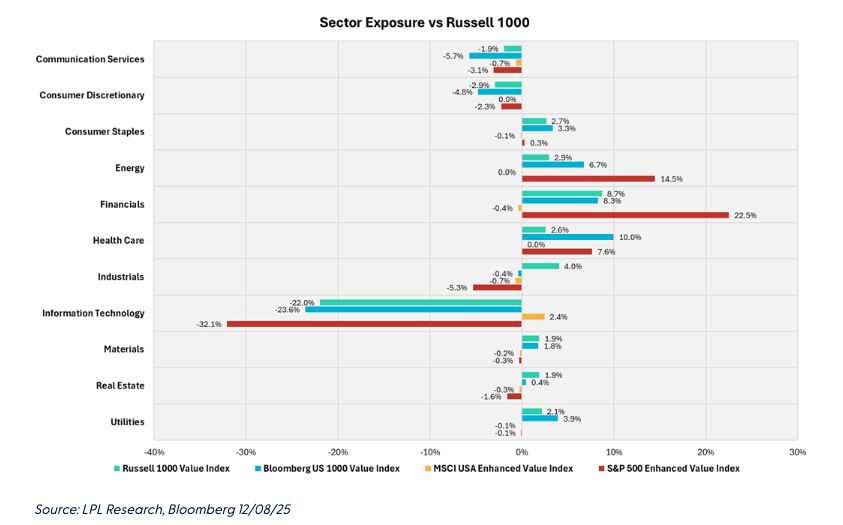
Like differences in factor exposures, our studied value indexes also have wide variation in sector exposures. The outlier here, as briefly discussed, is the outperforming MSCI USA Enhanced Value Index, which given its sector neutralized approach has market-like weightings to market sectors.
Digging into two sectors (Industrials and Health Care) that show relative dispersion between the two traditional value “style” indexes in our study (Russell 1000 Value and Bloomberg 1000 Value), we can assess how different indexes measure value and approach sector allocation in the index construction process.
-
Industrials: The sector has seen certain sub-industries experience strong price performance as they’ve been beneficiaries of data center / AI capital spending, while others without an AI story or with a residential / durable goods focus have languished. The sector is hardly cheap on earnings or cash flow, at least relative to the sector’s own history. However, the Russell 1000 Value index is relatively overweight the sector. This is likely due to Russell’s value methodology focusing solely on book value measures of value. Meanwhile, Bloomberg’s Value style index is slightly underweight, which makes sense as its value methodology uses earnings, cash flow, and book value-based measures of value. The S&P 500 Enhanced Value Index is the most underweight Industrials, which aligns with expectations given Industrials’ relative valuation is trading at premium to the market, and the index uses a non-sector neutral approach that looks to hold the cheapest 100 stocks in the S&P 500.
-
Health Care: On the other hand, the Health Care sector is a near mirror image to Industrials, with Russell 1000 Value only slightly overweight (+2.6%), while the Bloomberg 1000 Value (+10%) and S&P 500 Enhanced Value (+7.6%) are at much larger overweight levels to the sector. The S&P 500 Enhanced Value health care weighting aligns with expectations as the sector’s valuation spread to the market (measured by taking the S&P 500 price-to-earnings ratio and subtracting the health care sector’s price-to-earnings ratio) is approximately 2x its historical level. Said another way — health care is twice as cheap as it typically is relative to the market.
Value Indexes and Strategies Can Look Different – Though Typically Trend at the Same Time
Our study began when looking into value’s recent outperformance, and it uncovered many of the nuances that hide beneath the surface of the many value strategies in the marketplace. We are not suggesting any one strategy over any other and note that the index that has outperformed this year was the laggard in most of the prior 4 years. Our goal was simply to highlight how different value “style” and value “factor” indexes can be constructed, and how those differences can impact performance over the short and medium term.
The LPL Research Strategic and Tactical Asset Allocation Committee (STAAC) recommends a neutral weighting to value within large cap stocks and an underweight allocation within small caps. An increase in market volatility along with weakness in the AI theme may be needed for value stocks to outperform in 2026. Valuations are relatively attractive, and the One Big Beautiful Bill Act (OBBBA) may drive helpful capital investment and aid cyclicals. The Committee is waiting for more evidence of a sustained rotation to value before considering an overweight allocation, as discussed in our just-released Outlook 2026: The Policy Engine.
A message from Advisor Perspectives and VettaFi: Discover something new! Click here to register for our upcoming webcasts.
Value investments can perform differently from the market as a whole. They can remain undervalued by the market for long periods of time.
The Russell 1000 Growth Index measures the performance of those Russell 1000 companies with higher price-to-book ratios and higher forecasted growth values. Russell 1000 Value Index measures the performance of those Russell 1000 companies with lower price-to-book ratios and lower forecasted growth values.
The S&P 500 Enhanced Value is designed to measure the performance of the top 100 stocks in the S&P 500® with attractive valuations based on "value scores" calculated using three fundamental measures: book value-to-price, earnings-to-price, and sales-to-price.
The MSCI USA Enhanced Value Index captures large and mid-cap representation across the US equity markets exhibiting overall value style characteristics. The index is designed to represent the performance of securities that exhibit higher value characteristics relative to their peers within the corresponding GICS® sector.
Bloomberg US 1000 Value Total Return Index provides exposure to companies with superior value factor scores based on their earnings yield, valuation, dividend yield, and growth.
The Russell 1000 Index consists of the 1,000 largest securities in the Russell 3000 Index, which represents approximately 90% of the total market capitalization of the Russell 3000 Index. It is a large-cap, market-oriented index and is highly correlated with the S&P 500 Index.
Important Disclosures
This material is for general information only and is not intended to provide specific advice or recommendations for any individual. There is no assurance that the views or strategies discussed are suitable for all investors. To determine which investment(s) may be appropriate for you, please consult your financial professional prior to investing.
Investing involves risks including possible loss of principal. No investment strategy or risk management technique can guarantee return or eliminate risk.
Indexes are unmanaged and cannot be invested into directly. Index performance is not indicative of the performance of any investment and does not reflect fees, expenses, or sales charges. All performance referenced is historical and is no guarantee of future results.
This material was prepared by LPL Financial, LLC. All information is believed to be from reliable sources; however LPL Financial makes no representation as to its completeness or accuracy.
Unless otherwise stated LPL Financial and the third party persons and firms mentioned are not affiliates of each other and make no representation with respect to each other. Any company names noted herein are for educational purposes only and not an indication of trading intent or a solicitation of their products or services.
Asset Class Disclosures –
International investing involves special risks such as currency fluctuation and political instability and may not be suitable for all investors. These risks are often heightened for investments in emerging markets.
Bonds are subject to market and interest rate risk if sold prior to maturity.
Municipal bonds are subject and market and interest rate risk and potentially capital gains tax if sold prior to maturity. Interest income may be subject to the alternative minimum tax. Municipal bonds are federally tax-free but other state and local taxes may apply.
Preferred stock dividends are paid at the discretion of the issuing company. Preferred stocks are subject to interest rate and credit risk. They may be subject to a call features.
Alternative investments may not be suitable for all investors and involve special risks such as leveraging the investment, potential adverse market forces, regulatory changes and potentially illiquidity. The strategies employed in the management of alternative investments may accelerate the velocity of potential losses.
Mortgage backed securities are subject to credit, default, prepayment, extension, market and interest rate risk.
High yield/junk bonds (grade BB or below) are below investment grade securities, and are subject to higher interest rate, credit, and liquidity risks than those graded BBB and above. They generally should be part of a diversified portfolio for sophisticated investors.
Precious metal investing involves greater fluctuation and potential for losses.
The fast price swings of commodities will result in significant volatility in an investor's holdings.
This research material has been prepared by LPL Financial LLC.
Not Insured by FDIC/NCUA or Any Other Government Agency | Not Bank/Credit Union Deposits or Obligations | Not Bank/Credit Union Guaranteed | May Lose Value
For Public Use – Tracking: #835925
Read more commentaries by LPL Financial