Key takeaways
- Venezuela's Nicolas Maduro was captured by U.S. forces over the weekend, prompting many questions around what the intentions are for the country's potential path back to democracy, its vast oil reserves, and standing with other major global producers.
- Early market action from Sunday evening into Monday morning suggests global investors are not perturbed by the events in Venezuela: the dollar moved higher, equity futures climbed, and oil prices declined.
- A review of markets in 2025 underscores that it was a year defined by massive churn and volatility—evidenced by the S&P 500's double-digit percentage for the year, paired with a near-bear market and only two of the seven "Magnificent 7" members outperforming the index.
Happy New Year, everyone. This week's missive is a review of the year just past, but for obvious reasons, we want to open it with some thoughts from the full team at Schwab Center for Financial Research (SCFR) on the events that have unfolded in Venezuela.
What happened?
Over the weekend, President Trump announced that Venezuelan President Nicolas Maduro was captured during a large-scale U.S. strike that began on January 2, and he and his wife were subsequently transported to New York. Maduro faces drug trafficking and narco-terrorism charges, with Trump saying the United States would run the country (at least temporarily) and take control of Venezuela's oil reserves.
Our 2026 outlook had a theme of instability (in contrast to the simpler "uncertainty" descriptor). The events that have unfolded in Venezuela certainly fit that bill. International reactions are sharply divided, and the story is still unfolding. We would caution investors not to make knee-jerk portfolio decisions. Based on history (more on that below), we believe the equity market should look through the headlines; but could key off moves in the bond market.
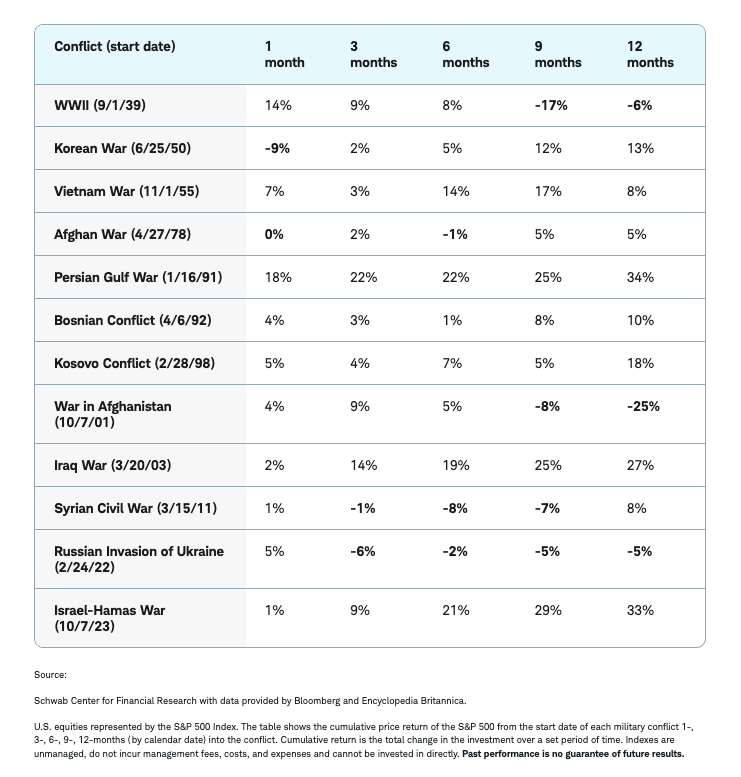
Our initial take is that, in isolation, what has unfolded in Venezuela is a more significant geopolitical event than a market event. Typically, geopolitical risk is transmitted to global markets via oil prices. We have trotted out the table below in the past showing how these types of events have rarely had a lasting impact on the stock market. Worth noting is that in the most severe case in 2001, the U.S. was already in the middle of a severe bear market, caused by the bursting of the internet bubble.
Military conflicts have rarely caused large negative returns for U.S. equities
Cumulative returns of the S&P 500 since the conflict's start date

One important reminder is that Venezuela is a small global player and oil producer. Around 50 years ago, it represented roughly 1% of global gross domestic product (GDP), a share that has now fallen to barely 0.1%. Global oil production rings in at about 80 million barrels per day (bpd), with inventory building at a rate of 2 million bpd, as estimated by the Energy Information Agency (EIA). Venezuela produces only 800 thousand bpd (of "heavy crude")—ranking it 17th among global producers. Contrast that with U.S. production of more than 13 million bpd, and Saudi Arabian and Russian production of about 10 million bpd. All else equal, a major disruption in Venezuelan oil production (in either direction) will have less of an impact on oil prices. Questions abound as to the impact on China's energy needs, but their needs can largely be met by Russian, Iranian, and open-market oil supplies.
Venezuela does have the highest proven oil reserves at about 303 billion barrels, according to the Organization of the Petroleum Exporting Countries (OPEC)—surpassing those of Iran, Canada, Iraq, Kuwait, and Saudi Arabia. However, there is limited current infrastructure in place to harvest those reserves due to decades of underinvestment in response to sanctions. Early reports indicate that Venezuela's infrastructure was apparently not damaged during the strike.
It's premature to lay out a long-term assessment of the oil market given that it will take quite a bit of time (and money) to significantly boost production there. Will the prospect alone of a supply increase down the road lower oil prices today? Or, is there a risk that production declines in the short run given the instability?
Market(s) outlook
Despite a somewhat hazy outlook, we think the oil market could respond with prices falling sharply in the "back months" (late-2026 and into 2027) on anticipation of lower prices due to increased supply. "Front months" (nearer term) likely won't be affected as much since it will take time (possibly years) for Venezuelan heavy crude to hit the market. Also, a drop in near-term prices could be limited by OPEC's decision to cut supplies until it can convene an emergency meeting. This uncertainty could weigh on the direction of long-term Treasury yields which, in turn, could translate to equity market volatility.
We expect limited impact on the near-term decision-making by the Federal Reserve given the fluidity of the situation. However, if it looks like oil prices will trend lower and thus lead to lower gasoline prices, it would help ease the ongoing inflation problem and possibly set the stage for easier monetary policy. All else equal, this would be positive for the stock market.
This is not a risk-free assessment, however. We may witness some risk-off market behavior if investors believe the United States is considering taking any similar action in other countries—not to mention the fact that the U.S. has struggled with regime change in the past (in Iraq, Afghanistan, and Libya, for example). So far, signals from markets on Sunday evening into Monday morning were broadly positive with S&P 500 futures up by 0.2%, the dollar climbing by 0.3%, Treasury yields down marginally, and Brent crude oil down by nearly 2% at its worst point (before paring its losses later in the morning on Monday, January 5) —all to suggest this is not (yet?) a major market event.
Meanwhile, back at the 2025 review ranch
Before we were crudely interrupted, this week's missive was to be a year-in-review, so let's get to that. We'll keep this brief as the visuals do most of the "talking."
Churn was the name of the game
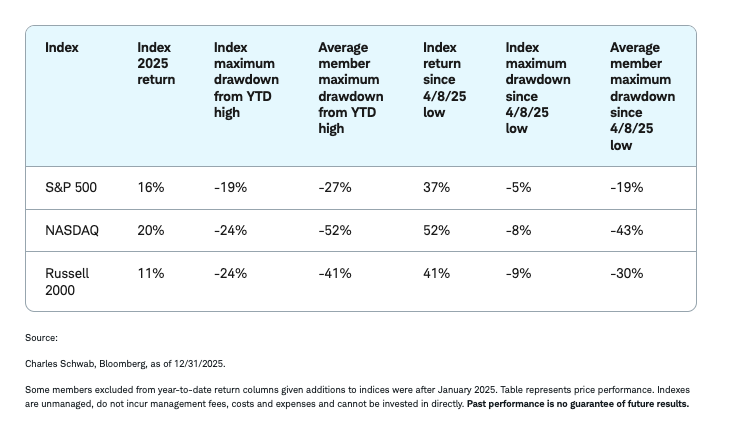
Below is a summary of returns for the major U.S. equity indexes. 2025 brought stellar performance at the index level—especially for the NASDAQ and S&P 500—but there was notable drama throughout the year as well as under the surface of the cap-weighted index returns. As a reminder, the S&P 500 suffered a near-bear market between mid-February and early-April; followed by a largely-gangbusters rally since the April 8 closing low. However, as shown in the last column, even during that run, the average member within each of the indexes experienced some drama.
Major indexes and maximum drawdowns
From Mag7 to Lag5
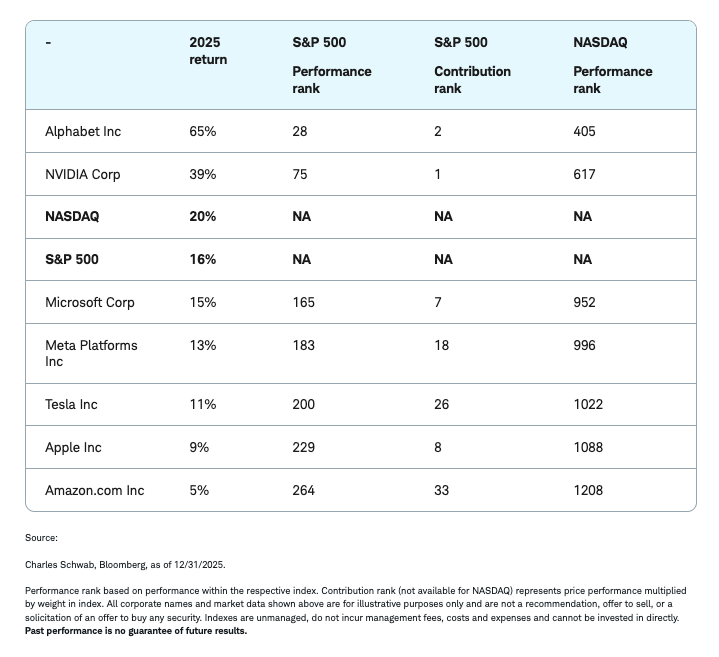
The obsession over the Magnificent 7 (Mag7) group of stocks faded throughout the year, with only two—Alphabet and NVIDIA—outperforming the S&P 500. There's a very important message imbedded in the table below. Although NVIDIA remains the top-ranked contributor to S&P 500 index returns, it was ranked only 75th in terms of price performance. In other words, it's not the best price performer … it's the top contributor by virtue of the multiplier of its huge cap size. Keep that in mind when thinking about concentration in your own portfolios. There are more fish in the market sea than just a small handful of stocks.
2025 Magnificent 7 Performance
Sector swings
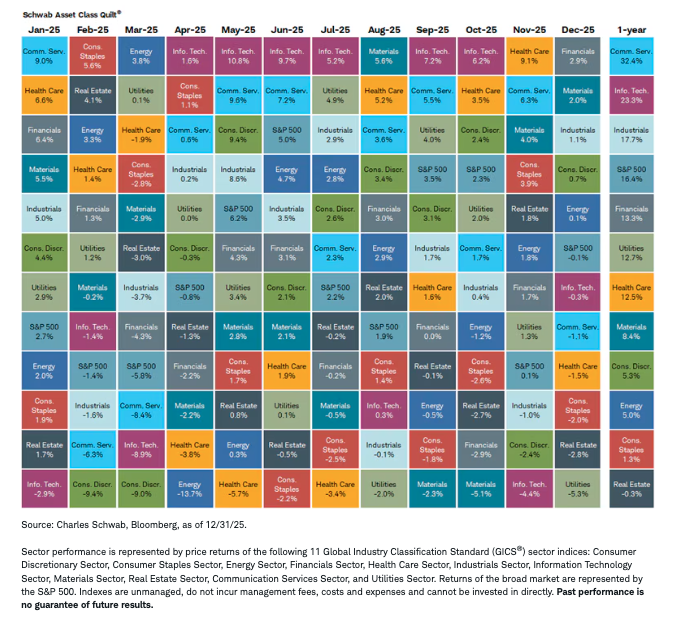
It was a wild ride for sectors last year, notwithstanding the top ranking for perennial crowd sector favorites, Communication Services and Technology. Those two underscore an important aspect of returns vs. rank. Despite Tech being the top performer in six out of 12 months, and Communication Services only being the top performer in one month, it was the latter that bested the former by nearly 10 percentage points by the end of the year. For our current sector ratings, see this report.
Mega-cap dominance in 2025
Go global!
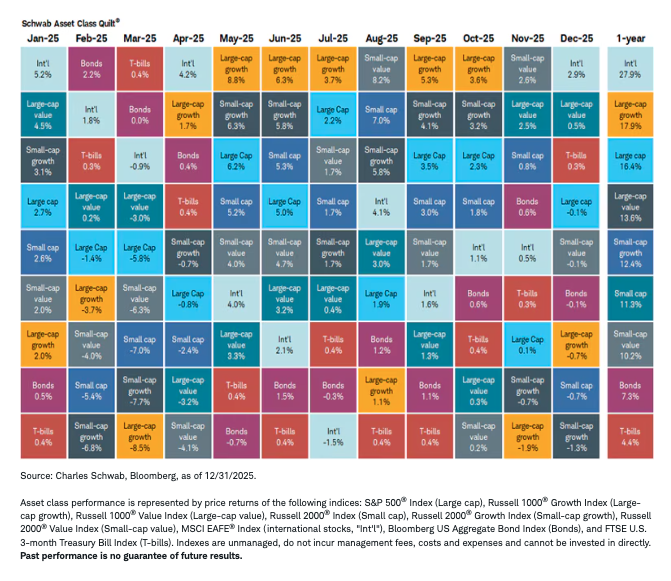
We have espoused the merits of international equity diversification for the past few years. For a while there, doing so often required saying "we're sorry." After last year, perhaps we can now say "you're welcome." As shown below in the asset class quilt, international stocks outperformed all other major asset classes last year; with small-cap value bringing up the rear in the equity universe. Yet again, you can see how rank vs. return comes into play: Large-cap growth was the top performer in five out of 12 months, while international was the top performer for a total of three months, yet it was the latter that outperformed by 10 percentage points. For Schwab's international outlook, see here.
International pulls ahead in 2025
In sum
While the situation in Venezuela remains in flux and will undoubtedly continue to shift moving forward, global markets have thus far taken the news in stride. From here, much will depend on the degree of the U.S.' involvement in Venezuela's future path, how larger oil producers outside of both countries will respond, and whether the energy market has a tantrum. In keeping with the aforementioned table showing the stock market's response to major geopolitical events, we continue to think diversification and staying invested are the best safeguards against any unsettling developments. That is in keeping with the relatively strong base from which markets are starting this year, given broad-based gains in 2025 and relatively healthy breadth.
This material is intended for general informational and educational purposes only. This should not be considered an individualized recommendation or personalized investment advice. The investment strategies mentioned are not suitable for everyone. Each investor needs to review an investment strategy for his or her own particular situation before making any investment decisions.
All expressions of opinion are subject to change without notice in reaction to shifting market, economic or political conditions. Data contained herein from third party providers is obtained from what are considered reliable sources. However, its accuracy, completeness or reliability cannot be guaranteed.
A message from Advisor Perspectives and VettaFi: Discover something new! Click here to register for our upcoming webcasts.
Past performance is no guarantee of future results.
Investing involves risk, including loss of principal.
The policy analysis provided by the Charles Schwab & Co., Inc., does not constitute and should not be interpreted as an endorsement of any political party.
Performance may be affected by risks associated with non-diversification, including investments in specific countries or sectors. Additional risks may also include, but are not limited to, investments in foreign securities, especially emerging markets, real estate investment trusts (REITs), fixed income, municipal securities including state specific municipal securities, small capitalization securities and commodities. Each individual investor should consider these risks carefully before investing in a particular security or strategy.
All corporate names and market data shown are for illustrative purposes only and are not a recommendation, offer to sell, or a solicitation of an offer to buy any security.
Diversification and asset allocation strategies do not ensure a profit and do not protect against losses in declining markets.
Currency trading is speculative, very volatile and not suitable for all investors.
Futures and futures options trading involves substantial risk and is not suitable for all investors. Please read the Risk Disclosure Statement for Futures and Options prior to trading futures products.
Schwab does not recommend the use of technical analysis as a sole means of investment research.
Source: Bloomberg Index Services Limited. BLOOMBERG® is a trademark and service mark of Bloomberg Finance L.P. and its affiliates (collectively "Bloomberg"). Bloomberg or Bloomberg's licensors own all proprietary rights in the Bloomberg Indices. Neither Bloomberg nor Bloomberg's licensors approves or endorses this material or guarantees the accuracy or completeness of any information herein, or makes any warranty, express or implied, as to the results to be obtained therefrom and, to the maximum extent allowed by law, neither shall have any liability or responsibility for injury or damages arising in connection therewith.
Indexes are unmanaged, do not incur management fees, costs, and expenses, and cannot be invested in directly. For additional information, please see schwab.com/indexdefinitions.
Investment and Insurance Products Are: Not FDIC Insured • Not Insured by Any Federal Government Agency • Not a Deposit or Other Obligation of, or Guaranteed by, the Bank or any of its Affiliates • Subject to Investment Risks, Including Possible Loss of Principal Amount Invested
The Charles Schwab Corporation provides a full range of brokerage, banking and financial advisory services through its operating subsidiaries. Its broker-dealer subsidiary, Charles Schwab & Co. Inc. (Member SIPC), and its affiliates offer investment services and products. Its banking subsidiary, Charles Schwab Bank, SSB (member FDIC and an Equal Housing Lender), provides deposit and lending services and products.
This site is designed for U.S. residents. Non-U.S. residents are subject to country-specific restrictions. Learn more about our services for non-U.S. residents, Charles Schwab Hong Kong clients, Charles Schwab U.K. clients.
© 2025 Charles Schwab & Co., Inc. All rights reserved. Member SIPC. Unauthorized access is prohibited. Usage will be monitored.
© Charles Schwab
Read more commentaries by Charles Schwab