Additional content provided by Kent Cullinane, CFA, Sr. Analyst, Research.
Warren Buffett’s reign as Chief Executive Officer (CEO) of Berkshire Hathaway came to a close on the last day of 2025. Buffett will be succeeded by Greg Abel, previously Vice Chairman of Non-Insurance Operations at Berkshire. Buffett stepped down after more than half a century, 60 years to be exact, at the helm of one of the largest investment conglomerates in the world.
In 1965, Buffett took over a struggling Berkshire, once a textile company, and transformed it into one of the most successful holding companies’ globally, strategically investing in companies with simple business models trading at intrinsic discounts. Buffett’s investment approach is widely recognized as value investing, one of the two primary investment philosophies — alongside growth investing — commonly employed by investment managers and advisors today. Below, we dive into some of Warren Buffett’s “rules of investing” that made him one of the most successful investors of all time.
Buy Wonderful Companies at Fair Prices
At the heart of value investing is the concept of buying an undervalued stock that appears to be mispriced by the market and holding that stock until its intrinsic value is reached. Investors determine intrinsic value in several ways, including analyzing a company’s financial statements, evaluating management, and identifying competitive advantages.
Buffett famously said, “It’s far better to buy a wonderful company at a fair price than a fair company at a wonderful price.” This highlights that not all companies that trade at a low or ‘discounted’ stock price are quality businesses. A “quality” business, according to Buffett, is one that has a strong competitive advantage, consistent profitability, competent management, and can prosper in a variety of market environments.
Invest in Businesses That Are Easy To Understand
Buffett strongly believes in investing in businesses that are easy to understand or are within an investor's circle of competence. This means investing in companies and/or industries that the investor can evaluate without relying too much on speculation. These business models may be predictable and simple, allowing the investor to deploy capital with confidence. Additionally, companies with more understandable business models may be easier to forecast into the future and discount back to the present to determine proper intrinsic value.
Along with having a “simple” business model, there are other “quality” characteristics — does the business and/or industry have a competitive advantage? Is the company in good financial condition? Is the management team capable? Can this company weather a variety of market environments?
Invest for the Long-Haul
Buffett is an advocate of long-term investing, and he’s notably mentioned his investment time horizon is indefinite. He believes patience and discipline can lead to substantial gains. When making an investment, Buffett believes that businesses with strong fundamentals and durable competitive advantages have the ability to remain profitable over a long-time horizon and throughout various market cycles. Letting investments compound over time, instead of trying to capitalize on short-term price movements, has led Berkshire to outperform the benchmark S&P 500 Index handily since its inception. While this performance is remarkable, there is no guarantee that this can be replicated.
In the latest Berkshire Hathaway Investor Letter (which has become one of the most-read periodic newsletters in the investing community), published at 2024 year-end, you’ll find Berkshire’s share price performance compared to the S&P 500, showing Berkshire has realized an annualized gain of 19.9% vs. the S&P’s 10.4% since Berkshire’s inception in 1965. The cumulative gain over this nearly 60-year period is 5,502,284%, compared to the S&P’s 39,054%. In other words, if you had invested $10,000 into Berkshire stock at its inception, it would be worth over $550 million at the end of 2024. Berkshire’s share price gained an additional 10.9% in 2025, bringing the total value of that initial $10,000 investment up to nearly $610 million.
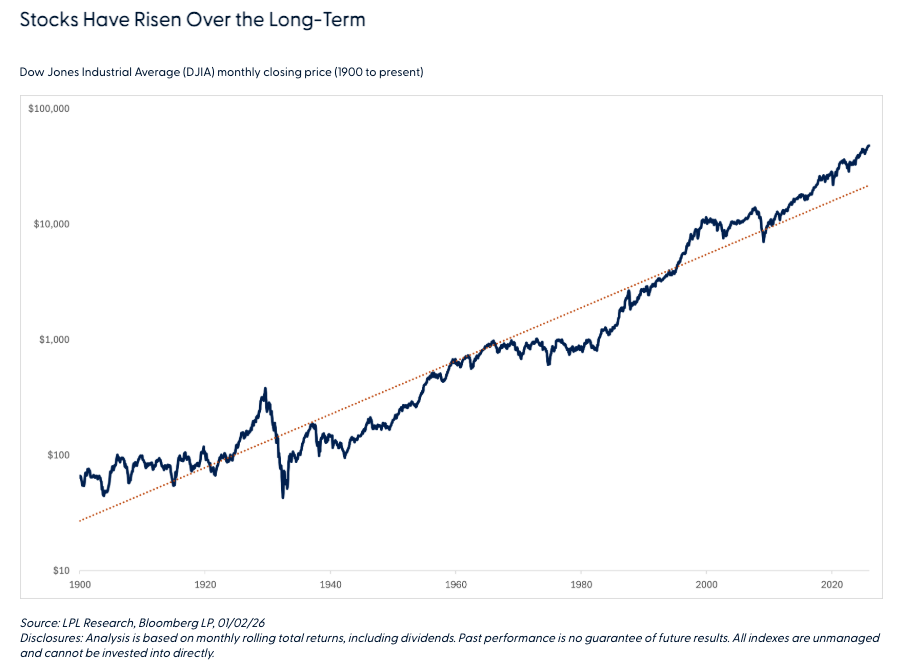
LPL Research believes in the power of long-term investing and compounding as well, with the “Stocks May Rise Over the Long-Term” chart highlighting the importance of staying invested for the long haul.

Be Fearful When Others Are Greedy, and Greedy When Others Are Fearful
Keeping a level head amid market fluctuations is another cornerstone of Buffett’s investing framework. When markets rise and investors become overly optimistic, stock valuations typically become hard to justify. Chasing overpriced stocks may lead to sub-optimal returns, so it's wise to assess investments critically to determine if their true value justifies the price. Conversely, during market downturns, fear-driven selling may push fundamentally strong businesses below their intrinsic value, creating potential opportunities for savvy investors.
Buffett utilized this contrarian investing method during the 2008 financial crisis, when he made substantial investments in battered down financial services companies Goldman Sachs (GS) and Bank of America (BAC). Buffett invested in the preferred stock of both companies, initiating $5 billion in positions in each. Both companies rebounded meaningfully when markets expanded after the crisis, leading to a $3.7 billion gain in GS and an over $20 billion gain in BAC, though past performance does not guarantee future results.
Never Lose Money
While investing always comes with risk, Buffett emphasizes that preserving capital is just as important as finding profitable investment opportunities. Thorough due diligence is a must prior to making an investment — understanding the business model, analyzing financial statements, evaluating the management team, and assessing the economic moat are some of the “quality” characteristics mentioned above.
Conclusion
LPL Research's investment approach aligns well with Warren Buffett’s methodology, particularly in its emphasis on data-driven decision-making, disciplined analysis, and rational investing. Buffett has long advocated for avoiding emotional decisions in markets, recognizing that investor psychology often leads to mispricing and inefficiencies — similar to LPL’s view on reflexivity and market disequilibrium.
Buffett prefers investing in businesses with predictable earnings, durable competitive advantages, and clear value propositions, minimizing speculation and uncertainty. LPL Research employs a similarly structured approach by leveraging systematic data analysis and extensive experience to generate investment recommendations, ensuring that decisions are grounded in reason and evidence rather than short-term sentiment.
Additionally, Buffett’s philosophy embraces the idea that markets are not always efficient, and that these inefficiencies create opportunities for patient, disciplined investors. LPL's multi-faceted decision-making approach reflects this principle, aiming to exploit market mispricing through a combination of quantitative research and seasoned judgment. By eliminating guesswork and emphasizing confidence in rational investing, LPL mirrors Buffett’s long-held belief that successful investing is as much about staying calm and logical as it is about finding strong businesses or assets.
Jeff Buchbinder, CFA, provides the top-down view of the stock market for LPL Financial Research. He has over 25 years of experience in equities.
Important Disclosures
This material is for general information only and is not intended to provide specific advice or recommendations for any individual. There is no assurance that the views or strategies discussed are suitable for all investors. To determine which investment(s) may be appropriate for you, please consult your financial professional prior to investing.
Investing involves risks including possible loss of principal. No investment strategy or risk management technique can guarantee return or eliminate risk.
Indexes are unmanaged and cannot be invested into directly. Index performance is not indicative of the performance of any investment and does not reflect fees, expenses, or sales charges. All performance referenced is historical and is no guarantee of future results.
This material was prepared by LPL Financial, LLC. All information is believed to be from reliable sources; however LPL Financial makes no representation as to its completeness or accuracy.
Unless otherwise stated LPL Financial and the third party persons and firms mentioned are not affiliates of each other and make no representation with respect to each other. Any company names noted herein are for educational purposes only and not an indication of trading intent or a solicitation of their products or services.
Asset Class Disclosures –
International investing involves special risks such as currency fluctuation and political instability and may not be suitable for all investors. These risks are often heightened for investments in emerging markets.
Bonds are subject to market and interest rate risk if sold prior to maturity.
Municipal bonds are subject and market and interest rate risk and potentially capital gains tax if sold prior to maturity. Interest income may be subject to the alternative minimum tax. Municipal bonds are federally tax-free but other state and local taxes may apply.
Preferred stock dividends are paid at the discretion of the issuing company. Preferred stocks are subject to interest rate and credit risk. They may be subject to a call features.
Alternative investments may not be suitable for all investors and involve special risks such as leveraging the investment, potential adverse market forces, regulatory changes and potentially illiquidity. The strategies employed in the management of alternative investments may accelerate the velocity of potential losses.
Mortgage backed securities are subject to credit, default, prepayment, extension, market and interest rate risk.
High yield/junk bonds (grade BB or below) are below investment grade securities, and are subject to higher interest rate, credit, and liquidity risks than those graded BBB and above. They generally should be part of a diversified portfolio for sophisticated investors.
Precious metal investing involves greater fluctuation and potential for losses.
The fast price swings of commodities will result in significant volatility in an investor's holdings.
This research material has been prepared by LPL Financial LLC.
Not Insured by FDIC/NCUA or Any Other Government Agency | Not Bank/Credit Union Deposits or Obligations | Not Bank/Credit Union Guaranteed | May Lose Value
For Public Use – Tracking: #847839
A message from Advisor Perspectives and VettaFi: Discover something new! Click here to register for our upcoming webcasts.
Read more commentaries by LPL Financial