Geopolitical Risk is Evolving: What You Should Know
Membership required
Membership is now required to use this feature. To learn more:
View Membership BenefitsKey Takeaways:
- Geopolitical shocks such as armed conflicts historically have tended to create short-term volatility but not long-lasting impacts on markets.
- The nature of geopolitical risk may be evolving. Global interconnectedness appears to be weakening, a shift in international relations that could lead to lasting implications like economic disruption and market volatility.
- Defense contractors outside the U.S. could experience increased opportunities. Additionally, the potential for U.S. dollar weakness could increase returns in international stocks.
Geopolitical shocks tend to have a short-term impact
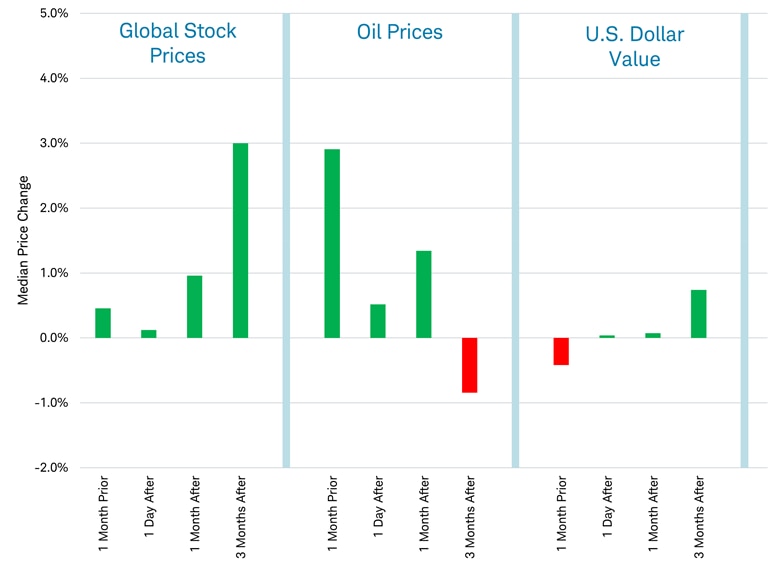
In the past, sudden shocks or the anticipation of geopolitical risk escalation such as armed conflicts have created short-term market volatility. Energy markets are particularly prone to these geopolitical shocks, particularly when there is potential for supply chain disruptions. Future disruptions to energy supply could drive prices higher in the short term, but the gains may not be sustainable without large-scale, extended interruptions in supply, because the global economy is in a state of excess supply of oil.
Historically there have been few geopolitical events that have caused prolonged market impacts. Generally, we observed prolonged negative market impacts occurred during economic recessions, which may have been exacerbated by geopolitical events. Our analysis of events dating back to 1970 indicates that geopolitical shocks have driven heightened short-term volatility but haven't typically had a long-lasting impact on equity markets, outside of recessions.
Short-term impact of geopolitical shocks
Geopolitical fracturing may have lasting investment implications
Today we may be entering a period where geopolitical pressures are causing a fracture in global interconnectedness. Changes in U.S. economic and geopolitical policy are motivating other countries to take steps to mitigate domestic impacts—by forging new trade alliances and increasing defense spending. In their formal speeches at the World Economic Forum in January, Canadian Prime Minister Mark Carney called this the "rupture in the world order" and German Chancellor Friedrich Merz said the "old world order is unraveling at a breathtaking pace."
Unlike the short-term market impacts of most geopolitical shocks, geopolitical fracturing could have more lasting implications. A move toward global trade protectionism could change investment risk profiles and result in companies building manufacturing capacity in higher-cost locations than in the past. Protectionism could also result in less cooperation across countries, leading to bottlenecks and resource hoarding in raw materials or other manufacturing inputs. The result: potentially higher inflation, more frequent supply shocks, and increased bouts of market volatility over the longer term.
Countries are looking to diversify away from the U.S.
Last year countries outside the U.S. stepped up the pace to diversify away from the U.S. by building trade alliances with each other. This trend seems to be continuing, evidenced by announcements already made in 2026.
The European Union (EU) and India resolved nearly two decades of deadlock, signing a historic free-trade agreement covering 2 billion people and a quarter of global gross domestic product (GDP), according to official government announcements. The EU also agreed to a free-trade deal with the South American trade bloc known as Mercosur after 30 years of negotiation. Other negotiations include Canada and South Korea signing an agreement to advance the Korean automotive footprint in Canada and cooperate on critical minerals and energy.
Countries may seek to strengthen economic ties with China to offset reduced dependence on the U.S. There has been movement on this front this year, as well. Canada and China entered a deal to cut tariffs in January. U.K. Prime Minister Keir Starmer visited China this year, the first official visit since 2018, suggesting a potential reset in economic relations between the two nations. South Korean President Lee Jae Myung met with Chinese President Xi Jinping in January to discuss a "full-scale restoration of Korea-China relations" according to South Korean newspaper Chosun, and German Chancellor Friedrich Merz is visiting China in February.
Other countries may still view China with some caution, as evidenced by continued tension in Australia despite its improved trade ties with China in recent years. As a result, a shift to a multipolar world seems to be underway, where multiple powers of varying strengths compete, including for access to critical resources.
Investment implications of geopolitical fracturing
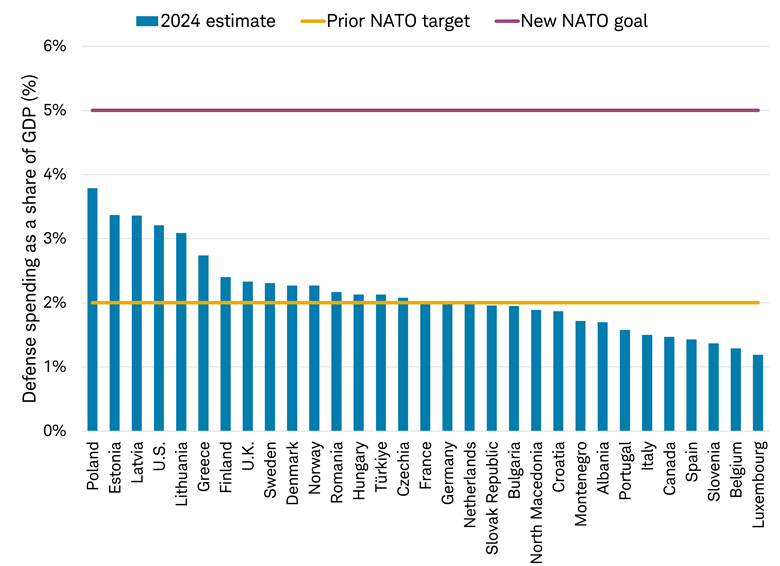
The investing implications of higher geopolitical tensions and the decreasing support by the U.S. to underwrite military security for Europe resulted in NATO agreeing to more than double its defense spending as a percentage of GDP in June 2025 from a prior target of 2% to 5% by 2035. Europe is likely to prioritize European defense contractors. Increased defense spending is happening globally; contractors in Japan and Korea also experiencing expanded opportunities from their governments. The risk is that not all countries have fiscal room to increase defense spending and expectations about the potential opportunities may be elevated.
Defense may be a growth industry


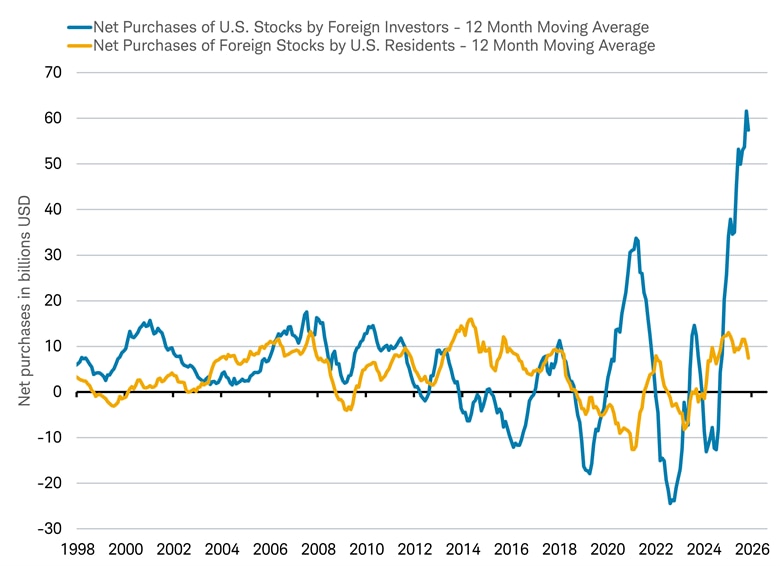
Geopolitical fracturing could also result in a shift away from dollar-denominated assets. In contrast to concerns last April about a "sell America" trade, where foreign investors outright sell U.S. stocks and bonds in substantial amounts, current data does not support this. Foreign investors still were net buyers of U.S. equities and U.S. bonds over the 12 months ending November 2025, according to Treasury International Capital (TIC) data from the U.S. Treasury. And the amount of money flowing into U.S. stocks from abroad is still far outpacing the amount U.S. investors are using to purchase non-U.S. stocks as seen in the chart below. Also, while U.S. investors have added to foreign stock investments, they also continue to invest in U.S. equities over the past year according to data from the Investment Company Institute (ICI).
More money flowing into U.S. investments than leaving

Rather, there could be a move to hedge exposure to the U.S. dollar. Over the past decade, a rising dollar meant that foreign investors in U.S. stocks and foreign exporters may not have felt a need to purchase protection by using financial instruments to manage the risks of exchange rate fluctuations. Over the past year, the decline in the U.S. dollar and outperformance of international stocks relative to U.S. stocks has resulted in investors, exporters and central banks diversifying their holdings.
The U.S. dollar could continue to weaken but that doesn't mean the situation is dire. The dollar remains the world's reserve currency, accounting for nearly 60% of global reserves through the third quarter of 2025, according to the International Monetary Fund's Currency Composition of Official Foreign Exchange Reserves (COFER). The dollar was used in one side of 89% of global currency transactions through April 2025, according to the Bank for International Settlements. It is important to remember that currencies are relative and there are not a lot of alternatives to the dollar—the U.S. Treasury market is the largest and most liquid in the world and the U.S. public equity market is ranked first by market capitalization.
The dollar is still elevated relative to its history
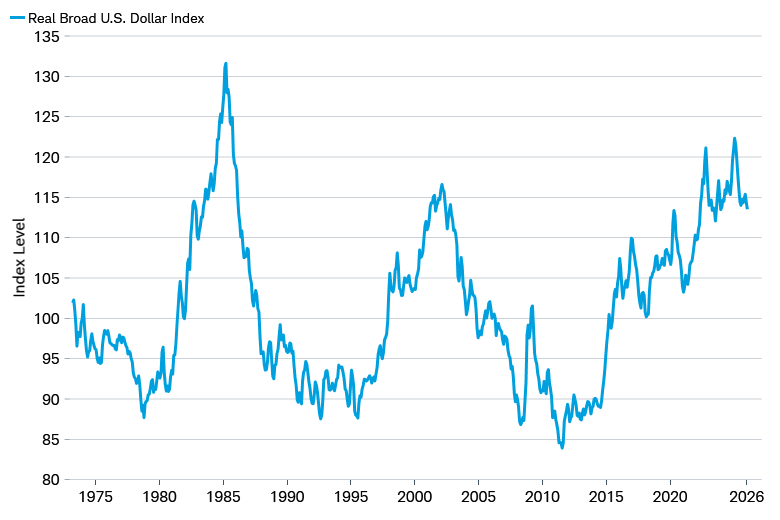

The mirror of a decline in the dollar is a stronger foreign currency. For example, the effect of a stronger euro relative to the U.S. dollar means returns earned overseas in euros exchange into more dollars, which boosts returns for U.S. investors. A weak dollar is part of our outlook for both developed market and emerging market international stocks.
In sum
Historically, geopolitical shocks have had only temporary impacts on financial markets. However, geopolitical pressure is causing a fracture in global interconnectedness and could have more lasting implications. Indeed, we've seen a rise in these pressures for several years now. Investors may need to think about adjusting the positioning of their portfolios to account for the evolution in geopolitical risk.
Heather O'Leary, Senior Manager, Equity Research and Strategy, contributed to this report.
A message from Advisor Perspectives and VettaFi: Discover something new! Click here to register for our upcoming webcasts.
This material is intended for general informational and educational purposes only. This should not be considered an individualized recommendation or personalized investment advice. The investment strategies mentioned may not be suitable for everyone. Each investor needs to review an investment strategy for his or her own particular situation before making any investment decisions.
All expressions of opinion are subject to change without notice in reaction to shifting market, economic or political conditions. Data contained herein from third party providers is obtained from what are considered reliable sources. However, its accuracy, completeness or reliability cannot be guaranteed.
Past performance is no guarantee of future results.
Investing involves risk, including loss of principal.
All names and market data shown are for illustrative purposes only and are not a recommendation, offer to sell, or a solicitation of an offer to buy any security.
International investments involve additional risks, which include differences in financial accounting standards, currency fluctuations, geopolitical risk, foreign taxes and regulations, and the potential for illiquid markets.
Investing in emerging markets may accentuate this risk.
Currencies are speculative, very volatile and not suitable for all investors.
Commodity-related products carry a high level of risk and are not suitable for all investors. Commodity-related products may be extremely volatile, may be illiquid, and can be significantly affected by underlying commodity prices, world events, import controls, worldwide competition, government regulations, and economic conditions.
Futures and futures options trading involves substantial risk and is not suitable for all investors. Please read the Risk Disclosure Statement for Futures and Options prior to trading futures product
Asset allocation strategies do not ensure a profit and do not protect against losses in declining markets.
The policy analysis provided by the Charles Schwab & Co., Inc., does not constitute and should not be interpreted as an endorsement of any political party.
Indexes are unmanaged, do not incur management fees, costs, and expenses and cannot be invested in directly. For more information on indexes, please see schwab.com/indexdefinitions.
The Schwab Center for Financial Research is a division of Charles Schwab & Co., Inc.
The Charles Schwab Corporation provides a full range of brokerage, banking and financial advisory services through its operating subsidiaries. Its broker-dealer subsidiary, Charles Schwab & Co. Inc. (Member SIPC), and its affiliates offer investment services and products. Its banking subsidiary, Charles Schwab Bank, SSB (member FDIC and an Equal Housing Lender), provides deposit and lending services and products.
This site is designed for U.S. residents. Non-U.S. residents are subject to country-specific restrictions. Learn more about our services for non-U.S. residents, Charles Schwab Hong Kong clients, Charles Schwab U.K. clients.
© 2026 Charles Schwab & Co., Inc. All rights reserved. Member SIPC. Unauthorized access is prohibited. Usage will be monitored.
Membership required
Membership is now required to use this feature. To learn more:
View Membership BenefitsSponsored Content
Upcoming Virtual Events View All












