The Super Bowl was viewed by a worldwide audience estimated at 200 million people, and over $4 billion was bet on the event globally. Aside from traditional wagers, books set odds on the length of the national anthem and the number of costumes that Bad Bunny wore during the halftime show.
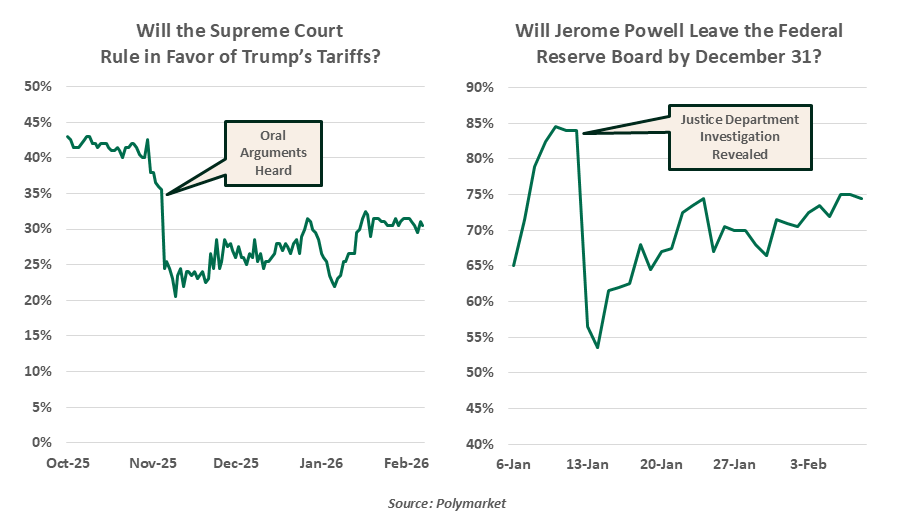
Unconventional wagering is not confined to sporting events. Prediction markets now cover a variety of questions, including many in the economic realm. Participants can bet on macroeconomic variables and monetary policy; the race for the chairmanship of the Federal Reserve recently attracted a lot of interest. Prediction platforms also cover election outcomes and geopolitical events such as the likelihood that China will invade Taiwan.

Prediction markets have their detractors (including my colleague, Ryan Boyle). They blur the line between gambling and recreation, and have been the targets of investigation (and prohibition, in some cases). Positions are placed and settled in cryptocurrencies, which adds to the novelty…and the anxiety. Neither we, nor Northern Trust, are endorsing participation on these platforms.
But prediction markets have earned the curiosity of economists. Amalgamating the impressions of groups of people almost always produces better outcomes than reliance on any individual. “Investors” in prediction markets act independently, based on the information each has available; this avoids groupthink. And while players need not make significant wagers (contract sizes are typically in increments of $1), there is enough of a financial incentive to sharpen focus.
The probabilities that emerge from trading can be used in a variety of contexts. They are updated interactively, while surveys take time to generate results. Evidence is limited, but there have been instances where prediction markets have outperformed traditional forecasting approaches.
To some, prediction markets are just a playground for speculation or a source of interesting headlines. But they may merit inclusion as part of a broad analytic toolkit.
Looking ahead, Polymarket shows Spain as a slight favorite over England and France for this summer’s World Cup. No odds are yet available on whether Bad Bunny will make an appearance at any of the matches.
Information is not intended to be and should not be construed as an offer, solicitation or recommendation with respect to any transaction and should not be treated as legal advice, investment advice or tax advice. Under no circumstances should you rely upon this information as a substitute for obtaining specific legal or tax advice from your own professional legal or tax advisors. Information is subject to change based on market or other conditions and is not intended to influence your investment decisions.
© 2025 Northern Trust Corporation. Head Office: 50 South La Salle Street, Chicago, Illinois 60603 U.S.A. Incorporated with limited liability in the U.S. Products and services provided by subsidiaries of Northern Trust Corporation may vary in different markets and are offered in accordance with local regulation. For legal and regulatory information about individual market offices, visit northerntrust.com/terms-and-conditions.
A message from Advisor Perspectives and VettaFi: Discover something new! Click here to register for our upcoming webcasts.
© Northern Trust
Read more commentaries by Northern Trust