The Treasury market is stuck between artificial intelligence (AI)-driven job displacement and the ongoing conflict in Iran. Earlier in the year, Treasury yields fell sharply as investors weighed the possibility that accelerated AI adoption could slow economic growth by displacing labor. As we noted in our recent Rate and Credit View: When AI Disruption Meets Leveraged Balance Sheets: Credit Market Risks in the Software Sector, AI is rapidly reshaping credit risks across the software as a service (SaaS) sector, shifting market attention from the demand benefits enjoyed by hyperscalers to the challenges facing highly leveraged enterprise software companies. Lower‑rated and private borrowers are most exposed as disruption compresses timelines for refinancing and heightens the risk of impaired business models. Tech sector spreads have already widened, and the software‑heavy leveraged loan market faces elevated concentration risk, weak credit quality, and an earlier‑than‑average maturity wall, with nearly half of software loans maturing within four years. Collateralized loan obligations (CLOs), major holders of these loans, are experiencing pressure from declining software loan prices, though structural protections continue to support senior tranches.
Investment‑grade issuers are more insulated thanks to stronger balance sheets and easier capital‑market access, but rising AI‑driven capital expenditures (Capex) needs and record issuance — especially from large tech firms — are adding supply pressure to spreads. Meanwhile, private credit represents the deepest structural risk because valuations adjust slowly, masking emerging stress. Software‑focused business development companies (BDCs) have begun experiencing heavy redemption requests, and private credit default rates are expected to rise. While those concerns remain part of the macro backdrop, they have recently been overshadowed by a sharp rise in inflation expectations — effectively erasing the earlier yield decline.
The Iran Conflict
Since the start of the Iran conflict, Treasury yields reversed sharply as investors began fearing the impact of rising energy prices on inflation. U.S. oil prices surged past $100 per barrel, and the 10-year yield pushed back above 4.15% on expectations of hotter inflation. The AI safety trade was overwhelmed by the inflation trade almost overnight and has since reversed most of the earlier fall in yields.
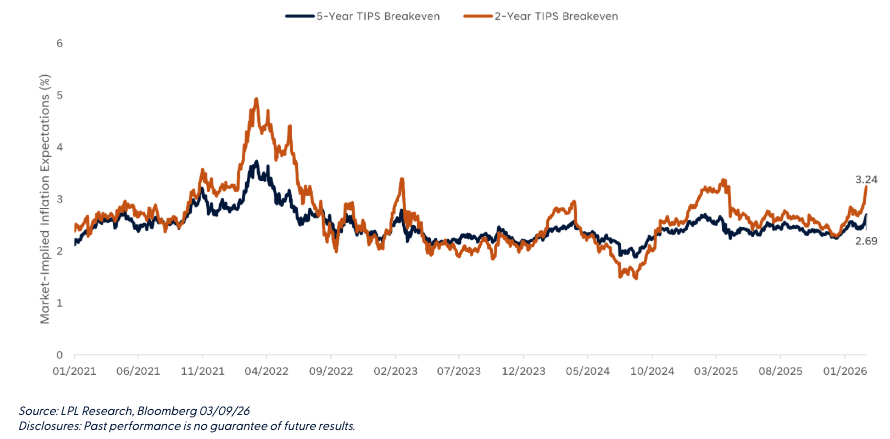
Geopolitical tensions in Iran continue to keep upward pressure on oil prices. The rise in energy costs is pushing near‑term inflation expectations higher, with the 2‑year Treasury Inflation-Protected Securities (TIPS) breakeven above 3% for the first time since last April and the 5-year TIPS breakeven rising sharply as well. TIPS breakevens, which represent the difference between nominal Treasury yields and TIPS yields, reflect the market’s estimate of inflation over the stated horizon. This growing inflation premium pushed the 2‑year Treasury yield to its highest level since last November as Federal Reserve (Fed) rate-cut expectations continue to get priced out.
Market-Implied Inflation Expectations Have Shifted Higher

Investor expectations for Fed rate cuts have shifted meaningfully over the past several weeks as well. Markets are now pricing in only a 50% probability of a second rate cut this year, a sharp decline from expectations of three cuts as recently as late February. The move reflects rising inflation concerns rather than any perceived improvement in economic growth.
The shift extends beyond U.S. borders: higher inflation expectations are pressuring global bond yields as well. Markets have now priced in a full rate hike from the European Central Bank in 2026 with over a 60% chance of a second hike later this year, further reflecting diminished global easing expectations.
Despite rising inflation fears, the Fed is sending signals that markets may be over‑adjusting. Fed Governor Chris Waller commented last Friday that if the current oil‑driven inflation shock proves temporary, the Fed would likely look through the recent rise in prices. That message suggests policy makers may not be as quick to scale back rate‑cut plans as the market currently implies — depending on the depth and duration of the Iran conflict, of course.
Bottom Line: Taken together, the combination of rising inflation expectations and ongoing AI‑related growth uncertainty argues for continued caution in interest‑rate exposure. For now, we remain neutral duration relative to benchmarks, waiting for more attractive entry points. We would look for the 10‑year Treasury yield to reach the 4.50–4.75% range before reconsidering duration positioning. And ongoing uncertainty around the ultimate impact of AI on corporate credit markets continues to support a broadly cautious stance.
A message from Advisor Perspectives and VettaFi: Discover something new! Click here to register for our upcoming webcasts.
Important Disclosures
This material is for general information only and is not intended to provide specific advice or recommendations for any individual. There is no assurance that the views or strategies discussed are suitable for all investors. To determine which investment(s) may be appropriate for you, please consult your financial professional prior to investing.
Investing involves risks including possible loss of principal. No investment strategy or risk management technique can guarantee return or eliminate risk.
Indexes are unmanaged and cannot be invested into directly. Index performance is not indicative of the performance of any investment and does not reflect fees, expenses, or sales charges. All performance referenced is historical and is no guarantee of future results.
This material was prepared by LPL Financial, LLC. All information is believed to be from reliable sources; however LPL Financial makes no representation as to its completeness or accuracy.
Unless otherwise stated LPL Financial and the third party persons and firms mentioned are not affiliates of each other and make no representation with respect to each other. Any company names noted herein are for educational purposes only and not an indication of trading intent or a solicitation of their products or services.
Asset Class Disclosures –
International investing involves special risks such as currency fluctuation and political instability and may not be suitable for all investors. These risks are often heightened for investments in emerging markets.
Bonds are subject to market and interest rate risk if sold prior to maturity.
Municipal bonds are subject and market and interest rate risk and potentially capital gains tax if sold prior to maturity. Interest income may be subject to the alternative minimum tax. Municipal bonds are federally tax-free but other state and local taxes may apply.
Preferred stock dividends are paid at the discretion of the issuing company. Preferred stocks are subject to interest rate and credit risk. They may be subject to a call features.
Alternative investments may not be suitable for all investors and involve special risks such as leveraging the investment, potential adverse market forces, regulatory changes and potentially illiquidity. The strategies employed in the management of alternative investments may accelerate the velocity of potential losses.
Mortgage backed securities are subject to credit, default, prepayment, extension, market and interest rate risk.
High yield/junk bonds (grade BB or below) are below investment grade securities, and are subject to higher interest rate, credit, and liquidity risks than those graded BBB and above. They generally should be part of a diversified portfolio for sophisticated investors.
Precious metal investing involves greater fluctuation and potential for losses.
The fast price swings of commodities will result in significant volatility in an investor's holdings.
This research material has been prepared by LPL Financial LLC.
Not Insured by FDIC/NCUA or Any Other Government Agency | Not Bank/Credit Union Deposits or Obligations | Not Bank/Credit Union Guaranteed | May Lose Value
For Public Use – Tracking: #1076420
Read more commentaries by LPL Financial