Dire Strait: War's Impact on Stocks
Membership required
Membership is now required to use this feature. To learn more:
View Membership BenefitsKey takeaways
- The central focus of the U.S./Israeli war with Iran is shifting from intensity to duration, especially as it pertains to how long traffic through the Strait of Hormuz (one of the most vital global oil chokepoints) remains disrupted.
- The United States stands in a better position relative to most developed countries when it comes to higher oil prices given its net oil exporter status and falling share of spending devoted to gasoline, but that doesn't mean a growth and/or inflation shock can't unfold if oil prices remain elevated.
- The war has both exacerbated the "smoke on the water, fire under the surface" nature of the U.S. equity market and led to a sharp reversal in U.S. equity underperformance relative to the rest of the world.
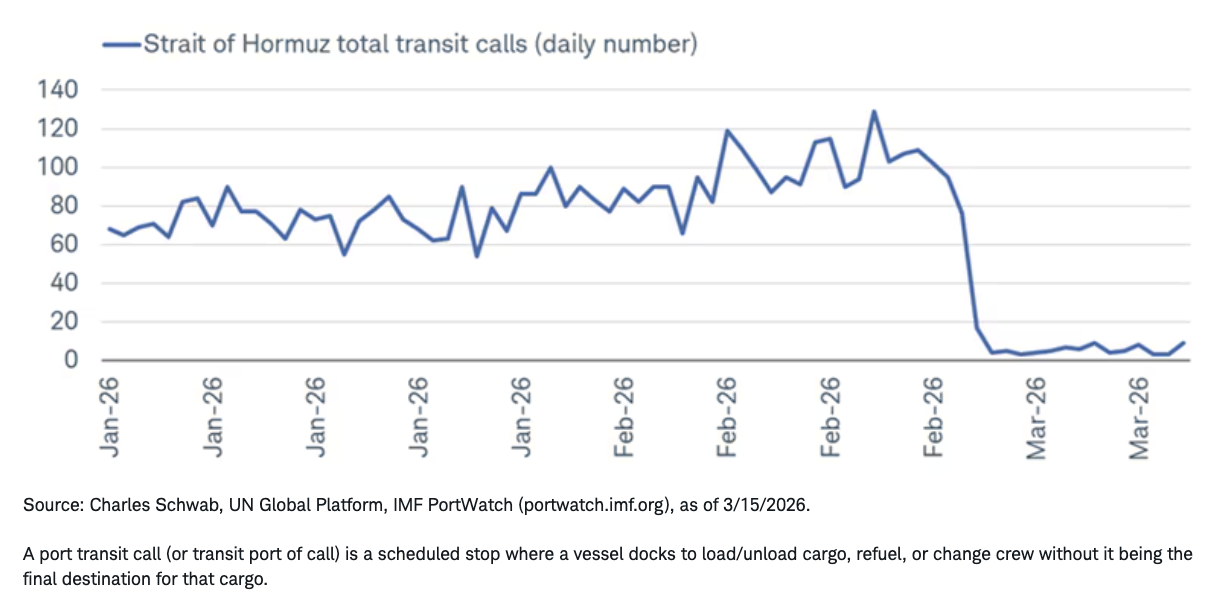
From an economic perspective, central to the war in Iran is the Strait of Hormuz—the only sea passage from the Persian Gulf to the open sea, which happens to transport about 20% of the world's oil. As you can see in the chart below, oil and liquefied natural gas (LNG ) flows through the strait have been disrupted to a significant degree, having nearly stalled out completely. While it is arguably semantics in saying that the Hormuz strait remains physically open to oil tankers, Iranian drone warfare and dangerous conditions have effectively meant safe passage by commercial and container ships is compromised, even when accompanied by the U.S. Navy and/or other global warships.
Strait to the bottom

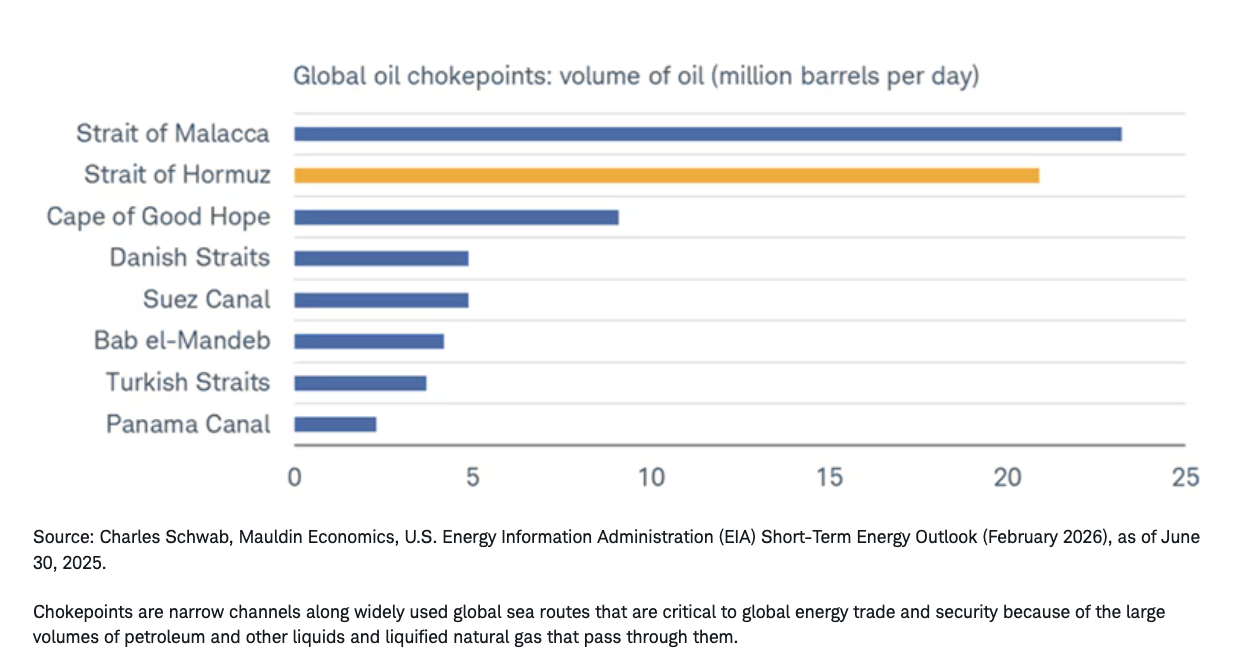
To put the strait's importance into perspective, consider the various global oil chokepoints in the chart below. These routes are critical to global oil and energy trade—not only because of their volume but also because of their security (or perceived security, at this point). The straits of Malacca and Hormuz dominate when it comes to volume, with the Cape of Good Hope a distant third. Per the Energy Information Administration (EIA), in the first half of 2025, total oil flows through the straits of Hormuz and Malacca averaged a combined 44.1 million barrels per day.
Strait to the source
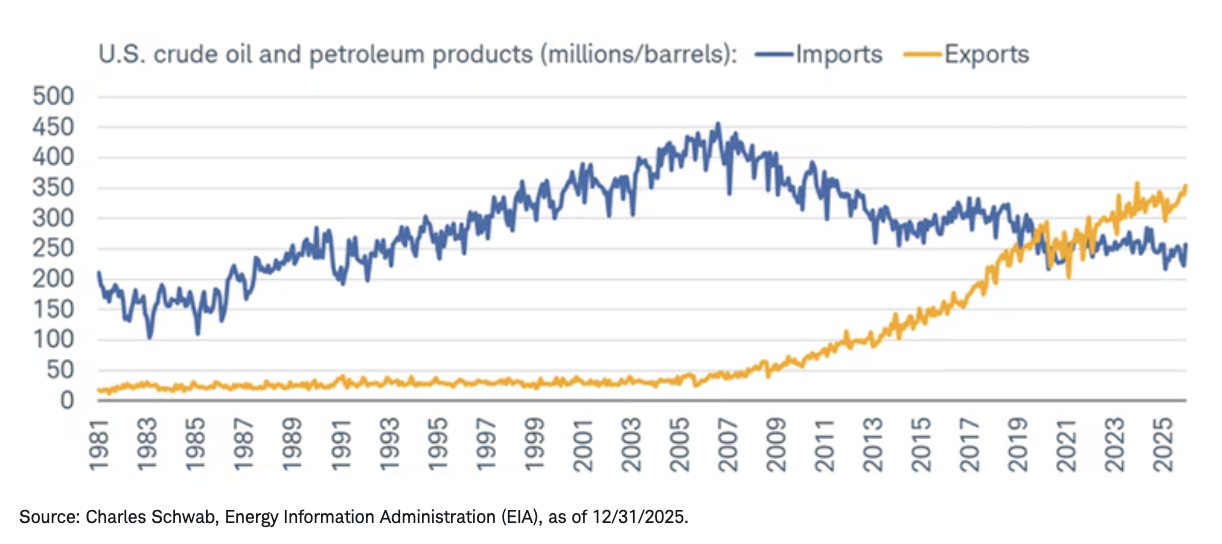
Worth pointing out is the EIA's estimate that 89% of the crude oil and condensate moving through the Strait of Hormuz went to Asian markets in the first half of 2025. China, India, Japan, and South Korea were and remain the dominant recipients, making the United States' oil supply situation not nearly as dire. For the past several years, the United States has been in the relatively advantageous position of being a net oil exporter, per the chart below.
Post-pandemic export advantage
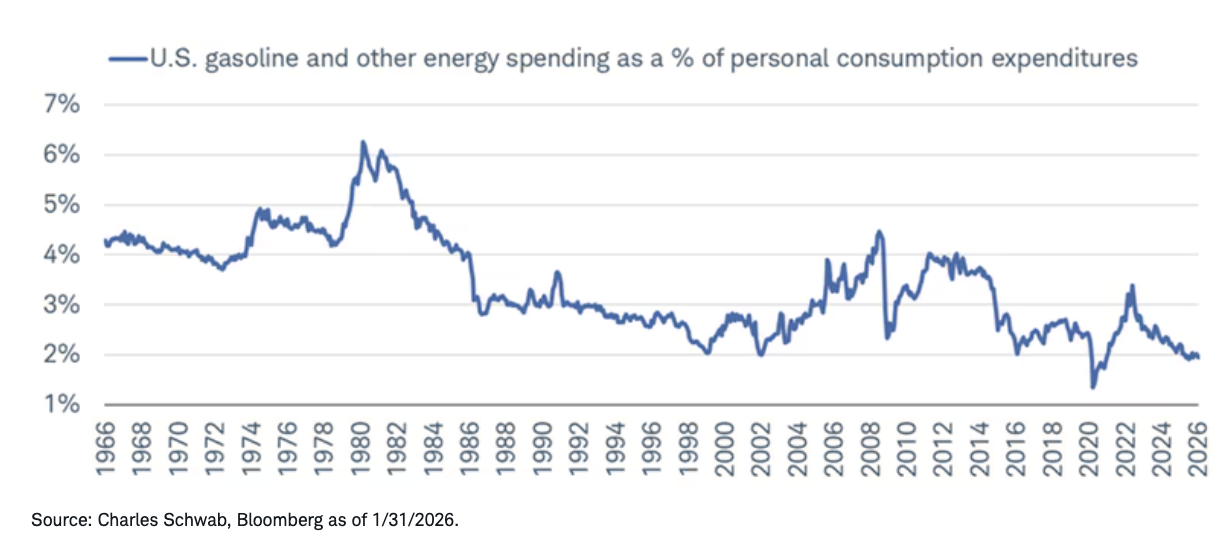
That is also reflected in the secular decline in U.S. consumers' share of spending that is devoted to gasoline and other energy products. As you can see in the chart below, the share has fallen from a peak of 6.3% in 1980 to 1.9% as of January 2026. This has helped dampen the blow of energy spikes in the modern era—or put another way, has raised the bar for how high oil prices have to go to meaningfully hit U.S. consumption.
Waning energy intensity
Still, though, this crisis is becoming less about the ultimate peak in oil prices and more about how long they remain elevated. The rub with the halting of most traffic through the Strait of Hormuz is that there is no viable alternative route, unlike other major chokepoints, as you can see in the following table.
Global oil chokepoints alternative routing options
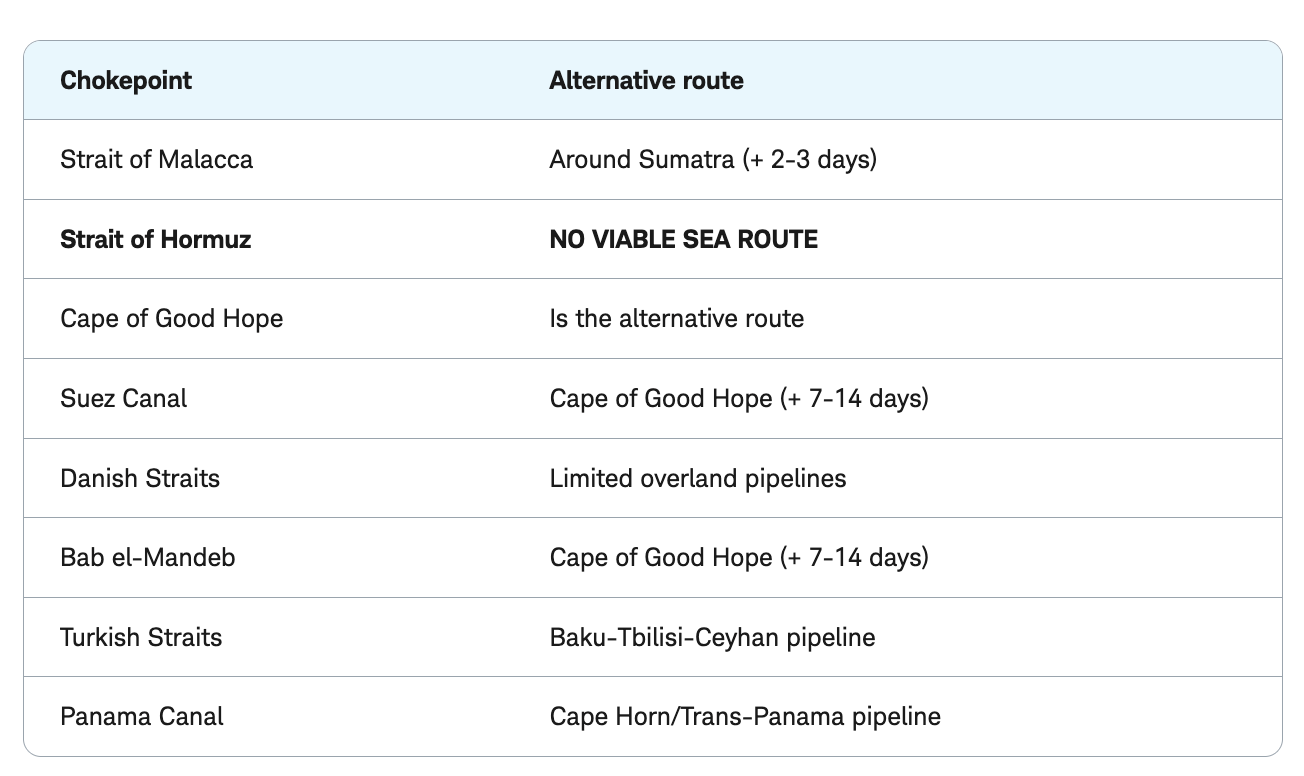

The longer that container traffic in the Strait of Hormuz is restricted, the higher the risk of oil prices staying higher for longer. Now that we are more than two weeks into the war, the intensity of the damage from missile strikes is becoming the less dominant issue, giving way to the duration of traffic disruption. Even if the United States were to come out and declare victory and/or a ceasefire imminently, questions would remain as to how long it would take for normal traffic in the Strait of Hormuz to resume. The resumption of both oil flow and production is now squarely in focus, and we would view a scenario in which oil prices take the elevator up and the escalator down as a negative development for the economy.
What say you, markets?
Brent crude has risen nearly 45% since the start of the war, exceeding the median 30% surge seen in previous large oil shocks, including the 1990 Gulf War, the 2003 Iraq War, and the 2022 Russian invasions of Ukraine. It's been a remarkable couple of weeks as it relates to the action in oil and the related impact on stocks, the U.S. dollar (USD), and Treasury yields.
Oil driving markets
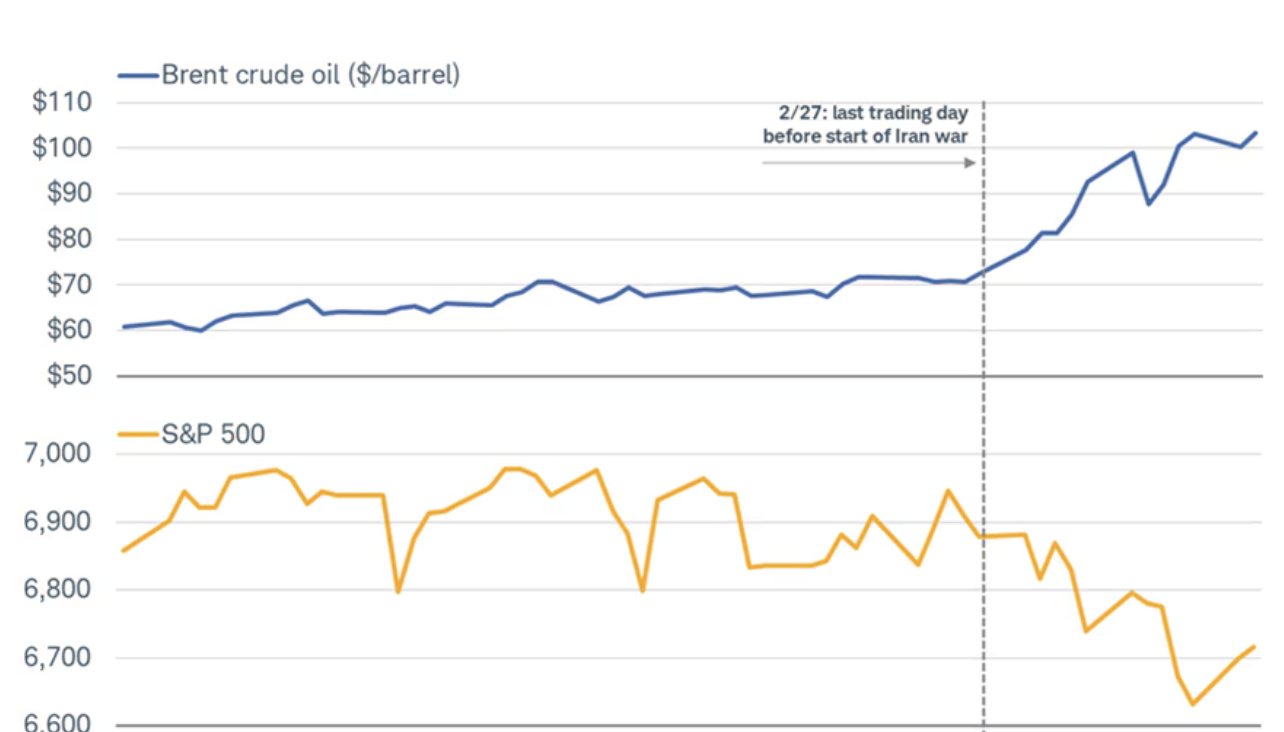
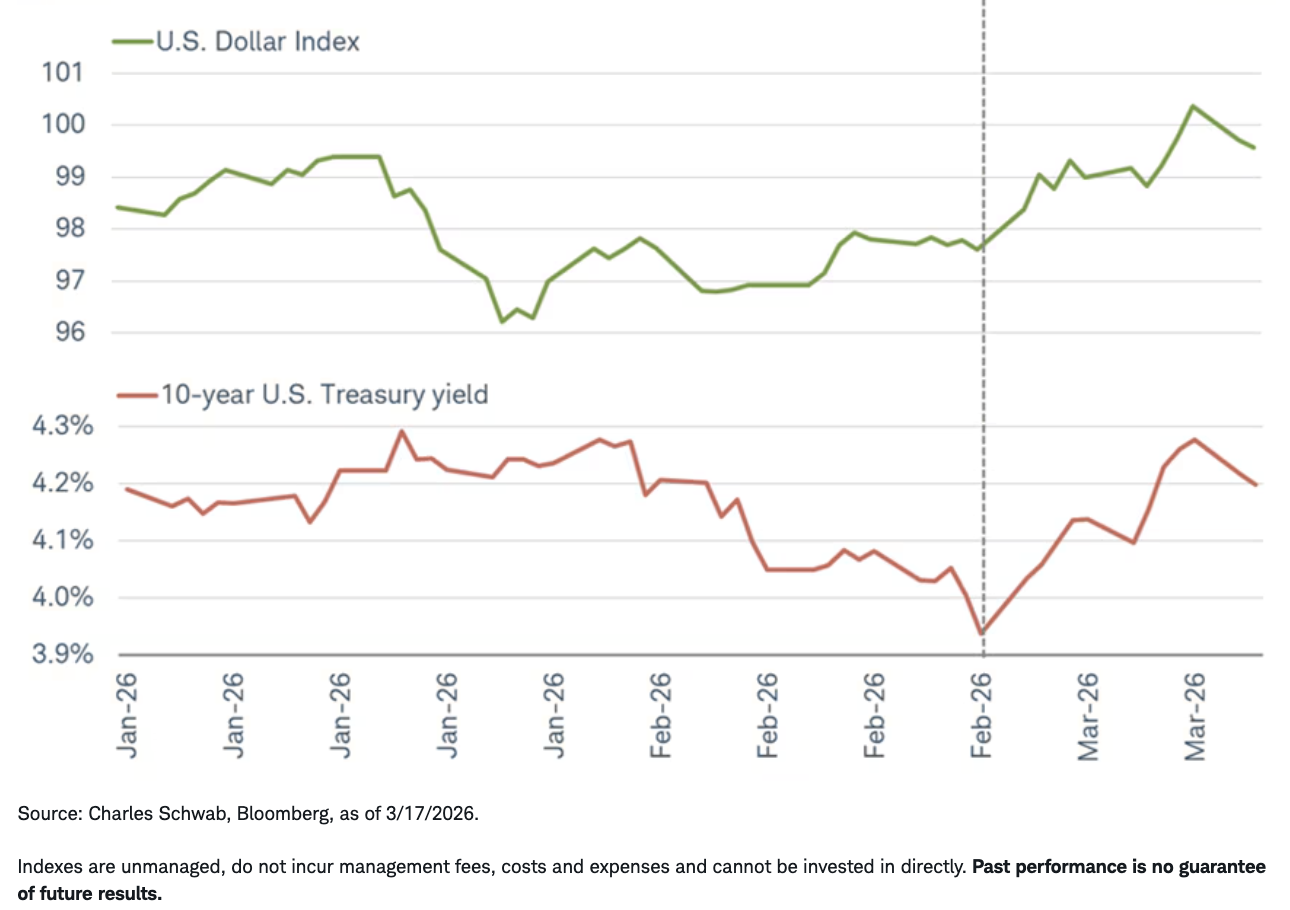
Conventionally, a major military conflict would send investors into U.S. Treasuries as a perceived safe haven, pushing yields lower alongside a typically lower U.S. dollar given the more common inverse relationship between oil prices and the dollar. In this conflict era so far, the U.S. dollar has strengthened, and Treasury yields have also risen…simultaneously. This is the fingerprint of a supply-driven inflation shock rather than a demand-destroying growth shock, and it has direct implications for the Federal Reserve's already-constrained room to maneuver.
The logic that has underpinned recent U.S. dollar strength is likely a function of traders determining that the United States is more insulated from the spike in oil prices given its aforementioned net exporter status. The logic underpinning the recent move higher in Treasury yields relates to the markets pricing in higher inflation risk from energy disruptions.
One thing leads to another
The defining financial market characteristic since the onset of the war in Iran has been the tightness and directionality of the relationship between crude oil and U.S. equities, shown below via the correlation between Brent crude oil (the global benchmark) and the S&P 500 on a rolling intraday basis.
Nearly all about oil prices
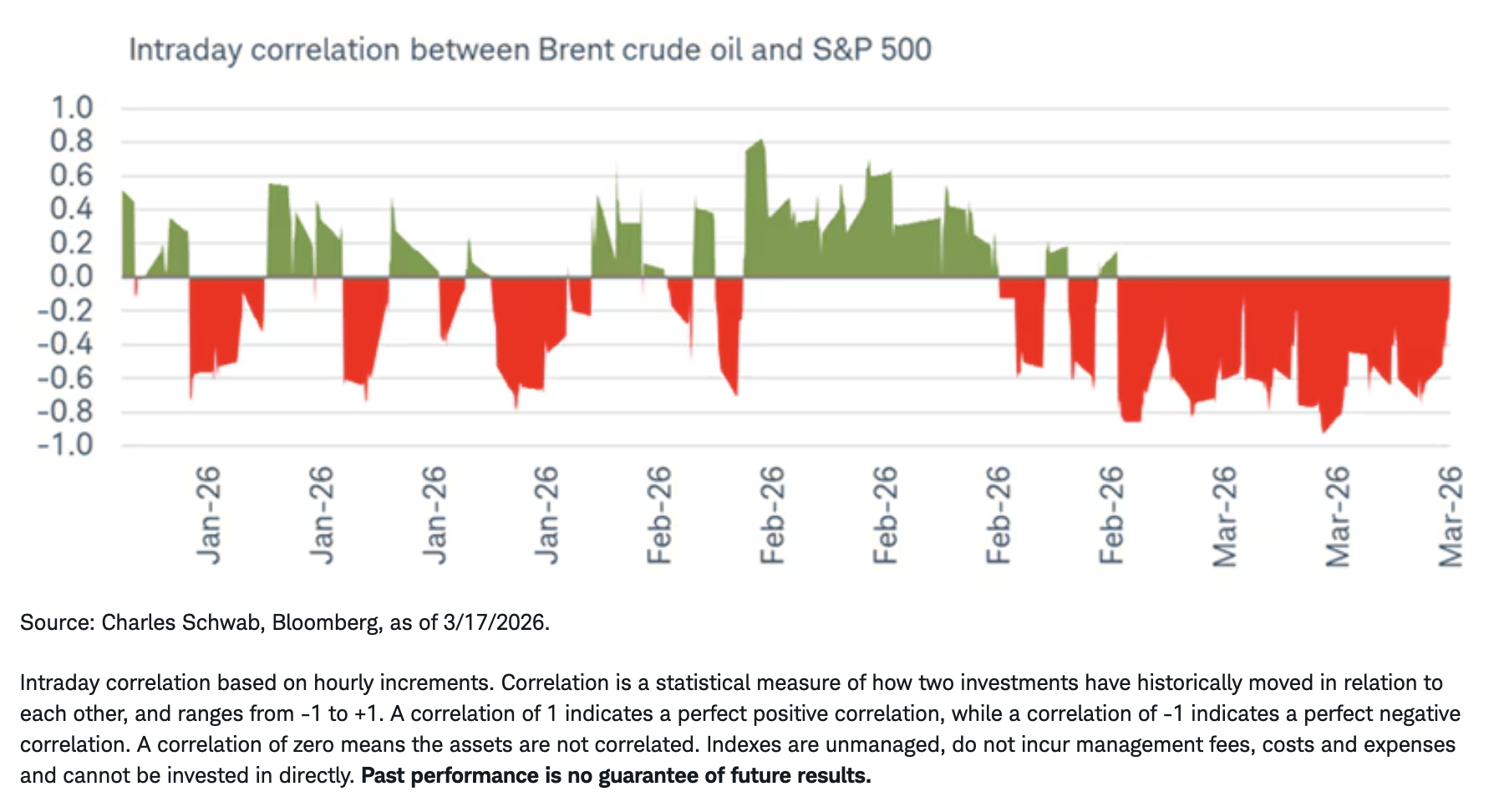
The oil-equity relationship has fluctuated over time and has been driven by type of regime:
- Negative in the 1970s and 1990s—when higher oil prices were seen as pure economic damage)
- Near-zero during the 2000s "commodity supercycle"—when demand-driven oil gains and equity gains moved together
- Periodically positive in the post-quantitative easing (QE) era—when both tracked global risk appetite
The current configuration (albeit a short span so far) most resembles the classic stagflation-era (1970s) dynamic, where the spike in crude oil is raising concerns about consumer spending and corporate profit margins vs. being a sign of economic vitality. That is the nature of a supply-driven shock vs. a demand-driven spike.
A tale of two markets (upstairs vs. downstairs)
One of the most analytically significant features of this year so far—about which we've written extensively—has been the extraordinary gap between the S&P 500's index-level performance and the churn rotation occurring beneath the surface. The table below is one that goes on my (Liz Ann's) X feed every morning. It shows that at the index levels, maximum drawdowns this year have not reached correction (-10%) territory.
Major indexes and maximum drawdowns
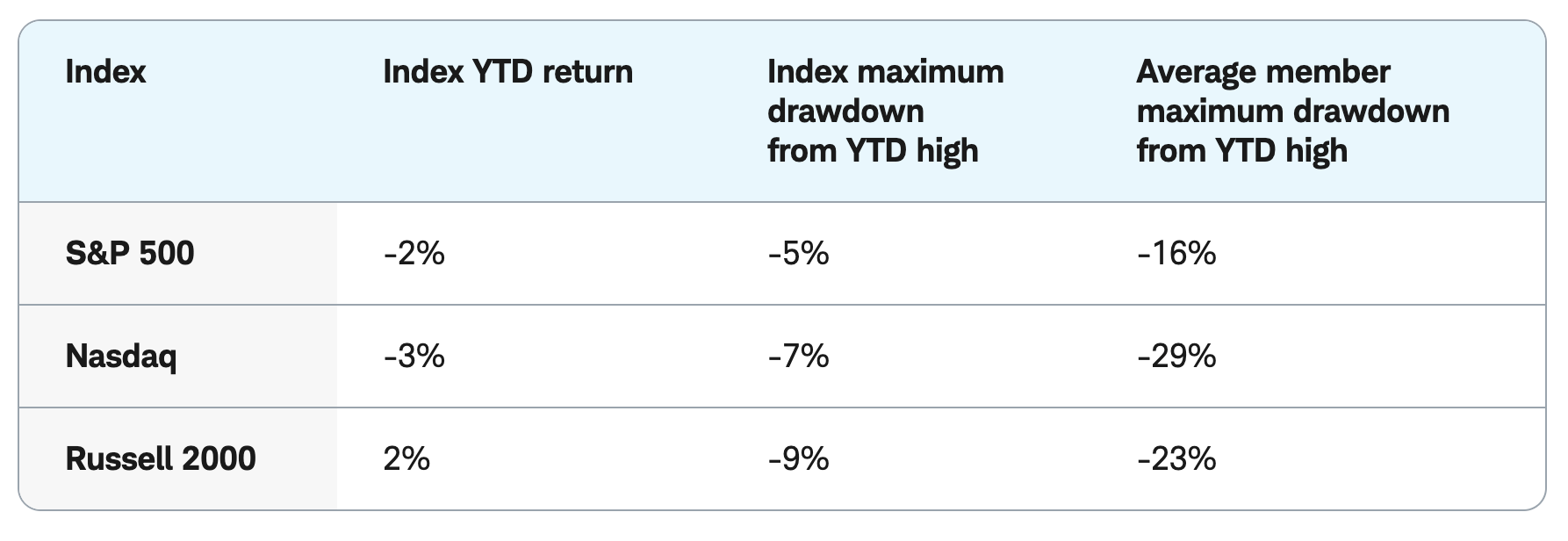

At the average member level, things have been much more volatile via a process of churn and rotation. Notwithstanding the minimal -5% drawdown for the S&P 500 at the index level, the average member has had a maximum drawdown of -16%. It's even more stark for the Nasdaq and Russell 2000, with member level average drawdowns in bear market territory at -29% and -23%, respectively. The Dow has been more insulated given its smaller number of constituents (and a higher weight in energy stocks).
Range-bound, but only on surface
From a technical standpoint, and shown below, the S&P 500 index has traded in a narrow band since its all-time high price on January 27.
Tight trading range at index level
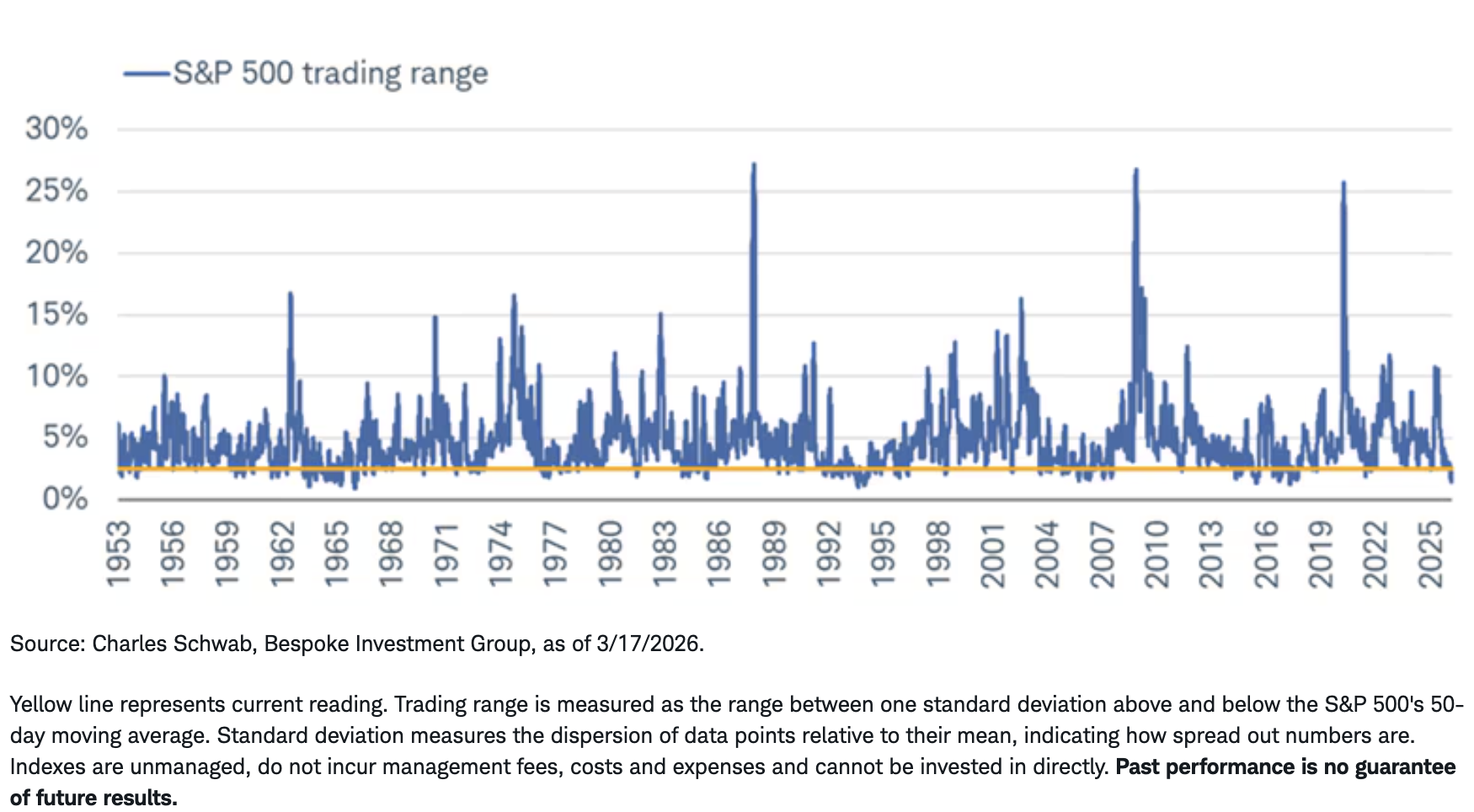
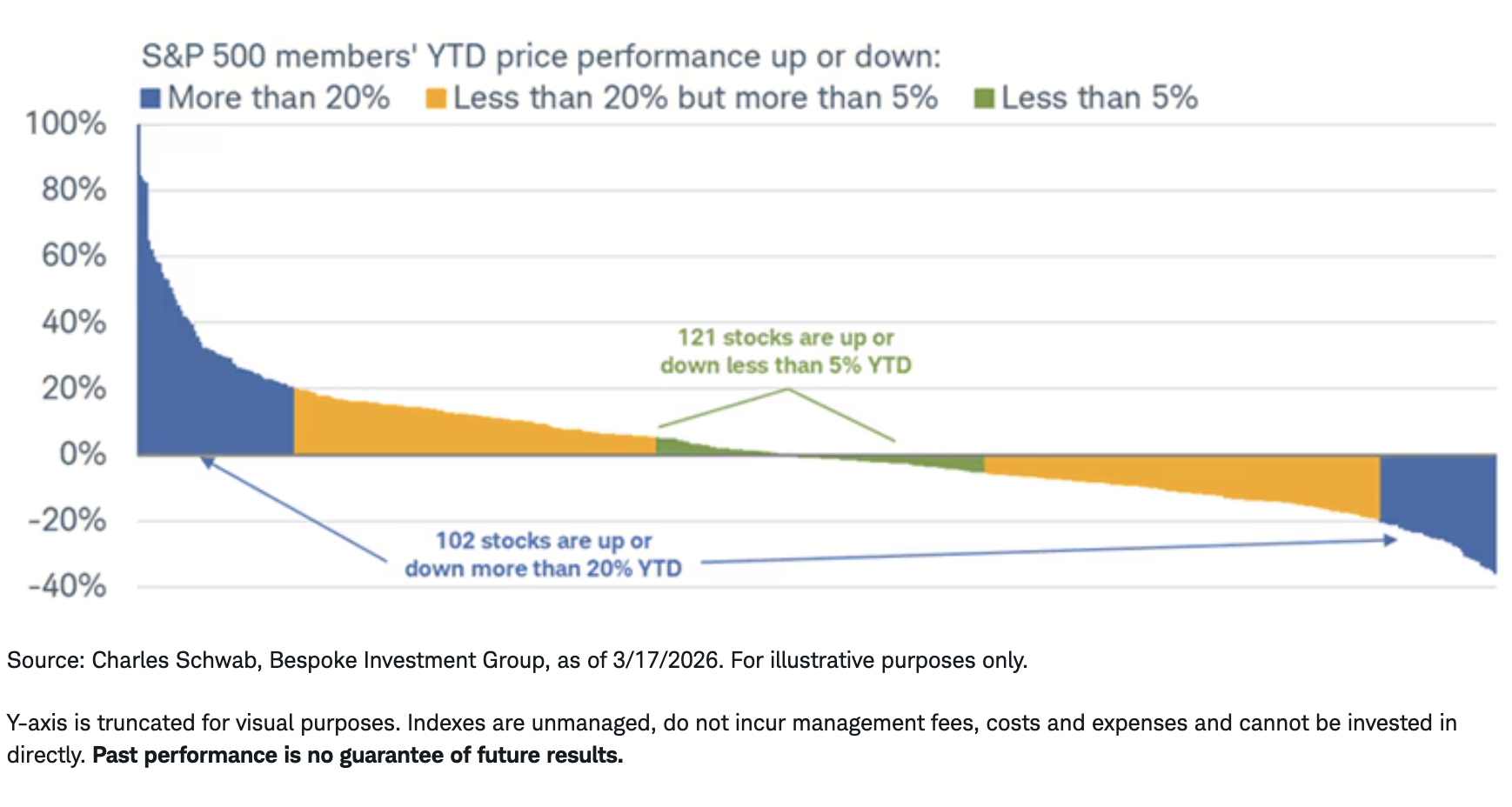
This has often been billed as market "resilience," when in reality it has been the product of higher "distribution." While the S&P 500 index has been hovering near flat this year, beneath the surface, more rotation and dispersion is seen. As shown below, the share of S&P 500 members' year-to-date returns exceeding +/- 20% is running hot, with nearly as many stocks having extreme moves as those within the same range as the index itself.
Large tails around tight index range
Inverted performance
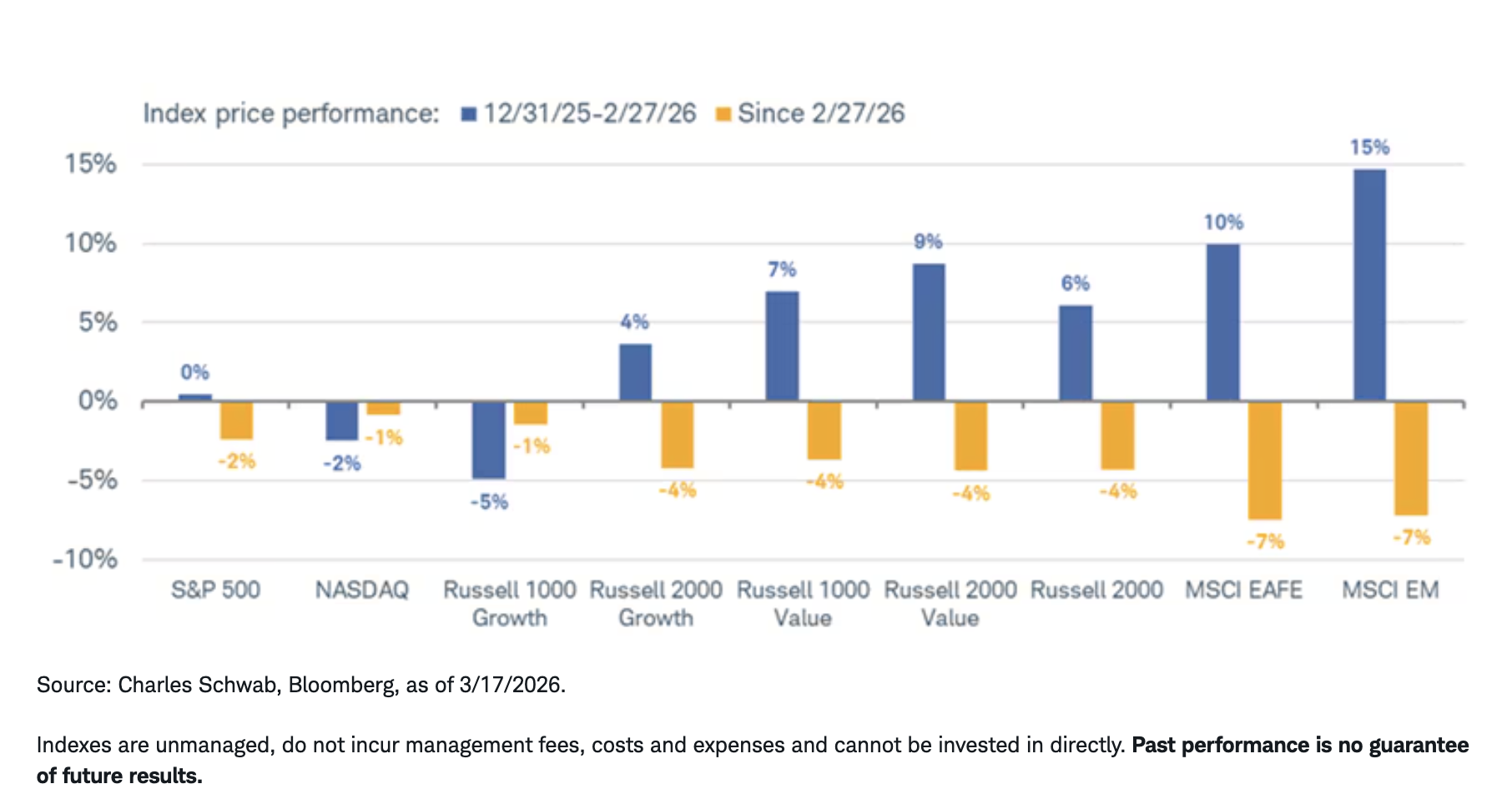
The war has also produced sharp reversals in relative global equity performance and it has particularly punished markets that had been among the strongest performers through February, as shown below. The logic is energy vulnerability, with Europe and Asia more reliant on oil/gas imports and are particularly exposed to Middle East supply disruptions.
Before the war, our bias was toward international equity market outperformance, but in light of war-related uncertainties, we have "neutralized" the view on international vs. domestic.
Mirror image performance for indexes
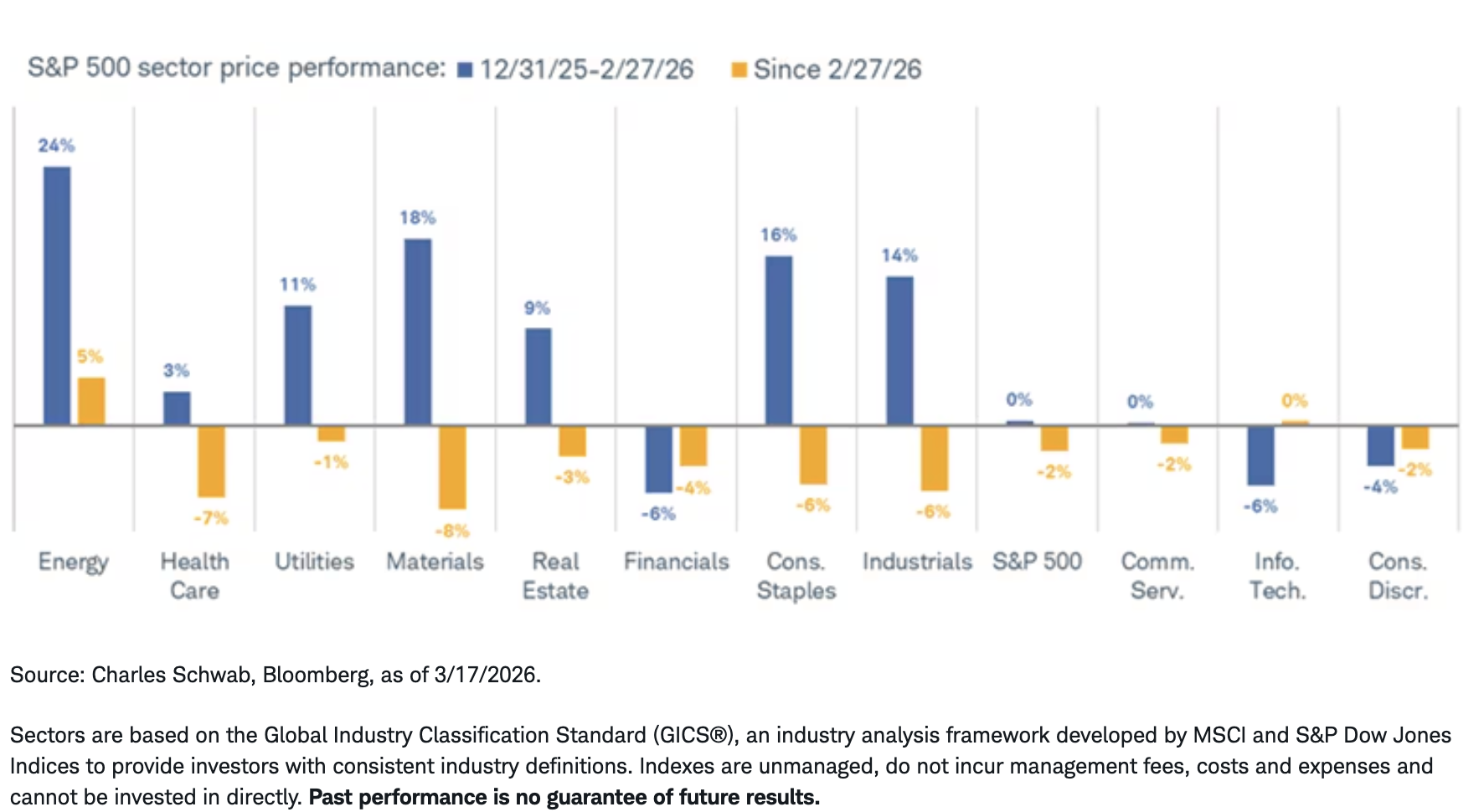
As for sector performance this year, the war has also led to some inverted performance relative to the first two months of this year, as shown below, notwithstanding Energy's leadership over both periods.
Mirror image performance for sectors
In sum
The 2026 period, especially since the onset of the U.S./Israeli war with Iran, presents one of the most analytically rich internal market environments in many years, in part because headline indexes are obscuring, rather than revealing, underlying stress. The war has not created these dynamics, but it has sharpened and extended them—tethering every trading session's tape to oil prices, which will likely remain the primary swing variable until the Strait of Hormuz's flows normalize.
A message from Advisor Perspectives and VettaFi: Discover something new! Click here to register for our upcoming webcasts.
This material is intended for general informational and educational purposes only. This should not be considered an individualized recommendation or personalized investment advice. The investment strategies mentioned may not be suitable for everyone. Each investor needs to review an investment strategy for his or her own particular situation before making any investment decisions.
All expressions of opinion are subject to change without notice in reaction to shifting market, economic or political conditions. Data contained herein from third party providers is obtained from what are considered reliable sources. However, its accuracy, completeness or reliability cannot be guaranteed.
Past performance is no guarantee of future results.
Investing involves risk, including loss of principal.
Fixed income securities are subject to increased loss of principal during periods of rising interest rates. Fixed income investments are subject to various other risks including changes in credit quality, market valuations, liquidity, prepayments, early redemption, corporate events, tax ramifications, and other factors. Lower rated securities are subject to greater credit risk, default risk, and liquidity risk.
International investments involve additional risks, which include differences in financial accounting standards, currency fluctuations, geopolitical risk, foreign taxes and regulations, and the potential for illiquid markets. Investing in emerging markets may accentuate this risk.
Commodity-related products carry a high level of risk and are not suitable for all investors. Commodity-related products may be extremely volatile, may be illiquid, and can be significantly affected by underlying commodity prices, world events, import controls, worldwide competition, government regulations, and economic conditions.
Currencies are speculative, very volatile and not suitable for all investors.
The policy analysis provided by the Charles Schwab & Co., Inc., does not constitute and should not be interpreted as an endorsement of any political party.
Diversification and asset allocation strategies do not ensure a profit and do not protect against losses in declining markets.
All names and market data shown are for illustrative purposes only and are not a recommendation, offer to sell, or a solicitation of an offer to buy any security.
Schwab does not recommend the use of technical analysis as a sole means of investment research.
Indexes are unmanaged, do not incur management fees, costs, and expenses and cannot be invested in directly. For more information on indexes, please see schwab.com/indexdefinitions.
The Schwab Center for Financial Research is a division of Charles Schwab & Co., Inc.
Source: Bloomberg Index Services Limited. BLOOMBERG® is a trademark and service mark of Bloomberg Finance L.P. and its affiliates (collectively "Bloomberg"). Bloomberg or Bloomberg's licensors own all proprietary rights in the Bloomberg Indices. Neither Bloomberg nor Bloomberg's licensors approves or endorses this material, or guarantees the accuracy or completeness of any information herein, or makes any warranty, express or implied, as to the results to be obtained therefrom and, to the maximum extent allowed by law, neither shall have any liability or responsibility for injury or damages arising in connection therewith.
Investment and Insurance Products Are: Not FDIC Insured • Not Insured by Any Federal Government Agency • Not a Deposit or Other Obligation of, or Guaranteed by, the Bank or any of its Affiliates • Subject to Investment Risks, Including Possible Loss of Principal Amount Invested
The Charles Schwab Corporation provides a full range of brokerage, banking and financial advisory services through its operating subsidiaries. Its broker-dealer subsidiary, Charles Schwab & Co. Inc. (Member SIPC), and its affiliates offer investment services and products. Its banking subsidiary, Charles Schwab Bank, SSB (member FDIC and an Equal Housing Lender), provides deposit and lending services and products.
This site is designed for U.S. residents. Non-U.S. residents are subject to country-specific restrictions. Learn more about our services for non-U.S. residents, Charles Schwab Hong Kong clients, Charles Schwab U.K. clients.
© 2026 Charles Schwab & Co., Inc. All rights reserved. Member SIPC. Unauthorized access is prohibited. Usage will be monitored.
Membership required
Membership is now required to use this feature. To learn more:
View Membership BenefitsSponsored Content
Upcoming Virtual Events View All












