As strikes on Iran continue and the Strait of Hormuz remains effectively closed, it’s clearly too early for market watchers to stop thinking about geopolitical risk. As discussed in recent commentaries but worth repeating, history shows stocks often recover quickly from wars and other military engagements, especially when economies are resilient and earnings fundamentals remain strong. Improved valuations, the strong earnings outlook, and a still-normal level of volatility suggest the risk‑reward backdrop for stocks is getting more favorable. That said, we don’t have market capitulation signals flashing (washed-out selling), nor do we have any more clarity on how the Strait of Hormuz opens up. For now, we believe the best course of action for investors is to be patient and wait for a better entry point to add equity risk.
Stocks Seem to Be Following the Playbook as History Doesn’t Repeat but Often Rhymes
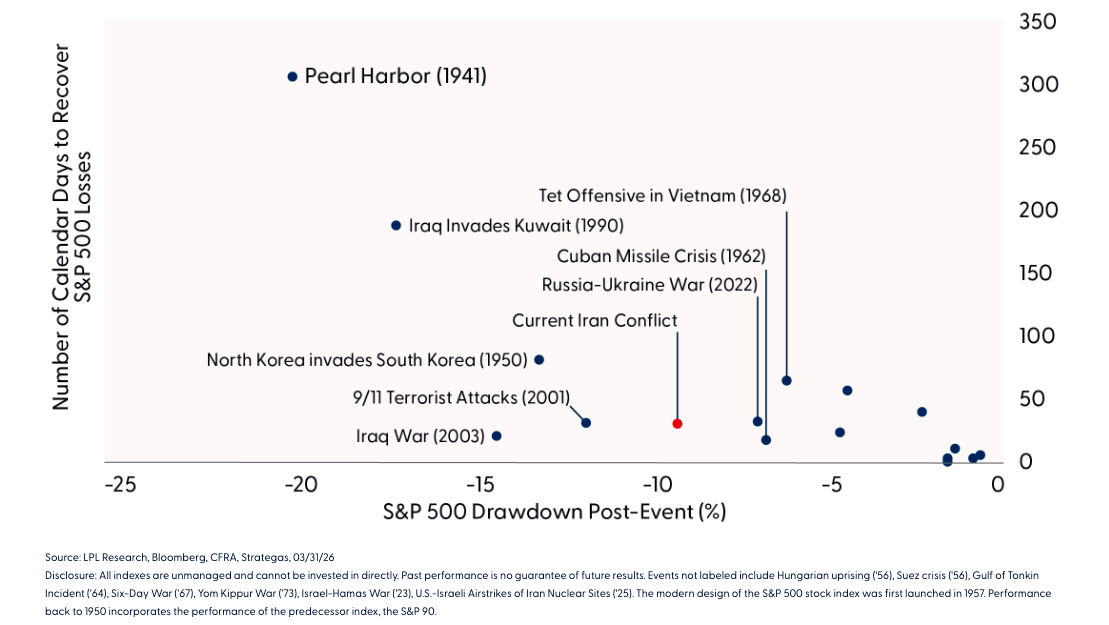
As we wrote about in our March 9 Weekly Market Commentary, stocks have historically been resilient to geopolitical shocks. In the “Stocks Have Historically Been Resilient to Military Conflicts” chart, we focus just on wars and significant military operations to get a more comparable set of events than the broader list we published last month. As the accompanying chart illustrates, even in the face of these more serious and longer-lasting events, the stock market has demonstrated impressive resilience — on average, the S&P 500 draws down 7% and recovers losses within an average of 55 days, or less than two months.
While the latest headlines and commentary from the White House suggest the conflict will be over within the next few weeks, which helped drive stocks higher early last week, disruptions to oil tankers and other shipments through the Strait of Hormuz cannot be ruled out, nor can the risk of further damage to energy facilities or other infrastructure in neighboring Gulf countries. In the event of a ceasefire that opens the Strait of Hormuz, we would expect oil prices to come down. But the price floor is likely higher than February levels in the $50s given what we’ve seen from the Iranian regime. On top of that, how long a possible détente might last — if we get one — remains an open question.
Bottom line, we believe history suggests that it’s quite possible that the 9% peak-to-trough drawdown in the S&P 500 reached in March may be all we get during this conflict. Market watchers may not have to wait too long for stocks to recover from year-to-date losses. At the same time, geopolitical uncertainty remains high enough to warrant patience and leave us comfortable recommending portfolio risk at or slightly below benchmarks currently, although past performance does not guarantee future results.
Impressive Stock Market Resilience Historically During Significant Military Conflicts

Putting the Middle East aside for a moment, we also want to reiterate that this level of volatility is completely normal. Regular readers may think we sound like a broken record, but we cannot overstate the importance of this point. As we wrote in our March 31 LPL Research blog, the average S&P 500 maximum annual drawdown is 14%, while the average annual gain for the S&P 500 is 10%. The drawdown of just 9% this year is well within the normal range and does not diminish our confidence that the broad market will end higher in 2026.
Of course, nothing is guaranteed. The risk of lasting disruption to energy production, transportation, or other critical assets in the region is real. Still, history suggests the risk-reward trade-off for stocks in the intermediate to longer term has become more favorable.
Earnings Still Drive Stock Prices
Some may be surprised by the stock market’s relative resilience during this conflict given the surge in oil prices. Expectations from markets and the Trump administration that the military operation will be over this month is certainly part of that resilience. U.S. energy independence is part of it as well. But if there is one reason stocks have held up well so far — and hopefully continue to do so — it is the strong earnings outlook, even in the face of higher oil prices and rising interest rates.
A dampened outlook for companies that are obviously hurt by high oil prices, such as airlines and cruise ship operators, has been more than offset by improving outlooks for earnings from technology companies, largely immune to the conflict, and U.S. energy companies, of course, which benefit. In fact, the consensus estimate for technology sector earnings per share (EPS) in 2026 has risen 6% over the last 30 days, while the consensus energy EPS estimate jumped 18%.
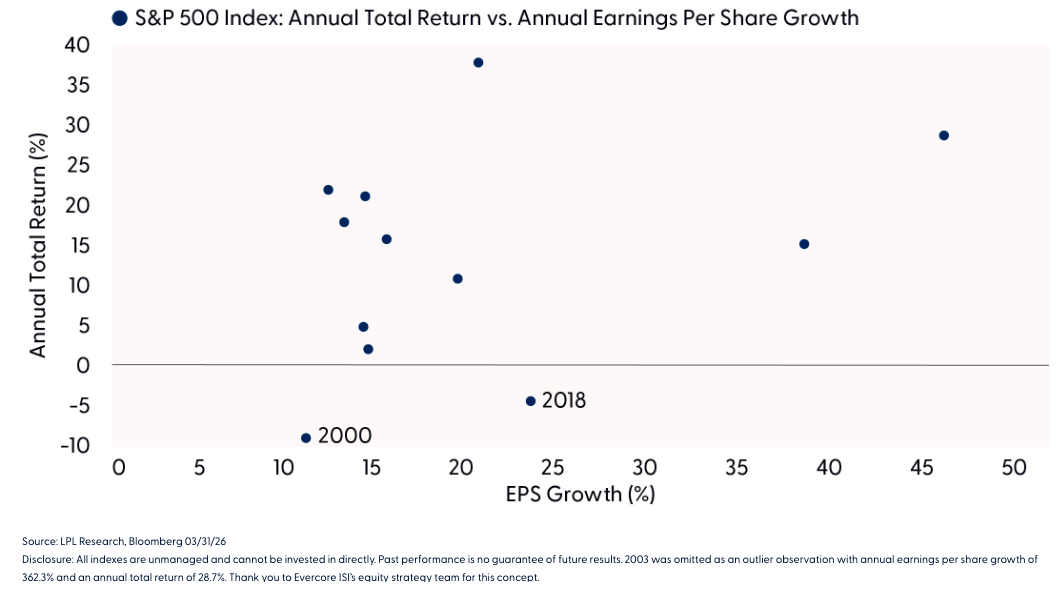
We wrote about earnings in the March 30 Weekly Market Commentary, so we won’t go too deep into the topic here. However, we do think it’s worth highlighting that stocks have a strong track record of gains when earnings grow double digits, as they are likely to in 2026. Although companies will probably talk expectations down during first quarter earnings conference calls given the complicated and dynamic macroeconomic and geopolitical backdrop, we still believe fundamentals support double-digit growth in S&P 500 EPS in 2026. As the accompanying figure illustrates, over a one-year time horizon, strong earnings growth may be accompanied by higher stock prices.
Over the last 30 years the only exceptions were 2000, when stocks were pricing in a bursting internet bubble before earnings fell, and 2018, when concerns about a Federal Reserve policy mistake drove a sharp correction beginning in early December of that year. Those fears quickly eased in 2019 as the S&P 500 went on to gain 30% that year.
Double-Digit Earnings Growth Tends to Be Accompanied By Stock Market Gains
Valuations Have Improved
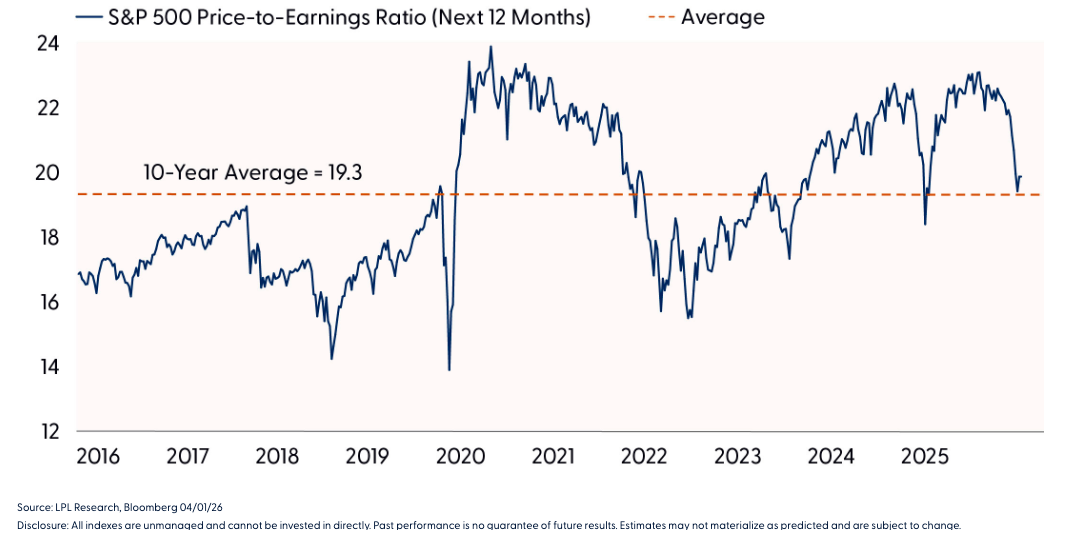
The benefit of stock market declines is that it gives investors an opportunity to buy stocks at lower valuations, assuming earnings hold up. That’s what seems to have happened. Since the conflict began on the last day of February, the S&P 500 has dropped about 4% and the consensus S&P 500 EPS estimate for 2026 has increased 2.5% (from roughly $310 to $317). We wouldn’t argue stocks are cheap, but when the Middle East calms down we see an opportunity for a higher price-to-earnings ratio. Our year-end fair value target range for the S&P 500, at 7,300 to 7,400, is based on a price-to-earnings ratio of 23 and our 2027 S&P 500 EPS estimate of $320.
Stock Market Pullback as Earnings Estimates Rose Has Lowered Valuations
Technical Analysis Take: What We Are Watching
After five consecutive weeks of selling pressure, buyers stepped back into the market last week, lifting the S&P 500 above key support from the November lows at 6,522. While this is a constructive development, the 200-day moving average (dma) at 6,644 looms as the next critical test for bulls. A sustained move above this level would reverse the short-term downtrend that has been in place since February and increase confidence that the pullback has run its course.
Beyond price action, we are also watching for cyclical sectors to reclaim leadership from defensives and for market breadth to expand toward bullish territory, both important signals of improving risk appetite. Failure at the 200-dma, however, would raise the likelihood of further downside risk, potentially toward support near the February 2025 highs at 6,144. In that scenario, we would want to see clearer signs of capitulation, including more deeply oversold conditions and investor positioning consistent with historical inflection points, evidence that has thus far been largely absent.
Beyond equities, macro conditions remain a key constraint on the market’s ability to regain momentum. The front end of the Treasury curve points to the risk of a higher-for-longer monetary policy backdrop, while the technical setup for longer-dated yields suggests there is still upside risk. At the same time, oil market volatility remains elevated, Brent crude has yet to decisively break below meaningful support, and breakeven inflation rates are beginning to price in some stagflation concerns.
Against this more challenging macro and technical backdrop, it is important to keep recent price action in perspective. Drawdowns are not anomalies in bull markets but a normal and recurring feature of market behavior. Outside of periods when equities are making new all-time highs, the market is almost always experiencing some degree of pullback. Since 1950, on a calendar year basis, the S&P 500 has spent nearly 70% of all trading days in a drawdown of up to 5%, and roughly 18% of trading days in the 5% to 10% range. More severe drawdowns are rare, with 15% or larger pullbacks occurring in only about 6% of trading days. Rather than signaling the end of a bull market cycle, these bouts of volatility have often created opportunities for investors, particularly when the longer-term uptrend for the S&P 500 remains intact, as it is now.
Conclusion
March’s volatility has been uncomfortable but not unusual. While stocks have faced a challenging mix of geopolitical risk, higher oil prices, and interest‑rate volatility, history reflects market resilience, especially when economic fundamentals remain intact. The comparison with prior conflicts reinforces that distinction. The 2003 Iraq War illustrates how markets can recover swiftly when earnings are improving, policy is supportive, and oil price spikes are contained.
Earnings continue to provide support for stocks during this volatile period. Consensus expectations for double‑digit S&P 500 EPS growth in 2026 have not only held firm, but they have improved despite recent market stresses, resulting in more reasonable valuations and pointing toward gains for stocks in 2026.
This does not mean risks have disappeared. Further disruption to energy infrastructure or shipping routes could prolong uncertainty and drive market volatility. However, based on historical precedent, the current risk‑reward backdrop over the medium-to-longer term appears favorable.
After five weeks of selling pressure, it was encouraging to see some buyers step in last week, pushing the S&P 500 back above key November support. The next test is a sustained break above the 200‑day average. We’re watching for cyclical leadership, improving breadth, and clearer capitulation signals for a potential attractive opportunity to add equities to move to an overweight position.
Asset Allocation Insights
LPL’s Strategic Tactical Asset Allocation Committee (STAAC) maintains its tactical neutral stance on equities. As the war in Iran continues with an off ramp not yet in view, investors may be well served by bracing for additional volatility. The stock market’s resilient track record during geopolitical crises is reassuring, leaving STAAC to look for opportunities to potentially add equities.
STAAC’s regional preferences across the U.S., developed international, and emerging markets (EM) are aligned with benchmarks. Attractive valuations in non-U.S. equities are offset by upward pressure in the U.S. dollar and dependence on oil and gas through the Strait of Hormuz, although the Committee continues to watch EM closely for potential opportunities after relative calm is restored in the Middle East.
The Committee maintains a slight preference for growth over value and large caps over small caps. In terms of domestic sectors, communication services and industrials remain overweight while the Committee continues to debate technology as a potential upgrade candidate given the still-strong earnings outlook and more attractive valuations.
Within fixed income, the STAAC holds a neutral weight in core bonds, with a slight preference for mortgage-backed securities (MBS) over investment-grade corporates. The Committee believes the risk-reward for core bond sectors (U.S. Treasury, agency MBS, investment-grade corporates) is more attractive than plus sectors. The Committee does not believe adding duration (interest rate sensitivity) at current levels is attractive and remains neutral relative to benchmarks.
Adam Turnquist, Chief Technical Strategist, LPL Financial
Jeffrey Buchbinder, Chief Equity Strategist, LPL Financial
You may also be interested in:
A message from Advisor Perspectives and VettaFi: Discover something new! Click here to register for our upcoming webcasts.
Disclosures
This material is for general information only and is not intended to provide specific advice or recommendations for any individual. There is no assurance that the views or strategies discussed are suitable for all investors or will yield positive outcomes. Investing involves risks including possible loss of principal. Any economic forecasts set forth may not develop as predicted and are subject to change.
References to markets, asset classes, and sectors are generally regarding the corresponding market index. Indexes are unmanaged statistical composites and cannot be invested into directly. Index performance is not indicative of the performance of any investment and do not reflect fees, expenses, or sales charges. All performance referenced is historical and is no guarantee of future results.
Any company names noted herein are for educational purposes only and not an indication of trading intent or a solicitation of their products or services. LPL Financial doesn’t provide research on individual equities.
All information is believed to be from reliable sources; however, LPL Financial makes no representation as to its completeness or accuracy.
All investing involves risk, including possible loss of principal.
US Treasuries may be considered “safe haven” investments but do carry some degree of risk including interest rate, credit, and market risk. Bonds are subject to market and interest rate risk if sold prior to maturity. Bond values will decline as interest rates rise and bonds are subject to availability and change in price.
The Standard & Poor’s 500 Index (S&P500) is a capitalization-weighted index of 500 stocks designed to measure performance of the broad domestic economy through changes in the aggregate market value of 500 stocks representing all major industries.
The PE ratio (price-to-earnings ratio) is a measure of the price paid for a share relative to the annual net income or profit earned by the firm per share. It is a financial ratio used for valuation: a higher PE ratio means that investors are paying more for each unit of net income, so the stock is more expensive compared to one with lower PE ratio.
Earnings per share (EPS) is the portion of a company’s profit allocated to each outstanding share of common stock. EPS serves as an indicator of a company’s profitability. Earnings per share is generally considered to be the single most important variable in determining a share’s price. It is also a major component used to calculate the price-to-earnings valuation ratio.
Precious metal investing involves greater fluctuation and potential for losses.
The fast price swings in commodities will result in significant volatility in an investor’s holdings. Commodities include increased risks, such as political, economic, and currency instability, and may not be suitable for all investors.
The NASDAQ Composite Index measures all NASDAQ domestic and non-U.S. based common stocks listed on The NASDAQ Stock Market. The market value, the last sale price multiplied by total shares outstanding, is calculated throughout the trading day, and is related to the total value of the Index. Indexes are unmanaged and cannot be invested in directly.
The MSCI US Broad Market Index captures broad U.S. equity coverage. The index includes 3,204 constituents across large, mid, small and micro capitalizations, about 99% of the U.S. equity universe. Indexes are unmanaged and cannot be invested in directly.
Bonds are subject to market and interest rate risk if sold prior to maturity. Bond values will decline as interest rates rise and bonds are subject to availability and change in price. Private credit carries certain risks — illiquidity, opacity, borrower concentration, and bespoke structures — that distinguish it from corporate bonds and bank loans and complicate its evaluation and oversight.
All index data from FactSet or Bloomberg.
This research material has been prepared by LPL Financial LLC.
RES-0006894-0326 | For Public Use | Tracking #1088174 (Exp. 04/2027)
Read more commentaries by LPL Financial