Rethinking Fixed Income Allocation in a Multi‑Polar World
Membership required
Membership is now required to use this feature. To learn more:
View Membership BenefitsAs we wrote in our recent Rate and Credit View, the case for global bonds has strengthened as the structure of fixed income markets — and the sources of risk within them — have become increasingly asymmetric. The U.S. bond market represents less than half of global fixed income outstanding, yet many portfolios remain overwhelmingly concentrated in U.S. Treasuries and credit, effectively tying outcomes to a single fiscal authority, a single central bank, and domestic yield curves. Expanding beyond U.S. borders meaningfully enlarges the opportunity set. Non‑U.S. developed markets and emerging economies operate under differentiated monetary regimes, demographic profiles, and business cycles, creating dispersion in yields, duration profiles, and policy paths that can be harnessed through active allocation.
Emerging market debt and hedged non-U.S. developed market debt offer compelling income potential and diversification benefits, supported by lower correlations to both U.S. Treasuries and U.S. equities when constructed thoughtfully.
Recent geopolitical developments have further improved the value argument of global investing within fixed income markets. Escalating tensions surrounding Iran and broader instability in the Middle East have driven periodic spikes in energy prices and have put upward pressure on bond yields through inflation expectations and term premia. In many non-U.S. developed countries, bond yields — despite falling on Friday following the announcement that the Strait of Hormuz was open to commercial traffic — remain among the highest levels seen in decades, offering both income and potential price appreciation opportunities.
Currency, credit, and liquidity risks are inherent in global fixed income and must be managed selectively, but they also represent sources of return for disciplined investors.
While not for everyone, in our view, a modest 5–10% allocation to global bonds within higher-risk fixed income portfolios can enhance income, reduce concentration risk, and improve overall portfolio resilience in an increasingly complex macro and geopolitical environment.
Read more: Tactical Positioning Update: From Preparation to Action
Global Bonds in a Fragmented World
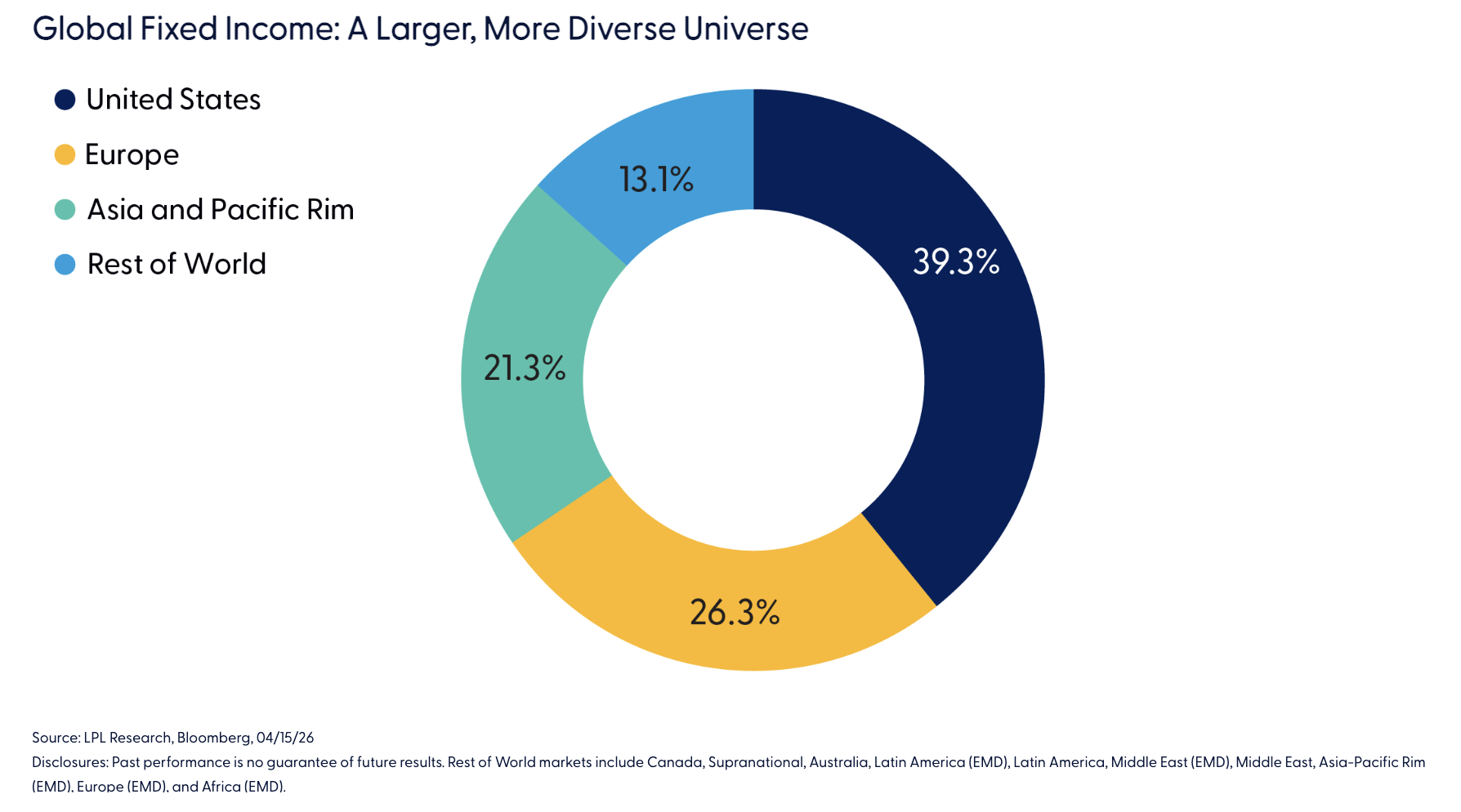
For most U.S. investors, fixed income means U.S. fixed income — Treasuries, investment-grade corporates, munis — as the domestic bond market is deep, liquid, and more than sufficient to build a diversified portfolio. But, in today’s increasingly fragmented global economy, U.S. fixed income investors face a pivotal choice: remain anchored in a domestic bond market that now represents less than 40% of the world’s outstanding debt or embrace a more complete opportunity set that includes non-U.S. developed and emerging market debt. The case for inclusion is not necessarily tactical but philosophical — an acknowledgment that portfolio resilience may demand exposure to differentiated economic cycles, monetary policies, and growth engines beyond America’s borders. Non-U.S. developed market bonds from issuers like Germany, Japan, the U.K., and Australia, alongside emerging market (EM) debt in both hard and local currencies, offer U.S. investors a combination of higher income potential, diversification, and long-term structural tailwinds that domestic Treasuries and corporates alone may not be able to replicate.
At its core, this argument rests on the recognition that the U.S. bond market, while deep and liquid, is increasingly concentrated in its risks — elevated fiscal deficits, political polarization, and potential term premium stubbornness. By contrast, non-U.S. developed debt provides access to alternative yield curves shaped by divergent central bank mandates, from the European Central Bank’s (ECB) data-dependent easing to the Bank of Japan’s yield curve management. EM debt, meanwhile, delivers compelling carry (higher yields) in an environment where many EM central banks have already delivered rate cuts amid cooling inflation and resilient domestic demand. With yields on hard-currency EM sovereign benchmarks still hovering above 6% (per the Bloomberg EM USD Aggregate Index) and local-currency real yields offering attractive compensation, these assets have historically delivered mid-single to low-double-digit returns over multi-year horizons, often outperforming U.S. high-yield on a risk-adjusted basis.
Yet the deepest value lies in diversification and correlation benefits. EM debt exhibits persistently low to moderate correlations with U.S. Treasuries (typically 0.3–0.5) and equities, driven by distinct drivers such as commodity cycles, regional trade dynamics, and independent policy responses. Local-currency EM bonds, in particular, serve as a natural hedge against dollar weakness, while non-U.S. developed bonds spread duration risk across global issuers. In an era of synchronized shocks giving way to decoupled recoveries, this imperfect correlation has repeatedly offered value in reducing portfolio volatility.
Allocating thoughtfully, though, is important and not for every investor — typically 5–10% depending on risk tolerance — and allows investors to capture these benefits while actively managing currency, credit, and liquidity risks through hedging, country selection, and professional oversight. The ethos is one of prudent globalism: recognizing that in a multipolar financial landscape, a U.S.-only fixed income strategy may no longer be necessary for long-term success.
Most of the Bond Market Lies Outside the U.S.
Non-U.S. developed market debt and EM debt represent significant portions of the global fixed income universe, offering U.S. investors alternatives to domestic Treasuries and corporate bonds. Non-U.S. developed debt includes sovereign and corporate bonds from countries like Germany, Japan, the U.K., France, Australia, and Canada — typically high-credit-quality issuers with deep markets but varying monetary policies. EM debt encompasses hard-currency (usually USD-denominated) and local-currency bonds from sovereigns and corporates in nations such as Brazil, India, Mexico, South Africa, Indonesia, and China. While the U.S. fixed income market is the largest, non-U.S. markets represent over 60% of the fixed income opportunity set.
Higher (Potential) Returns and Higher (Potential) Risks
Global bond investing offers several compelling benefits for portfolios that are increasingly concentrated in U.S. fixed income markets. Most notably, global bonds can provide higher yields by expanding the investable universe beyond U.S. Treasuries and investment‑grade credit. Many non‑U.S. developed markets, especially when hedged back to the U.S. dollar (more on that in the next section) and emerging economies offer structurally higher interest rates, positive real yields, and steeper yield curves, creating attractive income opportunities that are difficult to replicate domestically. This yield advantage can be especially valuable in late‑cycle environments or periods when U.S. rates are constrained by policy or demand for safe assets.
Beyond income, global bonds enhance diversification by introducing exposure to distinct monetary regimes, fiscal dynamics, and economic cycles. Central banks across regions often move at different paces, resulting in varied duration returns and roll‑down opportunities. Emerging market debt, in particular, has historically exhibited lower correlations to U.S. Treasuries and equities, improving portfolio efficiency when thoughtfully allocated.
Global fixed income can also improve risk balance within a portfolio. Currency exposure — when managed actively or selectively hedged — can act as an additional source of return or diversification during periods of U.S. dollar weakness. While risks such as currency volatility, credit quality, and liquidity must be carefully managed, these same factors create a return dispersion that skilled managers can exploit. Overall, incorporating global bonds can enhance income, reduce concentration risk, and strengthen portfolio resilience. That said, higher potential returns have historically come with higher risks (outlined below), which make these markets more volatile.
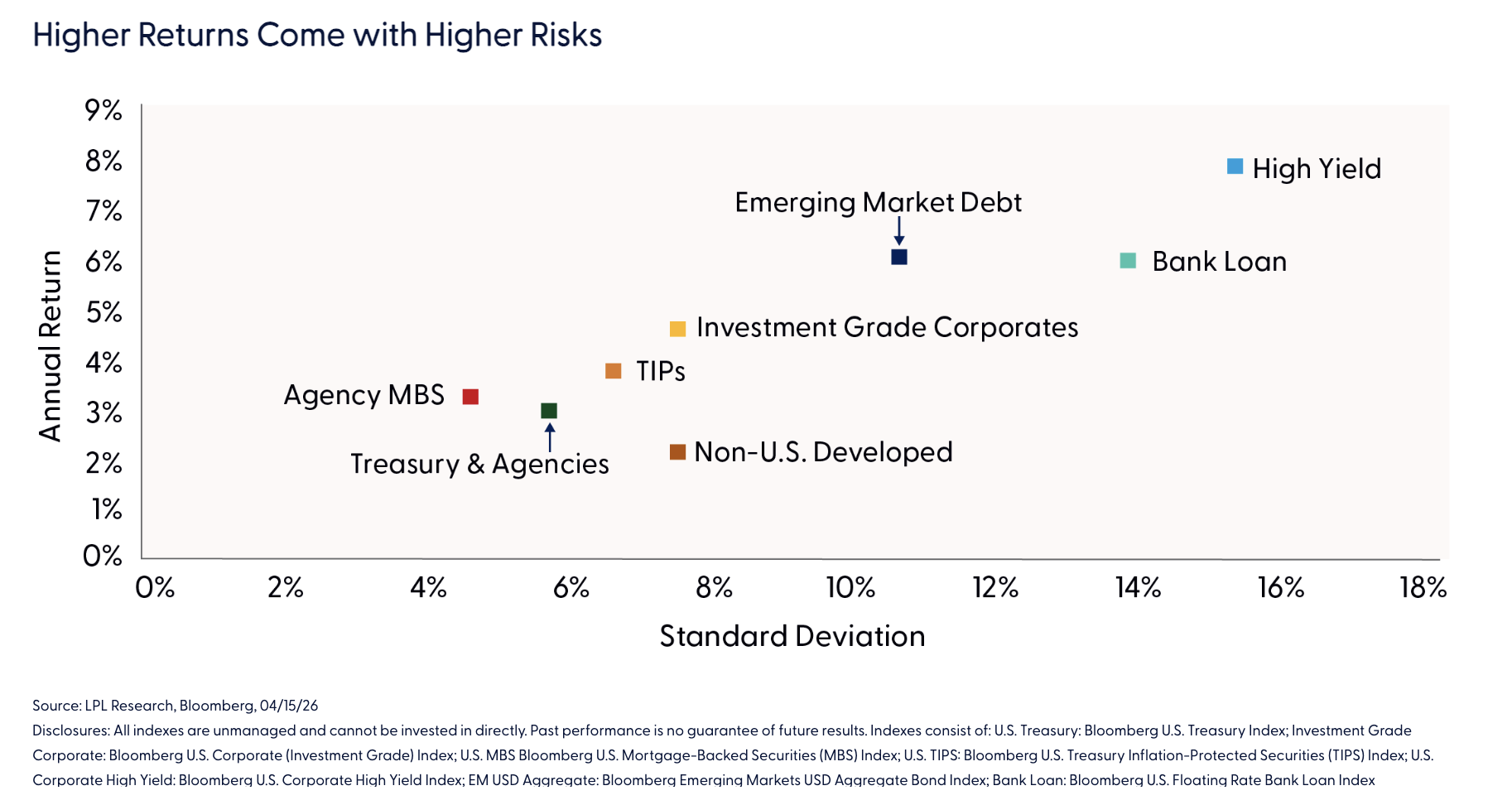
Despite these advantages, investing outside the U.S. entails material risks that require careful management. Currency risk is paramount for unhedged exposures, particularly in emerging market local‑currency debt, where U.S. dollar strength can overwhelm otherwise strong bond performance. Non‑U.S. developed markets face similar foreign exchange (FX) volatility, though hedging costs vary with rate differentials. Credit risk is elevated in EM, despite improving fundamentals such as lower debt burdens and stronger policy frameworks. Political instability, commodity dependence, and external shocks can still pressure both spreads and currencies, while hard‑currency EM debt can strain sovereign balance sheets during devaluations. Liquidity risk also persists: EM markets remain vulnerable to sharp risk‑off outflows, and some developed markets suffer from thin trading outside benchmarks. Finally, policy and geopolitical risks — from trade tensions to elections — can drive episodic volatility, while shifts in global rate expectations can raise correlations during systemic shocks, reducing diversification benefits precisely when they’re most needed.
Currency-Hedged Non-U.S. Developed Bonds Offering Attractive Income
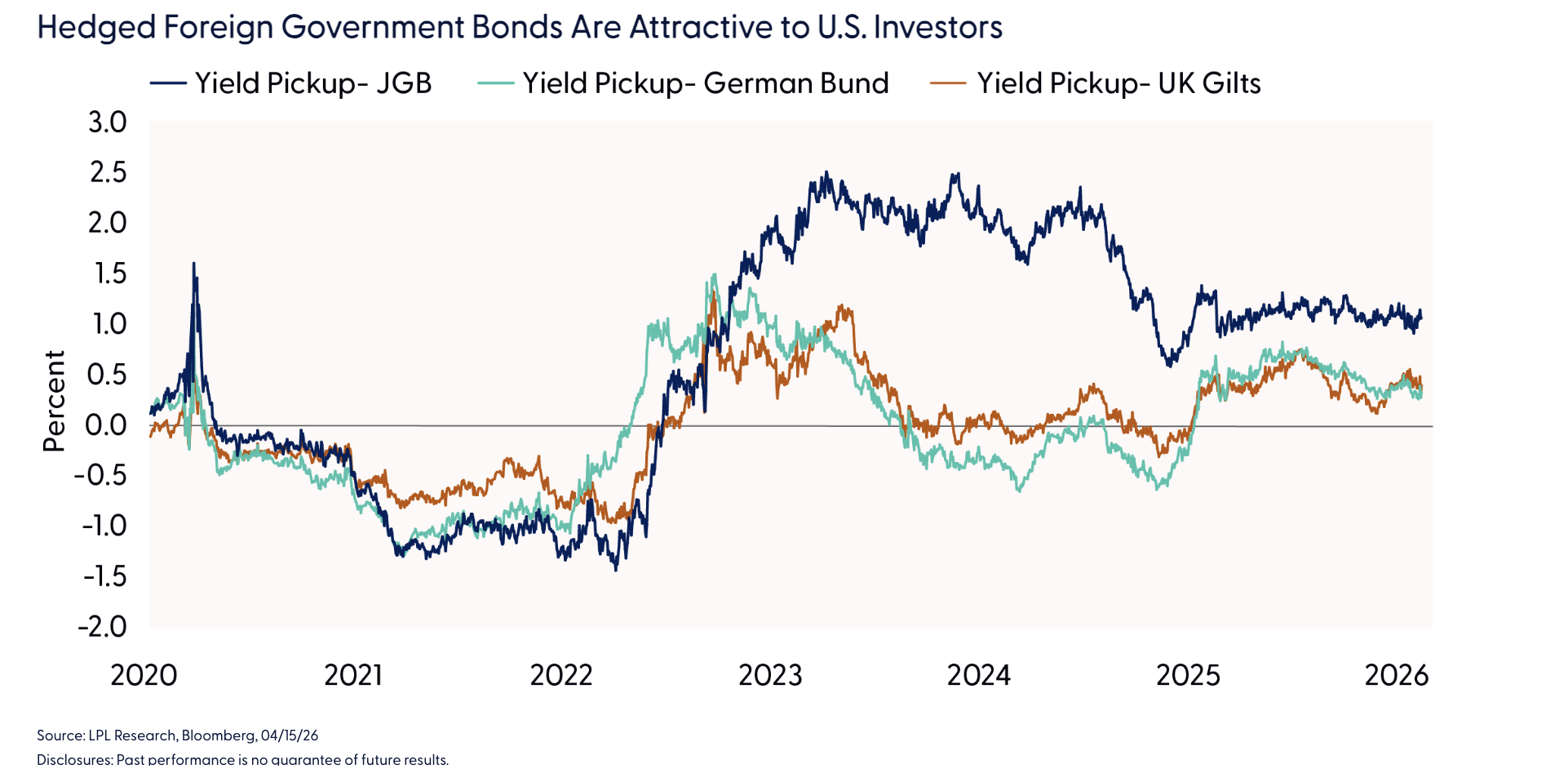
With U.S. 10-year Treasury yields hovering around 4.30%, many international sovereign bonds deliver competitive hedged returns thanks to a combination of solid local yields in select markets and a positive hedging carry driven by central bank policy rate differentials. Hedging via currency forwards or swaps eliminates FX volatility, as investors will purchase desired currencies in an effort to negate changes in exchange rates, so the effective return for a U.S. investor approximates the foreign bond yield plus the difference between U.S. and foreign short-term rates. For instance, as of April 15, while German 10-year Bunds yield roughly 3.00% locally, the hedging premium from the ECB’s 2.00% policy rate versus the Fed’s 3.50–3.75% adds approximately 1.5–1.75%, producing a hedged yield of 4.5–4.75% — modestly above U.S. Treasuries. U.K. Gilts at ~4.80% local offer near-zero carry but still edge out U.S. levels, while Japanese government bonds at ~2.40% benefit from a substantial 2.75–3.0% carry boost due to the Bank of Japan’s low 0.75% rate, resulting in an attractive hedged yield of 5.15–5.40%. Said another way, despite lower starting yields, hedging can provide a yield pick-up of 30 to 100 basis points above U.S. Treasury securities.
The Bottom Line
For investors, the takeaway is not that U.S. fixed income is unattractive — but that a U.S.-only approach may no longer be necessary in a more fragmented, multipolar global economy. With the U.S. bond market representing less than half of the global opportunity set and becoming increasingly concentrated in fiscal, political, and duration risk, selectively expanding into non‑U.S. developed and emerging market debt could meaningfully improve portfolio outcomes over the long term.
Global fixed income offers three core considerations: additional income potential, improved diversification, and access to differentiated economic and monetary cycles. Emerging market debt — particularly when blended across hard‑ and local‑currency exposure — can enhance carry and return potential, while non‑U.S. developed debt, especially in hedged form, can help reduce portfolio concentration and improve resilience during equity drawdowns. These benefits have become more compelling as policy paths diverge across regions and correlations remain imperfect.
That said, implementation matters. Currency volatility, credit dispersion, liquidity dynamics, and shifting correlations require thoughtful sizing. For investors with a higher risk tolerance, a modest allocation — typically 5–10% depending on risk tolerance and objectives — strikes a balance between opportunity and complexity. Blended approaches that combine local‑currency EM for yield, hard‑currency EM for credit exposure, and currency‑hedged developed markets for stability can help manage risk while preserving potential upside.
Ultimately, the improved case for global fixed income is about portfolio construction, not market timing. In an environment marked by decoupling growth paths, rising U.S. deficits, and uneven policy normalization, global bonds provide tools that U.S. bonds alone increasingly cannot. For long‑term investors focused on income, diversification, and resilience, global fixed income is less a tactical trade — and more a structural complement to the traditional U.S. core.
Asset Allocation Insights
LPL’s Strategic Tactical Asset Allocation Committee (STAAC) has moved portfolios to a modest overweight in equities and an underweight in fixed income. This shift builds on positioning decisions implemented ahead of the recent rise in volatility. In our view, increased market uncertainty has improved the forward-looking risk‑reward for incremental equity exposure, allowing us to act within our established tactical framework while maintaining prudent risk controls.
Within Growth with Income (GWI) portfolios — our closest proxy to a traditional 60/40 allocation — this adjustment reflects two related changes: neutralizing the underweight to U.S. small cap value and reducing exposure to MBS to fund that move. From a portfolio construction standpoint, this lifts equity exposure slightly above benchmark while keeping overall risk well within the intended tactical range. The change reflects improved expected equity returns following market weakness, alongside a more cautious outlook for select areas of core fixed income.
Our decision to neutralize small cap value is supported by improving technical trends and constructive fundamentals, including attractive valuations and rising capital investment. With geopolitical risks easing at the margin, we expect equities to outperform fixed income. Conversely, while MBS have delivered strong relative performance over recent years, tighter spreads and rising prepayment risks suggest more limited forward return potential.
Overall, our tactical views emphasize a modest equity overweight led by large‑cap growth, a continued focus on quality, caution in rate‑sensitive fixed income sectors, and an ongoing allocation to diversifying strategies and alternatives funded from cash.
Lawrence Gillum, Chief Fixed Income Strategist, LPL Financial
Disclosures
This material is for general information only and is not intended to provide specific advice or recommendations for any individual. There is no assurance that the views or strategies discussed are suitable for all investors or will yield positive outcomes. Investing involves risks including possible loss of principal. Any economic forecasts set forth may not develop as predicted and are subject to change.
References to markets, asset classes, and sectors are generally regarding the corresponding market index. Indexes are unmanaged statistical composites and cannot be invested into directly. Index performance is not indicative of the performance of any investment and do not reflect fees, expenses, or sales charges. All performance referenced is historical and is no guarantee of future results.
Any company names noted herein are for educational purposes only and not an indication of trading intent or a solicitation of their products or services. LPL Financial doesn’t provide research on individual equities.
All information is believed to be from reliable sources; however, LPL Financial makes no representation as to its completeness or accuracy.
All investing involves risk, including possible loss of principal.
US Treasuries may be considered “safe haven” investments but do carry some degree of risk including interest rate, credit, and market risk. Bonds are subject to market and interest rate risk if sold prior to maturity. Bond values will decline as interest rates rise and bonds are subject to availability and change in price.
The Standard & Poor’s 500 Index (S&P500) is a capitalization-weighted index of 500 stocks designed to measure performance of the broad domestic economy through changes in the aggregate market value of 500 stocks representing all major industries.
The PE ratio (price-to-earnings ratio) is a measure of the price paid for a share relative to the annual net income or profit earned by the firm per share. It is a financial ratio used for valuation: a higher PE ratio means that investors are paying more for each unit of net income, so the stock is more expensive compared to one with lower PE ratio.
Earnings per share (EPS) is the portion of a company’s profit allocated to each outstanding share of common stock. EPS serves as an indicator of a company’s profitability. Earnings per share is generally considered to be the single most important variable in determining a share’s price. It is also a major component used to calculate the price-to-earnings valuation ratio.
Precious metal investing involves greater fluctuation and potential for losses.
The fast price swings in commodities will result in significant volatility in an investor’s holdings. Commodities include increased risks, such as political, economic, and currency instability, and may not be suitable for all investors.
The NASDAQ Composite Index measures all NASDAQ domestic and non-U.S. based common stocks listed on The NASDAQ Stock Market. The market value, the last sale price multiplied by total shares outstanding, is calculated throughout the trading day, and is related to the total value of the Index. Indexes are unmanaged and cannot be invested in directly.
The MSCI US Broad Market Index captures broad U.S. equity coverage. The index includes 3,204 constituents across large, mid, small and micro capitalizations, about 99% of the U.S. equity universe. Indexes are unmanaged and cannot be invested in directly.
Bonds are subject to market and interest rate risk if sold prior to maturity. Bond values will decline as interest rates rise and bonds are subject to availability and change in price. Private credit carries certain risks — illiquidity, opacity, borrower concentration, and bespoke structures — that distinguish it from corporate bonds and bank loans and complicate its evaluation and oversight.
All index data from FactSet or Bloomberg.
This research material has been prepared by LPL Financial LLC.
A message from Advisor Perspectives and VettaFi: Discover something new! Click here to register for our upcoming webcasts.
Membership required
Membership is now required to use this feature. To learn more:
View Membership BenefitsSponsored Content
Upcoming Virtual Events View All










