Warsh, Policy Direction, and Treasury Market Consequences
Membership required
Membership is now required to use this feature. To learn more:
View Membership BenefitsLPL Research explores how a potential Warsh-led Fed could reshape policy, Treasury markets, and volatility amid rising deficits and shifting demand.
The Post-Powell Transition: As Jerome Powell’s tenure as Federal Reserve (Fed) chair draws to a close, markets are beginning to look beyond the familiar playbook that has guided monetary policy for much of the past decade. A likely transition to a Kevin Warsh–led Fed would represent more than a change in leadership — it could signal a shift in how the central bank interacts with markets, balances transparency with discipline, and defines its own role in the financial system.
A Smaller Fed Footprint: Warsh has consistently argued for a smaller Fed footprint, less explicit guidance, and a greater role for market price discovery. These priorities arrive at a delicate moment, as Treasury supply remains elevated and fiscal concerns are becoming harder to ignore.
Implications for Investors: For investors, the post-Powell era may be defined less by what the Fed promises and more by how markets respond when those promises are pared back, raising important questions about volatility, yields, and the true cost of capital in the Treasury market.
The Fed’s Next Chapter: Kevin Warsh and a Shift in Monetary Policy
As of early May 2026, the Fed stands on the cusp of one of its more significant leadership transitions in recent memory. Jerome Powell’s term as chair concludes on May 15 after guiding the central bank through the post-pandemic inflation surge and a rate-cutting campaign seemingly on hold, and Kevin Warsh — a former Fed governor, investment banker, and vocal critic of post-2008 monetary policy — appears poised for confirmation. Powell has signaled he will remain on the Board of Governors for an "indefinite period" until the ongoing investigation concludes with finality, providing continuity but explicitly declining any “shadow chair” role. His role as Fed Governor ends January 2028.
This handover occurs against a backdrop of robust but uneven economic growth, persistent fiscal expansion, and elevated public debt. For investors, the implications extend beyond short-term rate expectations. Warsh has articulated a clear preference for a smaller Fed footprint — through accelerated balance sheet normalization — and a deliberate reduction in forward guidance. These shifts could reshape market pricing dynamics, increase volatility, and intersect directly with mounting concerns over U.S. Treasury sustainability. In an environment where fiscal deficits remain structurally large, a less accommodative Fed could amplify pressures in the government bond market while forcing greater price discovery in risk assets.
Read more: AI, Healthcare, and Volatility: Positioning for 2026
Warsh’s Policy Framework: A Return to Restraint
Warsh’s approach to monetary policy is shaped by a more traditional view of what the Fed should and should not do. Rather than leaning heavily on intervention and detailed promises about the future path of rates, Warsh has consistently argued for restraint, humility, and a greater reliance on incoming data. During his Senate confirmation process, he described the coming shift not as a change in people, but as a change in how policy is conducted: a smaller Fed balance sheet and less emphasis on explicit forward guidance than has defined the Bernanke-Yellen-Powell era.
At the center of this philosophy is a belief that the Fed’s role expanded too far after the Global Financial Crisis. While extraordinary measures may have been justified at the time, Warsh argues they gradually became embedded features of policy, even as emergency conditions faded.
Rethinking the Fed’s Balance Sheet
Warsh has been a long-time critic of quantitative easing, referring to it as “reverse Robin Hood.” In his view, large-scale asset purchases supported financial markets and asset prices far more than the broader economy, widening wealth gaps and distorting how capital is allocated. As of late April 2026, the Fed’s balance sheet stood at around $6.7 trillion — still more than three times its pre-crisis size relative to the economy. To Warsh, this lingering expansion is evidence that the Fed never fully stepped back from its emergency footing.
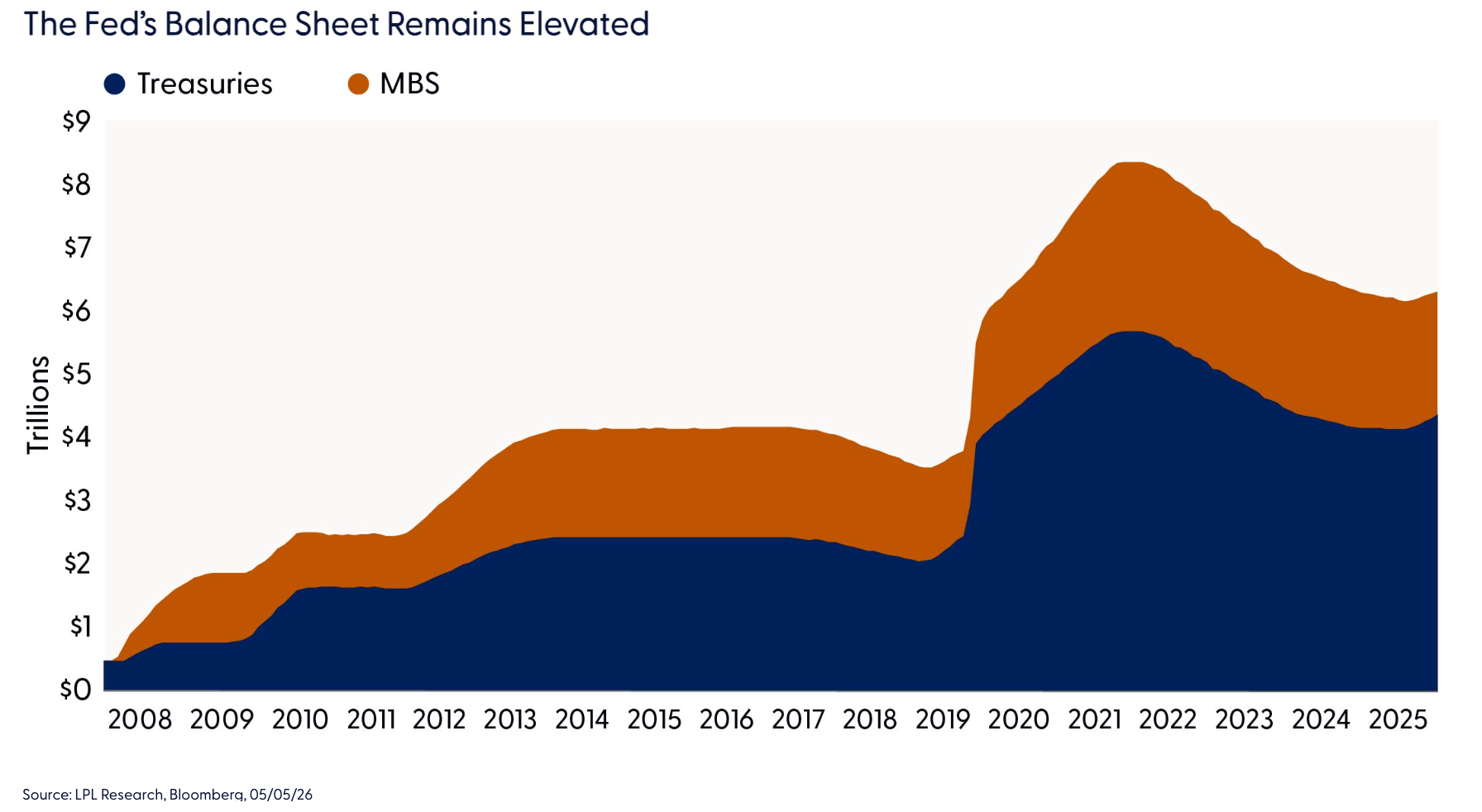
He also sees an oversized balance sheet as blurring the lines between monetary policy and fiscal support. By absorbing a large share of Treasury issuance, the Fed has effectively muted the market’s signal about government borrowing costs, reducing discipline on fiscal policy and making it harder for markets to assess risk.
Shrinking the Footprint — Gradually
Warsh’s proposed solution is straightforward, even if its execution is not. He favors returning the Fed’s asset holdings to a narrower focus on Treasuries and allowing securities to roll off over time, shrinking the balance sheet naturally rather than selling assets aggressively. This would steadily reduce the Fed’s presence and allow private investors and banks to take on a larger role.
Importantly, Warsh has suggested that balance sheet reduction could accompany easier interest rate policy — effectively pairing rate cuts with continued runoff. In that framework, policy support would come through rates rather than through ongoing asset accumulation. Over time, this would push more interest rate risk back into the market, likely leading to higher yields at longer maturities and greater price swings.
From Warsh’s perspective, this is a feature, not a bug. He believes markets function best when prices reflect risk rather than central bank reassurance. A smaller Fed balance sheet, in his view, would help restore healthier price discovery and reduce expectations of Fed intervention during periods of fiscal or market stress.
That said, shrinking the balance sheet further would require the banking system to operate comfortably with fewer reserves. Without changes to the current post-2008 framework — which encourages banks to hold large reserve cushions — the Fed’s ability to downsize meaningfully without triggering market disruptions could remain limited.
Less Guidance, More Market Discipline
Alongside balance sheet reduction, Warsh has been openly skeptical of the Fed’s modern communications toolkit. He has criticized heavy reliance on dot plots, frequent press conferences, and detailed rate signaling as creating an illusion of precision. In colorful terms, he has likened excessive forward guidance to “central bank fast food” — easily consumed, but not particularly nourishing.
Under a Warsh led Fed, investors should expect fewer explicit rate commitments and less commentary designed to smooth over near‑term volatility. The communications style would likely resemble an earlier era: less frequent, more measured, and intentionally ambiguous, encouraging investors to focus more on economic fundamentals — growth, inflation, and fiscal trends — rather than parsing every word from the Fed.
Market Implications: More Volatility, Fewer Promises
A pullback from detailed guidance would almost certainly come with tradeoffs. In the near term, interest rate volatility would likely rise, particularly at the front end of the curve, as markets adjust to less advance signaling. Equity and credit markets could also experience sharper repricing around data releases, as expectations shift more abruptly.
Over time, however, a less talkative Fed may reduce the risk of policy mistakes caused by overpromising support or backing itself into corners it later struggles to exit.
History offers a cautionary reminder here. The 2013 Taper Tantrum showed just how sensitive markets can be to changes in Fed messaging. Simply hinting at a reduction in asset purchases, without any actual tightening, was enough to send Treasury yields sharply higher within months. That episode underscores both the power of Fed communication and the potential consequences when that communication shifts.
Under Warsh, those shifts would be intentional: fewer guarantees, fewer safety nets, and a greater role for markets in setting prices, even if that means more volatility along the way.
Fiscal Pressures Move into Focus: Warnings Grow Louder
The potential shift in Fed leadership comes at a time when concerns about U.S. fiscal health are becoming harder to dismiss. In late April 2026, Fitch Ratings cautioned that persistently large deficits are likely to keep U.S. debt levels well above those of similarly rated sovereigns. The agency expects overall government deficits to run around 8% of gross domestic product (GDP) in both 2026 and 2027, reflecting a mix of recent tax cuts, elevated defense spending, and uncertain tariff revenue. Under those assumptions, the federal debt is projected to climb above 120% of GDP by 2027. Longer-term pressures tied to an aging population and recurring political standoffs over the debt ceiling, only add to the risk profile.
The International Monetary Fund (IMF) has delivered a similarly sobering message, expecting little additional improvement, with shortfalls stabilizing closer to the 7–7.5% range in coming years, and gross federal debt exceeding 140% of GDP by the early 2030s. Of particular concern, the IMF points to a growing reliance on short-term borrowing and warns that stabilizing debt would require a sizable fiscal adjustment.
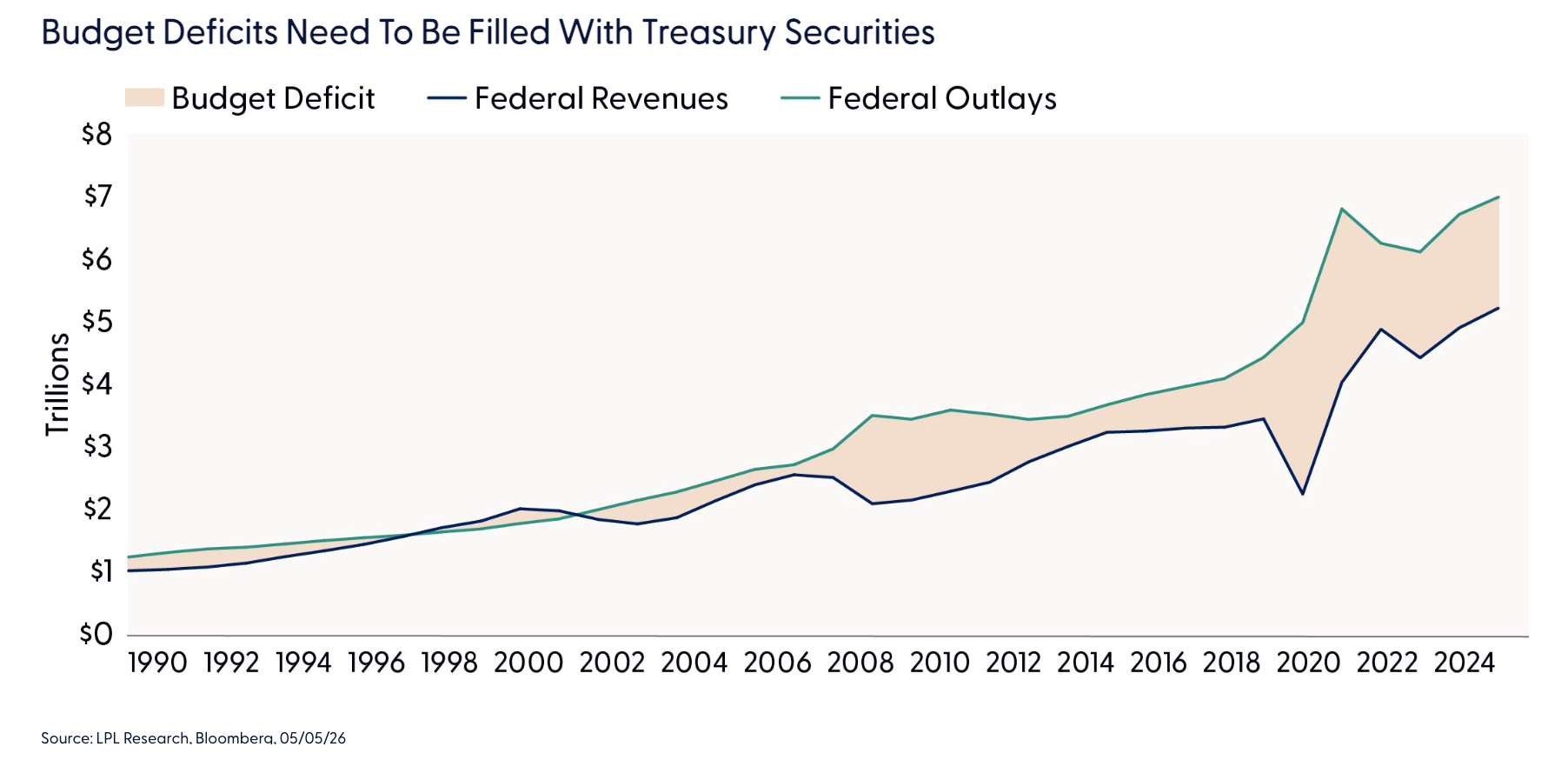
These warnings are no longer theoretical. Debt held by the public has already risen above 100% of GDP for the first time since World War II. Annual interest costs on that debt now exceed $1 trillion, consuming $0.20 of every dollar of federal revenue. Looking ahead, deficits are projected to average above 6% of GDP over the next decade, implying a steady stream of heavy Treasury issuance. As demographic pressures intensify and entitlement spending grows, the window for an orderly fiscal reset appears to be narrowing — and markets may increasingly demand higher compensation to finance it.
A Heavier Supply Era: Treasury Issuance Meets a Changing Buyer Base
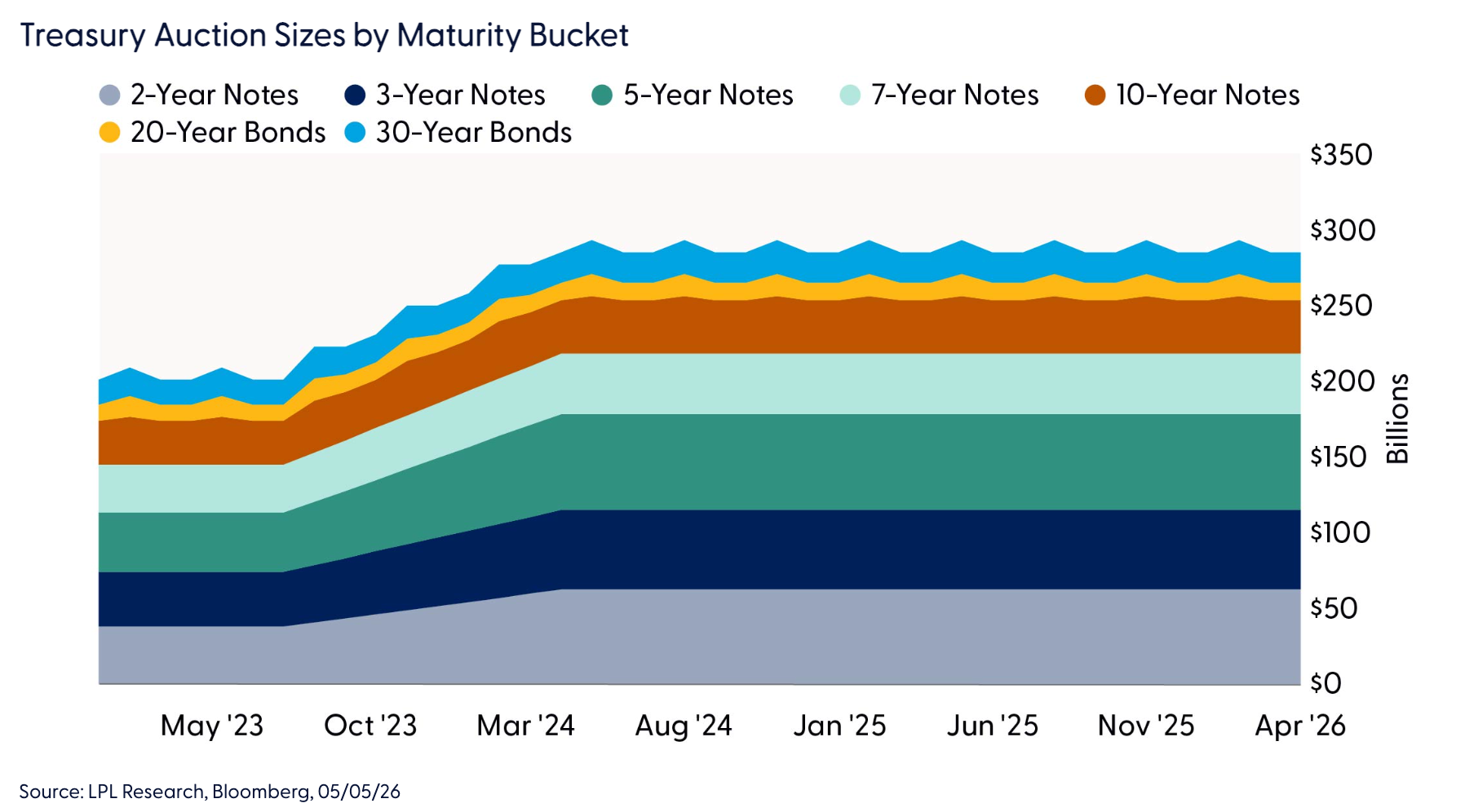
U.S. Treasury issuance has entered a new phase. After years of pandemic-era borrowing and structurally higher deficits, the supply of government debt remains far larger than it was before 2020 — and it is not coming down meaningfully anytime soon. Auction sizes are broadly running well above pre-pandemic norms, and recent fiscal legislation has reinforced a “higher for longer” borrowing outlook. What matters just as much as the volume of issuance, however, is who is being asked to absorb it.
For much of the past decade, Treasuries have benefited from a pair of reliable, price insensitive buyers. The Fed, through quantitative easing, bought duration regardless of yield, mechanically suppressing the term premium. Foreign central banks played a similar role, recycling trade surpluses into Treasuries as part of reserve management. Both anchors have weakened. The Fed is shrinking its balance sheet, and foreign official demand has faded as global reserve managers marginally diversify away from dollar-denominated assets. While the dollar’s reserve currency status remains intact, the identity of the marginal buyer has shifted decisively toward private investors.
Today’s buyers — domestic asset managers, insurance companies, hedge funds, and banks — are far more price sensitive. Unlike central banks, they require adequate compensation to take down supply. As issuance grows and demand becomes more discriminating, yields must do more to clear the market, raising the risk of higher term premiums and less predictable absorption of new debt.
What the Latest Treasury Guidance Tells Us
Last week’s Treasury Quarterly Refunding Announcement (QRA) underscores this dynamic. Borrowing needs remained large and increasingly front‑loaded, even though near‑term projections were broadly in line with expectations. Treasury revised up its estimate for second‑quarter marketable borrowing and projects a sizable borrowing requirement for the third quarter of 2026, in part to maintain higher Treasury General Account balances as a buffer against larger outflows and rollover risks.
At the same time, the issuance cadence is not changing. Treasury held auction sizes steady across nominal coupons, Treasury Inflation-Protected Securities (TIPS), and floating-rate notes for another quarter, reinforcing its message that current auction sizes are likely to persist for several more quarters — which means the Treasury will continue to rely on shorter-maturity Treasury Bill issuance. Heavy borrowing needs and unchanged issuance guidance imply that any future increases in coupon sizes are being pushed further out. Current expectations center on mid-2027, with the likely focus on intermediate maturities — particularly the two- to seven-year sector — where demand conditions will ultimately dictate timing.
The Bottom Line
The transition to a Kevin Warsh led Fed would represent more than a change at the top. It would signal a potential philosophical shift toward a leaner, less interventionist, and less communicative central bank at a time of rising fiscal pressures. Warsh’s emphasis on balance sheet reduction and pared back forward guidance is rooted in restoring market discipline, but it arrives against a backdrop of historically large deficits and rising debt service costs.
Whether this vision can be fully implemented remains an open question. Internal dynamics within the Federal Open Market Committee, combined with external political and fiscal constraints, will shape how far and how fast change can occur. As Mike Tyson famously quipped, “Everyone has a plan until they get punched in the mouth.” While no punches are expected, a policy environment marked by debate, dissent, and compromise seems likely. With the Committee increasingly aligned around a “higher for longer” posture, and with Powell’s continued presence limiting the scope for an abrupt dovish pivot, the odds of aggressive rate cuts under a Warsh chairmanship appear low, in our view.
Importantly, despite a growing debt burden and rising interest costs, the U.S. is not on the verge of a fiscal crisis, nor is the Treasury market at risk of losing its foundational role in the global financial system. Demand will persist, and deficits will be funded. The more relevant question for investors is not whether Treasuries will be bought, but at what price. To date, markets have absorbed supply without protest, suggesting that dire predictions about the immediate end of Treasury exceptionalism remain overstated.
That said, if Warsh’s framework is meaningfully advanced — a significant “if” — the era of abundant central bank insurance may be fading. A return to a more classical policy regime would place greater emphasis on fundamentals, price discovery, and risk differentiation, with a byproduct of volatility as the market does more work
For portfolio construction, this argues for flexibility and discipline. Fixed income investors may favor short-to-intermediate maturities or selective TIPS exposure to balance income generation with duration and inflation risks, while maintaining caution toward the long end of the curve until fiscal credibility improves. Credit markets may face headwinds from higher risk-free rates and a diminished Fed backstop, increasing the premium on issuer quality and balance sheet strength. While the adjustment may be uneven, elevated yields continue to offer attractive income opportunities, particularly for investors prepared to navigate a world with fewer policy promises and more genuine market signals.
Asset Allocation Insights
LPL’s Strategic and Tactical Asset Allocation Committee (STAAC) recently moved its equities recommendation to a tactical overweight and fixed income to underweight to reflect the improving macroeconomic backdrop.
Within balanced portfolios, this adjustment reflects two related changes: neutralizing the underweight to U.S. small cap value and reducing exposure to mortgage-backed securities (MBS) to fund that move. From a portfolio construction standpoint, this lifts equity exposure slightly above benchmarks while keeping overall risk well within the intended tactical range. This reflects improved expected equity returns following market weakness, alongside a more cautious outlook for select areas of core fixed income. While MBS have delivered strong relative performance over recent years, tighter spreads and rising prepayment risks suggest more limited forward return potential.
Overall, our tactical views emphasize a modest equity overweight led by large cap growth, a continued focus on quality bond sectors, caution in rate‑sensitive fixed income sectors, and an ongoing allocation to diversifying strategies and alternatives.
Lawrence Gillum, Chief Fixed Income Strategist, LPL Financial
Brian Booe, Associate Analyst, LPL Financial
Disclosures
This material is for general information only and is not intended to provide specific advice or recommendations for any individual. There is no assurance that the views or strategies discussed are suitable for all investors or will yield positive outcomes. Investing involves risks including possible loss of principal. Any economic forecasts set forth may not develop as predicted and are subject to change.
References to markets, asset classes, and sectors are generally regarding the corresponding market index. Indexes are unmanaged statistical composites and cannot be invested into directly. Index performance is not indicative of the performance of any investment and do not reflect fees, expenses, or sales charges. All performance referenced is historical and is no guarantee of future results.
Any company names noted herein are for educational purposes only and not an indication of trading intent or a solicitation of their products or services. LPL Financial doesn’t provide research on individual equities.
All information is believed to be from reliable sources; however, LPL Financial makes no representation as to its completeness or accuracy.
All investing involves risk, including possible loss of principal.
US Treasuries may be considered “safe haven” investments but do carry some degree of risk including interest rate, credit, and market risk. Bonds are subject to market and interest rate risk if sold prior to maturity. Bond values will decline as interest rates rise and bonds are subject to availability and change in price.
The Standard & Poor’s 500 Index (S&P500) is a capitalization-weighted index of 500 stocks designed to measure performance of the broad domestic economy through changes in the aggregate market value of 500 stocks representing all major industries.
The PE ratio (price-to-earnings ratio) is a measure of the price paid for a share relative to the annual net income or profit earned by the firm per share. It is a financial ratio used for valuation: a higher PE ratio means that investors are paying more for each unit of net income, so the stock is more expensive compared to one with lower PE ratio.
Earnings per share (EPS) is the portion of a company’s profit allocated to each outstanding share of common stock. EPS serves as an indicator of a company’s profitability. Earnings per share is generally considered to be the single most important variable in determining a share’s price. It is also a major component used to calculate the price-to-earnings valuation ratio.
Precious metal investing involves greater fluctuation and potential for losses.
The fast price swings in commodities will result in significant volatility in an investor’s holdings. Commodities include increased risks, such as political, economic, and currency instability, and may not be suitable for all investors.
The NASDAQ Composite Index measures all NASDAQ domestic and non-U.S. based common stocks listed on The NASDAQ Stock Market. The market value, the last sale price multiplied by total shares outstanding, is calculated throughout the trading day, and is related to the total value of the Index. Indexes are unmanaged and cannot be invested in directly.
The MSCI US Broad Market Index captures broad U.S. equity coverage. The index includes 3,204 constituents across large, mid, small and micro capitalizations, about 99% of the U.S. equity universe. Indexes are unmanaged and cannot be invested in directly.
Bonds are subject to market and interest rate risk if sold prior to maturity. Bond values will decline as interest rates rise and bonds are subject to availability and change in price. Private credit carries certain risks — illiquidity, opacity, borrower concentration, and bespoke structures — that distinguish it from corporate bonds and bank loans and complicate its evaluation and oversight.
All index data from FactSet or Bloomberg.
This research material has been prepared by LPL Financial LLC.
A message from Advisor Perspectives and VettaFi: Discover something new! Click here to register for our upcoming webcasts.
Membership required
Membership is now required to use this feature. To learn more:
View Membership BenefitsSponsored Content
Upcoming Virtual Events View All











