Software in the “Age of Intelligence”
Membership required
Membership is now required to use this feature. To learn more:
View Membership BenefitsExecutive summary
Enterprise software is undergoing its most significant reset in a generation. Artificial intelligence (AI) is reallocating value within software—creating clear winners and exposing vulnerabilities in business models that have worked well for the past two decades. We believe investors who treat software as a uniform asset class will make costly mistakes.
What AI has changed
The cost of writing software has collapsed. AI coding tools now perform at the level of elite human programmers, meaning more software will be created and deployed than ever before.
AI is automating knowledge work at scale. Enterprises can now do more with fewer people, putting direct pressure on software companies whose revenue depends on human headcount (seats) growing predictably.
The “software as a service” model is fracturing. The industry is splitting into distinct camps, and this past earnings season made that division even clearer.
Implications for the industry
- Seat-based software incumbents that have not yet adapted their business models may face increasing pressure.
- Companies that benefit from AI-driven usage expansion—infrastructure, security, orchestration—and systems of record deeply embedded in enterprise workflows will be better positioned.
-
Analysis requires a disciplined framework: pricing power, gross margin stability, consumption-based monetization and evidence that AI is accelerating the business.
The two disruptions
Two separate, but related, forces are reshaping enterprise software.
The first is the collapse in the cost of creating software. Since 2022, AI has moved from a novelty to a genuine engineering peer. By late 2025, leading AI coding tools had nearly matched the output of skilled human developers and are continuing to improve. The consequence is straightforward: The volume of software written and deployed globally will increase dramatically. The barrier to creation has effectively fallen, forcing enterprise software investors to re-evaluate how these companies operate.
The second disruption is broader. The same AI systems that write code can now draft documents, synthesize research, manage workflows and automate complex analysis, as well as engage in other agentic knowledge work. Enterprises are realizing that AI doesn't just make developers more productive; it can make entire organizations leaner. That realization raises an uncomfortable question for many software vendors: If AI can perform the work, how many human software seats does an enterprise customer need?
Together, these forces are not destroying software, they are shifting value around and repricing it.
Exhibit 1: Recent Model Advances Rapidly Shifted Coding from Assistance to Autonomy
AI Coding Has Reached an Inflection Point
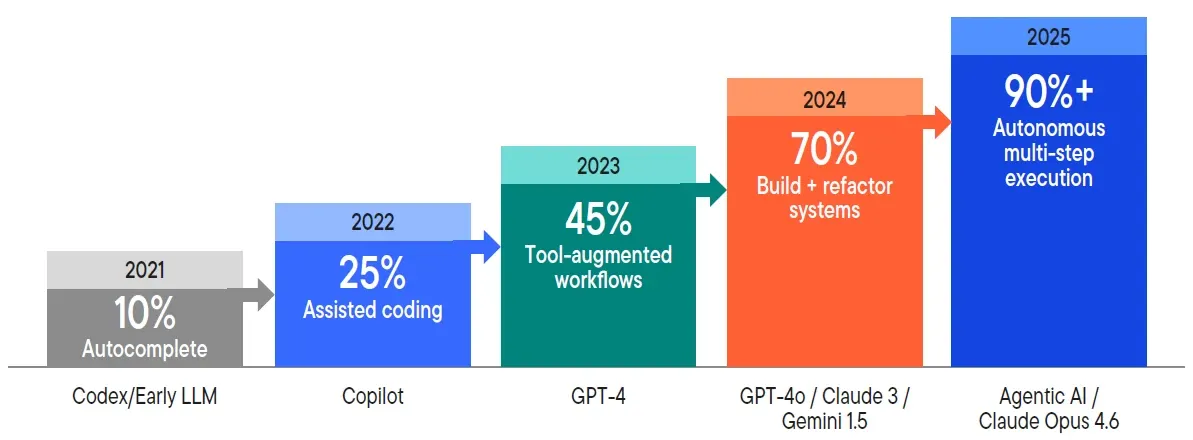
Source: Franklin Equity. This chart represents a framework for illustrating the qualitative shift in coding autonomy since 2021. In 2021, Codex, the first Large Language Model (LLM) focused on content generation and completions. In 2022, GiftHub and Copilot, early real-world developer adoption at scale. In 2023, GPT-4 large rea-soning models with coding support. In 2024, Next-gen multi-modal code models, such as GPT-4o, Gemini 1.5, and Claude 3, which represented step-ups in context length, planning and code-understanding. In 2025, Advanced agentic and coding augmented systems, such as Claude Opus 4.6, integrated agentic tools, which represented the shift toward models that can autonomously plan, execute and manage code workflow through tools, not just generate code.
Discernment: Three camps
We believe the most important insight from this past earnings season is that "software" is no longer a single investment narrative. We think the sector has split into three distinct camps:
- AI workload beneficiaries. As enterprises deploy AI at scale, the underlying systems become more complex. More needs to be monitored, secured, governed and orchestrated. Companies that manage this complexity have started to experience accelerating demand. AI is the engine driving their growth, not a threat to it.
- Seat-model incumbents under pressure. Companies built on the assumption that enterprise headcount would grow predictably (and that each employee would need a license) are facing change. They are not all in decline, but they face a painful transition: reinventing how they capture value at the precise moment customers are questioning how much value they need.
- AI operating platforms. The most compelling long-term opportunity sits here. These are companies whose products serve as the connective tissue of enterprise AI deployment—workflow orchestration, process automation and systems of record with critical enterprise context on how work is done. Their value proposition is strengthening as AI complexity grows and the best of them are growing faster than their pre-AI trajectory with pricing power intact.
The new investment question
The old question was: How fast can this company add seats and upsell value?
The new question is: Where does AI create incremental usage, pricing power and workflow control—and where does it erode them?
This distinction is not subtle. Usage-based expansion driven by AI agents and machine-generated workloads can scale up non-linearly, while headcount-driven seat expansion is capped by the size of the human workforce. The companies best positioned today tend to sit closer to machine activity than to human activity—their products are consumed by systems and workflows, not just by employees logging in each morning.
Our investment framework
We believe companies well-positioned in this environment are aligned with the following criteria:
Pricing power through deep integration. Systems of record and systems of engagement that are genuinely difficult to displace, where switching costs are high and the cost of removal outweighs the cost of staying.
AI-driven revenue acceleration. Companies where we can trace the revenue impact through actual usage growth and expanding customer relationships.
Gross margin stability. The acid test of real pricing power: Can a company add AI capability and get paid for it, or does it simply absorb higher costs? Stable or improving gross margins are a strong signal.
Internal AI leverage. Companies using AI effectively in their own operations, particularly in product development, tend to ship better products faster. This compounds over time.
Consumption or outcome-based monetization. The direction of enterprise software pricing is clear. Companies that have already made this transition, or have a credible path to it, are better positioned for the decade ahead.
The bottom line
AI is not replacing software. It is repricing software by reallocating value away from human-seat models and toward companies embedded in AI-driven infrastructure, data and enterprise orchestration. The total volume of software consumed globally will almost certainly grow. But we believe the distribution of that value will look very different from the past decade.
WHAT ARE THE RISKS?
All investments involve risks, including possible loss of principal.
Equity securities are subject to price fluctuation and possible loss of principal.
Small- and mid-cap stocks involve greater risks and volatility than large-cap stocks.
Investment strategies which incorporate the identification of thematic investment opportunities, and their performance, may be negatively impacted if the investment manager does not correctly identify such opportunities or if the theme develops in an unexpected manner. Focusing investments in the health care, information technology (IT) and/or technology-related industries carries much greater risks of adverse developments and price movements in such industries than a strategy that invests in a wider variety of industries.
Any companies and/or case studies referenced herein are used solely for illustrative purposes; any investment may or may not be currently held by any portfolio advised by Franklin Templeton. The information provided is not a recommendation or individual investment advice for any particular security, strategy, or investment product and is not an indication of the trading intent of any Franklin Templeton managed portfolio.
WF: 10372558
IMPORTANT LEGAL INFORMATION
This material is intended to be of general interest only and should not be construed as individual investment advice or a recommendation or solicitation to buy, sell or hold any security or to adopt any investment strategy. It does not constitute legal or tax advice. This material may not be reproduced, distributed or published without prior written permission from Franklin Templeton.
The views expressed are those of the investment manager and the comments, opinions and analyses are rendered as at publication date and may change without notice. The underlying assumptions and these views are subject to change based on market and other conditions and may differ from other portfolio managers or of the firm as a whole. The information provided in this material is not intended as a complete analysis of every material fact regarding any country, region or market. There is no assurance that any prediction, projection or forecast on the economy, stock market, bond market or the economic trends of the markets will be realized. The value of investments and the income from them can go down as well as up and you may not get back the full amount that you invested. Past performance is not necessarily indicative nor a guarantee of future performance. All investments involve risks, including possible loss of principal.
Any research and analysis contained in this material has been procured by Franklin Templeton for its own purposes and may be acted upon in that connection and, as such, is provided to you incidentally. Data from third party sources may have been used in the preparation of this material and Franklin Templeton ("FT") has not independently verified, validated or audited such data. Although information has been obtained from sources that Franklin Templeton believes to be reliable, no guarantee can be given as to its accuracy and such information may be incomplete or condensed and may be subject to change at any time without notice. The mention of any individual securities should neither constitute nor be construed as a recommendation to purchase, hold or sell any securities, and the information provided regarding such individual securities (if any) is not a sufficient basis upon which to make an investment decision. FT accepts no liability whatsoever for any loss arising from use of this information and reliance upon the comments, opinions and analyses in the material is at the sole discretion of the user.
Franklin Templeton has environmental, social and governance (ESG) capabilities; however, not all strategies or products for a strategy consider “ESG” as part of their investment process.
Products, services and information may not be available in all jurisdictions and are offered outside the U.S. by other FT affiliates and/or their distributors as local laws and regulation permits. Please consult your own financial professional or Franklin Templeton institutional contact for further information on availability of products and services in your jurisdiction.
Issued in the U.S. by Franklin Templeton, One Franklin Parkway, San Mateo, California 94403-1906, (800) DIAL BEN/342-5236, franklintempleton.com. Investments are not FDIC insured; may lose value; and are not bank guaranteed.
You need Adobe Acrobat Reader to view and print PDF documents. Download a free version from Adobe's website.
CFA® and Chartered Financial Analyst® are trademarks owned by CFA Institute.
A message from Advisor Perspectives and VettaFi: Discover something new! Click here to register for our upcoming webcasts.
Membership required
Membership is now required to use this feature. To learn more:
View Membership BenefitsSponsored Content
Upcoming Virtual Events View All












