Key Takeaways
- Tracking labor-market rates (not just headline job numbers) may give investors a clearer read on underlying economic strength.
- Chicago Fed President Austan Goolsbee's "four horsemen" rates to watch are unemployment, hiring, layoff, and vacancy.
- In early 2026, the four horsemen broadly indicated a "low-hire, low-fire" labor market—unemployment and layoffs remained relatively low, but hiring, job-finding, and vacancies had cooled.
- Some economists add the job-finding rate to the four horsemen, because it can diverge from the hiring rate and may reveal whether hires are coming from the unemployed pool or switching jobs.
Most investors understand the importance of tracking the labor market. In the United States, where consumer spending accounts for roughly 70% of gross domestic product (GDP), ebbs and flows in hiring or firing can quickly ripple through the broader economy and into financial markets, turning once-sound investment decisions into costly missteps.
However, relying solely on common metrics like nonfarm payroll employment or jobless claims to assess the labor market's health may not always provide the full picture. Many experts believe a more nuanced approach is required. Monitoring metrics like wage growth and labor force participation can help, but Austan Goolsbee, President of the Chicago Federal Reserve, prefers to focus on what he calls "the four horsemen" of the labor market: the unemployment rate, hiring rate, layoff rate, and vacancy rate.
Goolsbee argues that tracking these labor market rates—rather than unemployment levels—may help investors get a more accurate picture of underlying economic strength. That's because rates account for changes in the size of the labor force, which can distort raw employment numbers.
"The four horsemen of truth and justice, in my view, are rates," Goolsbee explained in an episode of Bloomberg's Odd Lots podcast. "They're less susceptible to the immigration and population labor supply problems."
When combined, the four horsemen can help investors track how jobs are created, filled, and lost—and then gauge how that feeds into the overall level of unemployment. In this article, we'll break down each metric and explain what it might signal for investors.
Read more: Schwab Market Perspective
Unemployment rate
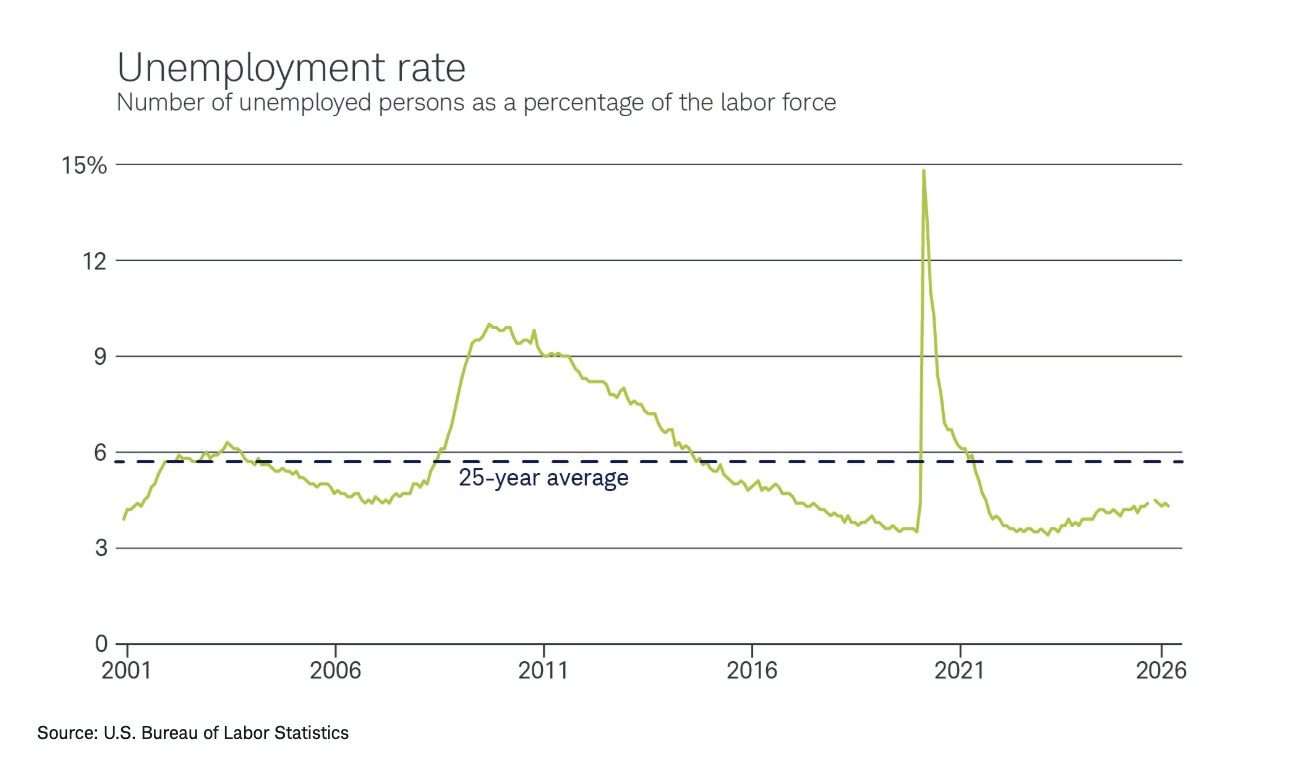
The unemployment rate measures the overall percentage of the labor force that does not currently have a job but is available for—and actively seeking—employment. It's calculated by dividing the number of unemployed persons by the total labor force, then multiplying by 100 to get a percentage.
A low unemployment rate often suggests the labor market is tight and the economy is strong, while a high unemployment rate typically signals a loose labor market and an economy that may be slowing or already contracting.
On its own, the unemployment rate provides only a snapshot of current labor market conditions. For investors, it's important to watch the rate's trend over time and compare current unemployment levels with historical averages.

Layoff rate
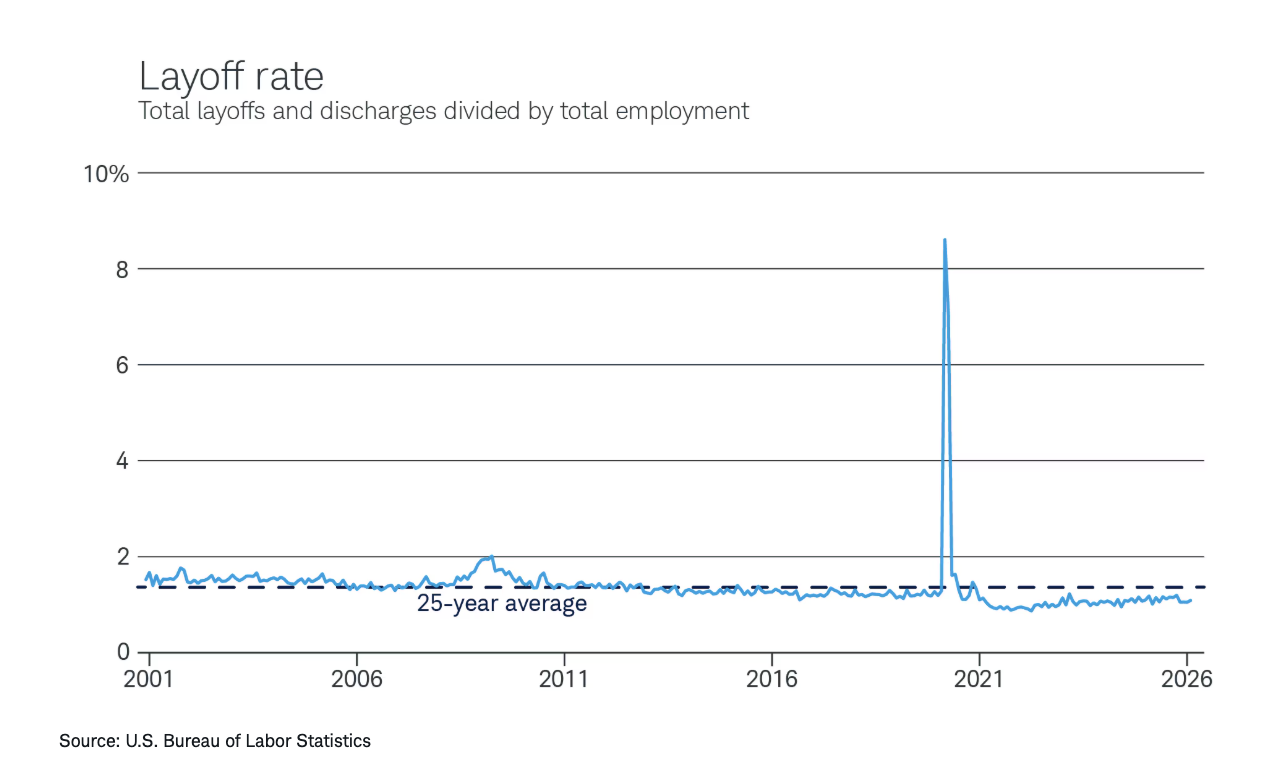
The layoff rate is the percentage of employed workers who lose their jobs each month. It's calculated by dividing total layoffs and discharges by total employment, then multiplying by 100 to get a percentage.
This metric captures the pace of employer-driven job separations, helping investors gauge potential pressure on household incomes and, therefore, consumer spending.
A high layoff rate typically signals stress in the labor market and the broader economy, with employers cutting back on headcount to reduce costs. A low layoff rate means employers are reluctant to let go of workers, which can point to a tight labor market or stable, if slower, economic growth. Historically, a layoff rate near its long-term average—rather than high or low—has been associated with a relatively healthy labor market.
Investors should consider paying attention to any sudden or outsized jumps in this metric, as they may occur near the start of economic downturns. Layoff rates often spike early in recessions before easing as the economy recovers.
Vacancy rate
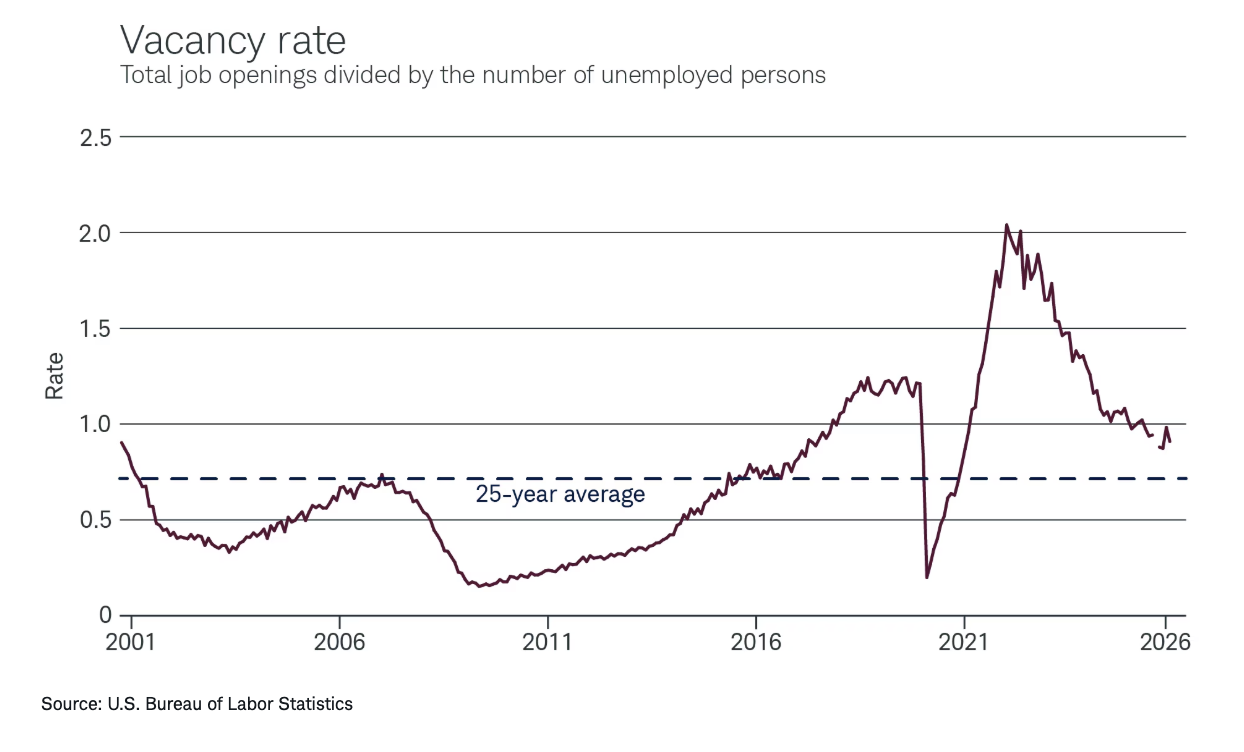
The vacancy rate is the number of unfilled job openings per unemployed worker. It's calculated by dividing total nonfarm job openings by the number of unemployed persons. This rate measures demand for labor and is used to gauge labor market tightness.
A high vacancy rate is often seen as a sign that the labor market is loose, while a low vacancy rate typically means the labor market is tight. However, interpreting the vacancy rate can be difficult and depends on context. For example, a high vacancy rate can stem from weak labor demand amid economic weakness or from a surge in difficult-to-fill job openings. On the other hand, a low vacancy rate can indicate an efficient labor market with strong hiring, or it can signal a stagnating economy with low hiring.
This metric can still be a useful leading indicator for investors. It tends to fall when the labor market is cooling and then drop rapidly during recessions as companies pull job listings.
Hiring rate
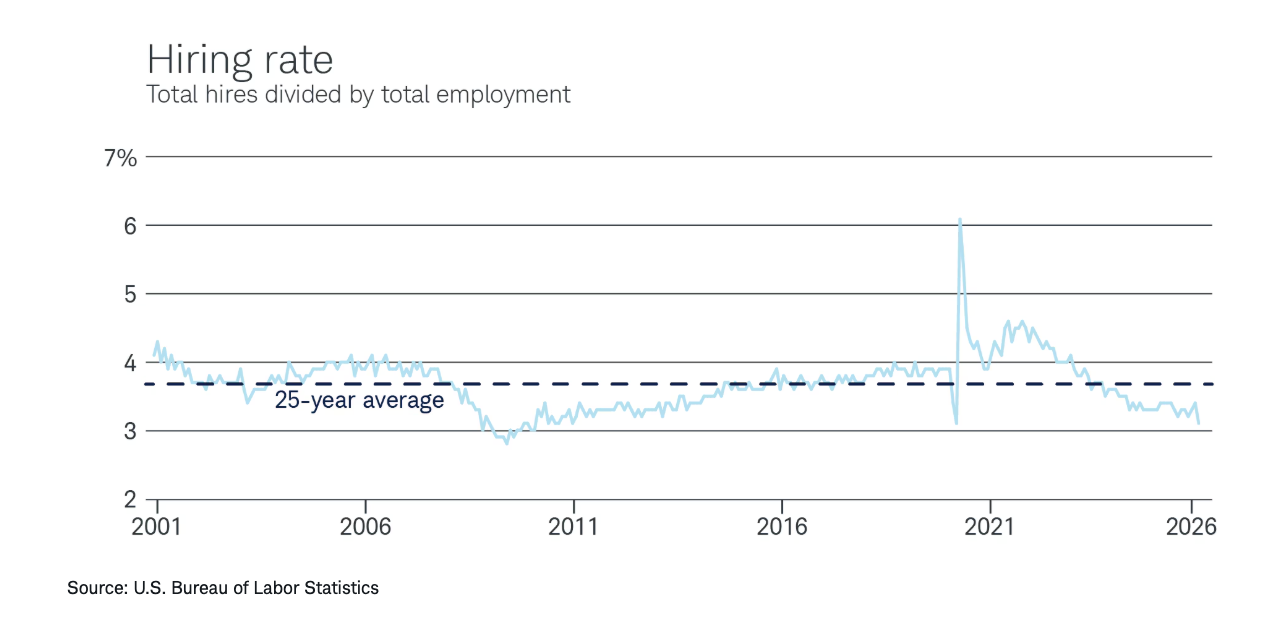
The hiring rate is a measure of how fast companies are filling open positions. It's calculated by dividing the total number of hires by total employment, then multiplying by 100 to get a percentage.
This rate offers a read on how efficiently labor demand is translating into actual employment. An elevated hiring rate typically reflects strong demand for labor and a growing economy in which companies are competing for talent. Conversely, a low hiring rate can signal weak demand for labor and greater economic uncertainty.
This metric is another useful leading indicator, since companies in periods of economic stress often reduce or freeze hiring before turning to layoffs. As a result, the hiring rate tends to drift lower as labor markets weaken and can drop sharply during recessions.
A fifth horseman?
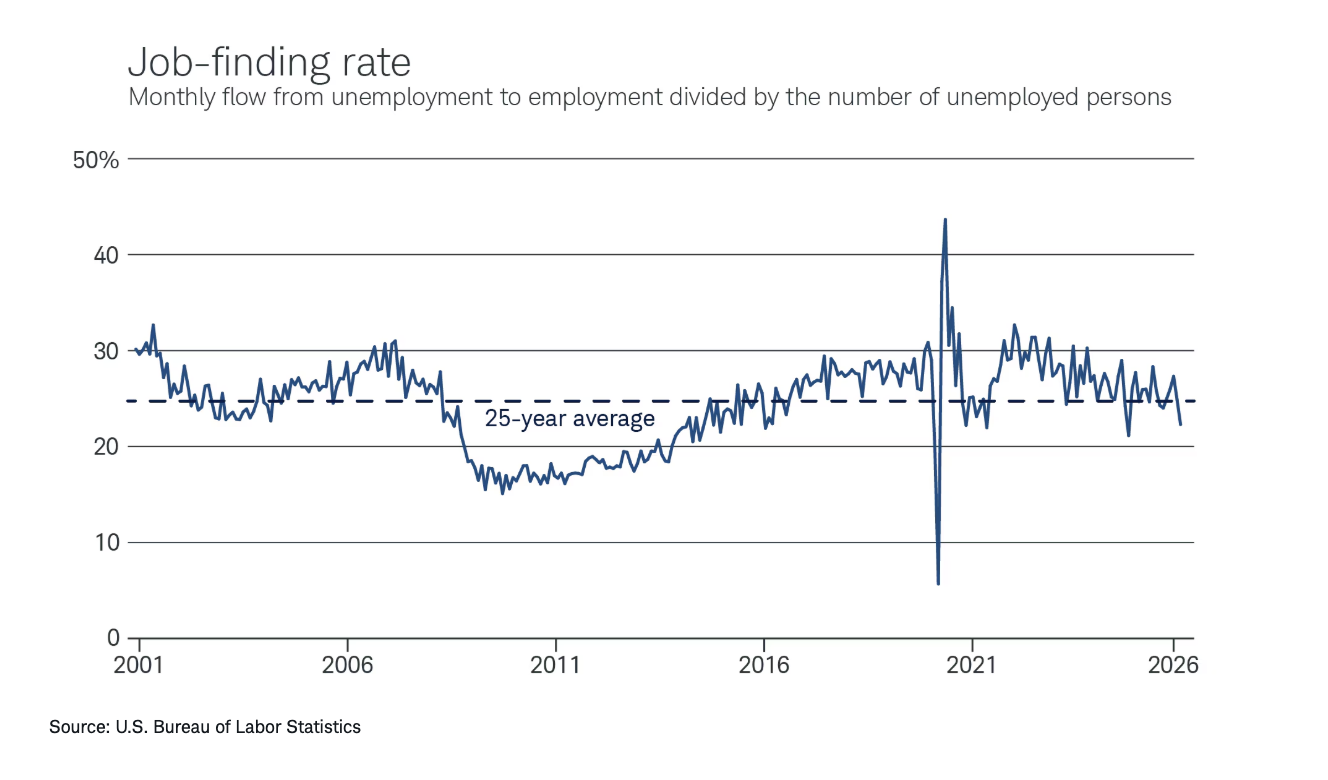
Some economists consider the job-finding rate—which measures the odds of an unemployed worker finding a job within a given month—to be one of the four horsemen of the labor market rather than the hiring rate. It's calculated by dividing the monthly flow from unemployment to employment by the number of unemployed workers, then multiplying by 100 to get a percentage.
By measuring how quickly unemployed workers are finding jobs, the job-finding rate provides the worker's side of the hiring story.
While related to the hiring rate, it's a distinct metric that can offer insight into underlying labor market conditions, particularly when used with other tools. For example, an elevated hiring rate alongside a weak job-finding rate may suggest employers are filling jobs—but generally not from the pool of unemployed workers. Instead, they may be hiring from other firms or leaning on temporary or contract workers. This scenario can be a sign there is a "skills gap" in the economy, where the skills employers require for roles and the abilities of available workers don't align.
Where are the four horsemen headed now?
Although the labor market has shown signs of softening in 2026, the four horsemen mainly point to an ongoing "low-hire, low-fire" environment.
The unemployment rate, while elevated from its post-COVID lows, sat at just 4.3% in April. That's well below the 25-year average of 5.7% and just slightly above its five-year average of 4.1%. At the same time, even though big tech layoffs have garnered attention this year, the layoff rate remains low on a historical basis, indicating most employers remain reluctant to let go of talent.
The hiring, job-finding, and vacancy rates, however, aren't looking as strong. Together, these measures suggest that finding a new job has become more challenging for workers who quit or were laid off.
In March, the hiring rate was 3.5%, just below its 25-year average of roughly 3.7%. The job-finding rate also slipped below its 25-year average earlier this year, although it recovered in March. And although the vacancy rate remains above its 25-year average, it's fallen sharply from its late 2021 highs and is significantly lower than pre-pandemic levels.
When viewed together, the four horsemen provide a picture of the labor market that has made some economists cautious about the outlook for the U.S. economy.
"Right now, it's all about low-hire, low-fire," economist Claudia Sahm said on a recent episode of the OnInvesting podcast. "This doesn't feel like a sustainable setup. Something is going to switch. Either hiring picks up because the economy has been growing, or maybe the growth we've seen in the economy wasn't really there."
ADP's chief economist, Nela Richardson, is slightly less pessimistic. "I would describe the labor market simply as solid, but highly fragmented," she said on another recent episode of the OnInvesting podcast, noting that healthcare job growth has lifted overall employment in 2025 and 2026 despite weakness in other sectors of the economy.
A few more rates to consider
While the four horsemen can help investors gauge labor market conditions and make more informed investment decisions, there are a few other lesser-known labor market rates that can provide more context, particularly in the current environment.
The quit rate, for example, measures the number of employees who voluntarily leave their jobs as a percentage of total employment. After spiking in 2021 and 2022, this rate has been stuck well below pre-pandemic levels for more than two years, signaling workers are reluctant to test the job market in the current low-hire, low-fire environment.
The labor force participation rate—which tracks the percentage of the population that is either working or actively looking for work—can also offer insights into underlying economic conditions. This rate fell to a four-and-a-half-year low of 61.9% in March. Declining participation can weigh on economic growth and, in some cases, artificially inflate the unemployment rate and obscure underlying labor market weakness.
Bottom line: The four horsemen ride together
These four rates—vacancy, layoff, unemployment, and hiring—work best as a set and when viewed in context. Each metric captures a different dimension of the labor market and is influenced by numerous factors.
Layoff and hiring rates, for example, help gauge flows in and out of the labor market, but they can be affected by skill misalignment or aging populations. The vacancy rate, meanwhile, tracks labor demand but can be thrown off by "ghost" job postings that don't truly represent immediate hiring needs. Finally, the unemployment rate serves as the scorecard for the labor market, but it can be impacted by population changes.
Despite their limitations, when used together—and alongside other metrics like the quit rate and labor force participation rate—the four horsemen may give investors a clearer view of labor-market trends. Used in context, these indicators can help investors assess economic risks and make more informed decisions.
This material is intended for general informational and educational purposes only. This should not be considered an individualized recommendation or personalized investment advice. The investment strategies mentioned are not suitable for everyone. Each investor needs to review an investment strategy for his or her own particular situation before making any investment decisions.
For illustrative purpose(s) only. Individual situations will vary. Not intended to be reflective of results you can expect to achieve.
All expressions of opinion are subject to change without notice in reaction to shifting market, economic or political conditions. Data contained herein from third party providers is obtained from what are considered reliable sources. However, its accuracy, completeness or reliability cannot be guaranteed.
Investing involves risk, including loss of principal.
Supporting documentation for any claims or statistical information is available upon request.
A message from Advisor Perspectives and VettaFi: Discover something new! Click here to register for our upcoming webcasts.
© Charles Schwab
Read more commentaries by Charles Schwab