From the April payroll report released on May 8, we realize that not all industries are equally impacted by AI. Diagnostic imaging centers, an area where AI is thought to replace humans, have increased demand for workers, whereas bookkeeping demand has declined in recent years. William Jevons, a British economist born in the same town as the Beatles but less famous, explained that increased efficiencies may spark additional demand and that this concept may help us understand the potential AI impacts on the job market.
The Jevons paradox suggests that when technology makes the use of a resource more efficient, demand for that resource can rise rather than fall because lower costs unlock new uses and broader adoption. Applied to AI and the labor market, this means AI may reduce the time and cost required to perform many tasks, but that does not necessarily imply a proportional decline in labor demand. Instead, by making tasks, software development, customer service, research, and operations more productive, AI can expand the volume of work organizations are able to undertake and create demand for new roles, new products, and new business models. Or in the case of diagnostic imaging centers, as mentioned above, the lower cost of the service is a catalyst for a spike in demand, and so a firm hires more workers to meet the shift in demand.
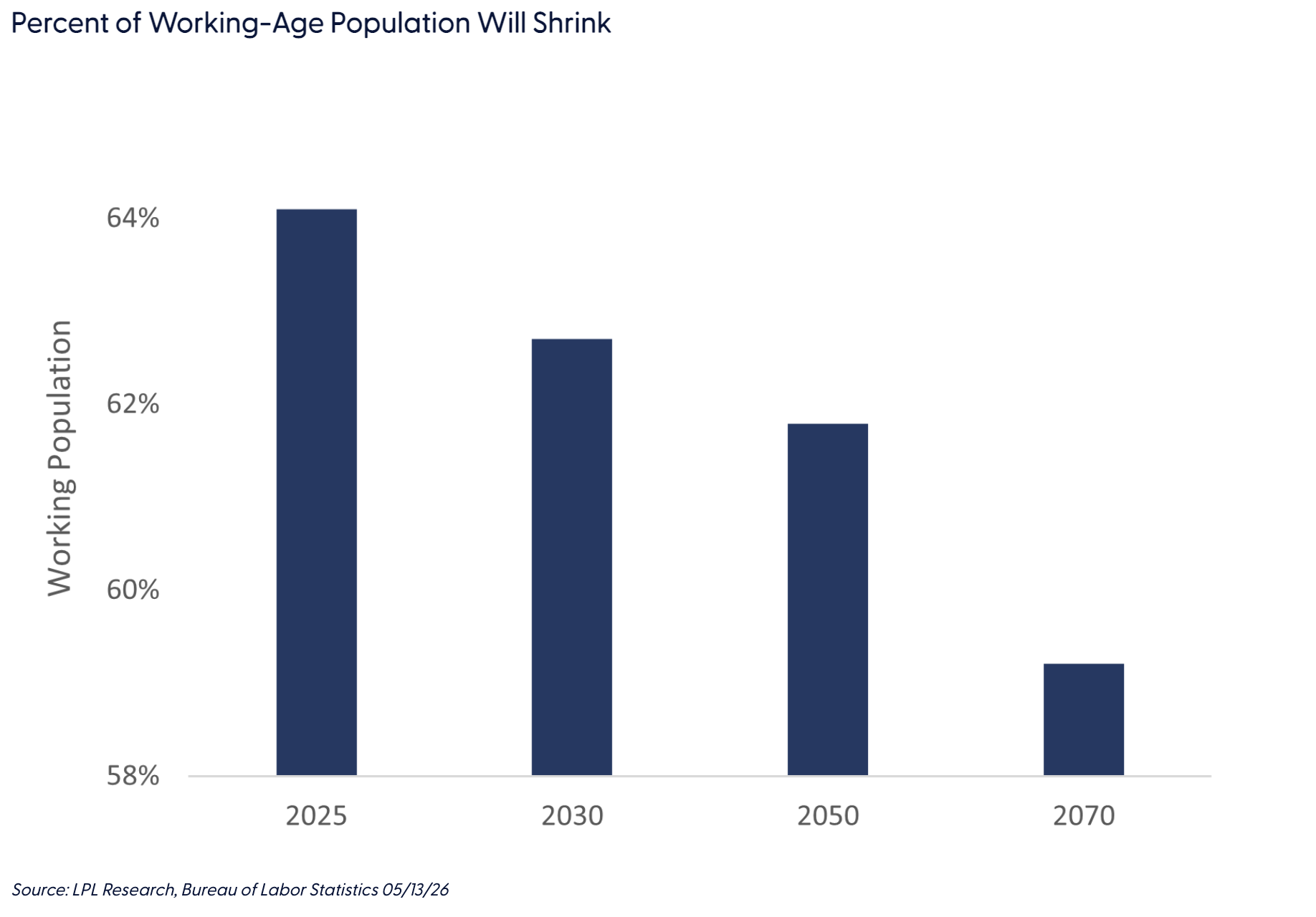
The implication is that AI’s labor-market impact will likely be less about the wholesale elimination of jobs and more about the reallocation of tasks across workers, firms, and industries. Some routine or automatable tasks will be displaced, and certain occupations will face pressure. But as AI lowers the cost of service, demand may increase for workers who can use AI effectively, improve workflows, and apply human judgment. In this sense, AI could follow a Jevons-like pattern: greater efficiency may increase the overall demand for AI-enabled work, even as it changes the composition of employment and raises the premium on adaptability, digital fluency, and higher-value human skills. And AI may end up being the antidote to a shrinking labor force.
Read more: Energy Shock Expected to Hit Prices Harder Than the Economy

Policymakers and investors increasingly see AI as a way to offset the economic drag from aging populations, especially in developed economies where the workforce is starting to shrink. As more people move into retirement and a larger share of the population is over 70, fewer workers are available to support overall growth. AI is viewed as a way to fill that gap by boosting how much each worker can produce rather than relying on a larger workforce. It can automate repetitive tasks, enhance decision-making, and allow smaller teams to generate the same or greater output. That dynamic matters for governments as well, since slower workforce growth puts pressure on tax revenue while spending on healthcare and pensions is rising.
From an investor perspective, AI is also tied to long-term profitability in a world where labor is becoming scarcer and more expensive. Companies that adopt these technologies can reduce their dependence on hiring while improving efficiency and output, which helps protect margins. This encourages more spending on technology and capital investment as businesses look to substitute machines for labor. Over time, many investors believe AI could drive a sustained increase in productivity similar to earlier technological shifts. In that sense, it is being treated as a structural solution to demographic challenges, one that could extend the growth trajectory of aging economies while supporting returns even as population dynamics become less favorable.
AI is likely to reshape rather than simply eliminate jobs, with efficiency gains potentially increasing demand for AI-enabled work while raising the premium on adaptability and human judgment.
For more ways AI will shape the outlook for economic growth, inflation, and the job market, check out this month’s Economic Navigator.
Jeffrey Roach guides the overall view of the economy for LPL Financial Research and has over 20 years of experience in investing and economics.
Important Disclosures
This material is for general information only and is not intended to provide specific advice or recommendations for any individual. There is no assurance that the views or strategies discussed are suitable for all investors. To determine which investment(s) may be appropriate for you, please consult your financial professional prior to investing.
Investing involves risks including possible loss of principal. No investment strategy or risk management technique can guarantee return or eliminate risk.
Indexes are unmanaged and cannot be invested into directly. Index performance is not indicative of the performance of any investment and does not reflect fees, expenses, or sales charges. All performance referenced is historical and is no guarantee of future results.
This material was prepared by LPL Financial, LLC. All information is believed to be from reliable sources; however LPL Financial makes no representation as to its completeness or accuracy.
Unless otherwise stated LPL Financial and the third party persons and firms mentioned are not affiliates of each other and make no representation with respect to each other. Any company names noted herein are for educational purposes only and not an indication of trading intent or a solicitation of their products or services.
Asset Class Disclosures –
International investing involves special risks such as currency fluctuation and political instability and may not be suitable for all investors. These risks are often heightened for investments in emerging markets.
Bonds are subject to market and interest rate risk if sold prior to maturity.
Municipal bonds are subject and market and interest rate risk and potentially capital gains tax if sold prior to maturity. Interest income may be subject to the alternative minimum tax. Municipal bonds are federally tax-free but other state and local taxes may apply.
Preferred stock dividends are paid at the discretion of the issuing company. Preferred stocks are subject to interest rate and credit risk. They may be subject to a call features.
Alternative investments may not be suitable for all investors and involve special risks such as leveraging the investment, potential adverse market forces, regulatory changes and potentially illiquidity. The strategies employed in the management of alternative investments may accelerate the velocity of potential losses.
Mortgage backed securities are subject to credit, default, prepayment, extension, market and interest rate risk.
High yield/junk bonds (grade BB or below) are below investment grade securities, and are subject to higher interest rate, credit, and liquidity risks than those graded BBB and above. They generally should be part of a diversified portfolio for sophisticated investors.
Precious metal investing involves greater fluctuation and potential for losses.
The fast price swings of commodities will result in significant volatility in an investor's holdings.
This research material has been prepared by LPL Financial LLC.
Not Insured by FDIC/NCUA or Any Other Government Agency | Not Bank/Credit Union Deposits or Obligations | Not Bank/Credit Union Guaranteed | May Lose Value
For Public Use – Tracking: #1113157
A message from Advisor Perspectives and VettaFi: Discover something new! Click here to register for our upcoming webcasts.
Read more commentaries by LPL Financial