Supply Shocks and AI-Related Demand Blur Inflation Signals for the Fed
Membership required
Membership is now required to use this feature. To learn more:
View Membership BenefitsRecent Federal Reserve communications have turned more hawkish, reflecting concern that persistent supply-driven price pressures could begin to feed into inflation expectations. But unlike in prior cycles, today’s environment is not defined by supply shocks alone. The forces driving higher costs – geopolitical tension, energy disruptions, and strategic investment – are coinciding with a surge in AI-related spending and wealth effects that are supporting demand in parts of the economy.
This combination matters for policy. Traditionally, central banks can “look through” supply shocks because they weigh on real incomes and demand. Today, however, supply constraints may be interacting with investment- and wealth-driven demand in ways that blur that signal – raising the risk of misdiagnosing the underlying inflation process. What’s more, the demand augmentation from AI could eventually give way to a more disinflationary rise in productivity and fall in labor share (for more, read our 21 May 2026 Macro Signposts, “AI, Market Power, and Diminishing Labor Share”).
Read more: Measuring What Matters in Public and Private Fixed Income
Our baseline is that this uncertainty keeps the Fed on hold through 2026, followed by rate cuts in 2027. However, the range of outcomes is widening, with a growing risk that policy will need to pivot more abruptly in either direction in 2027.
Fed signals openness to rate hikes amid inflationary pressures
Recent Fed communications suggest policymakers are increasingly sensitive to the risk that inflation remains above target. Minutes from the April Fed meeting indicate that a majority of participants see further policy firming as appropriate if inflation does not moderate, while a range of Fed officials have since publicly commented that rate hikes can no longer be ruled out.
The Fed’s hawkish pivot comes as U.S. Personal Consumption Expenditures (PCE) annualized inflation – both headline (which includes food and energy prices) and core measures – has accelerated in recent months to levels more than a percentage point above the Fed’s 2% long-term inflation target. (Learn more about how the Fed assesses inflation in our 6 May 2026 Macro Signposts, “U.S. Inflation Measures Tell Two Different Stories.”)
The acceleration in PCE data, along with stabilizing labor market momentum and some moderation in the unemployment rate, has lifted the Fed’s own Taylor rule estimates of appropriate monetary policy. The range of rules the Fed reports in its semiannual Monetary Policy Report to Congress suggests the policy rate is 75 to 100 basis points (bps) too accommodative (see Figure 1). (The Taylor rule is a formula, with several variations, that estimates an appropriate level for the policy rate based on economic data.)
Figure 1: The Fed’s Taylor rule estimates indicate current monetary policy is accommodative

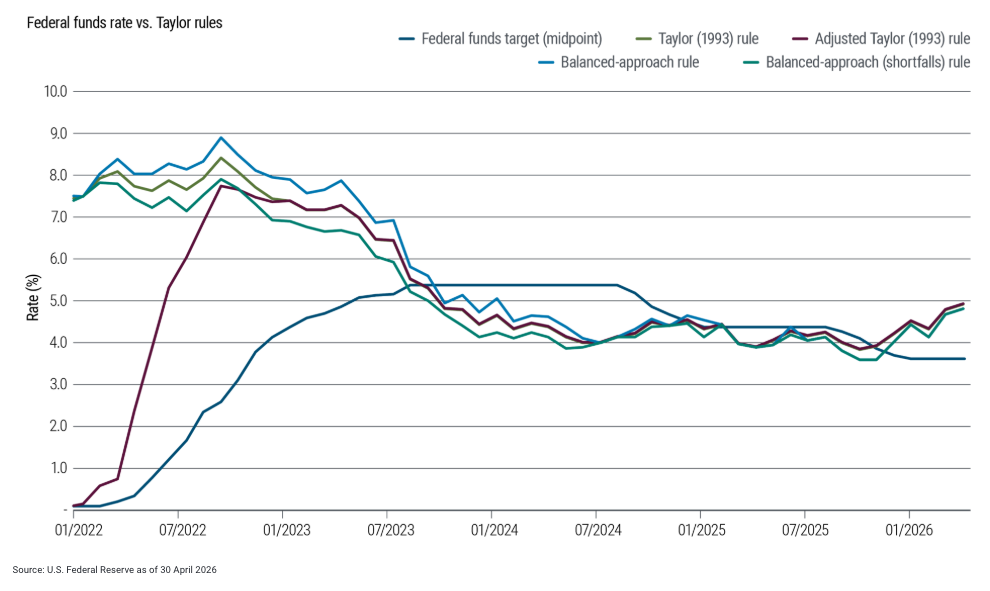
Stubbornly elevated inflation has coincided with supply shocks, including tariffs and higher energy prices from the Iran conflict. Economic theory and historical evidence suggest that central banks should be cautious about tightening policy aggressively in response to supply-driven price pressures – in other words, that they should “look through” the inflation data. This tendency likely explains the current gap between policy rules (such as the Taylor rule) and actual policy.
However, other trends in the U.S. economy – with its large-scale tech and energy sectors – complicate the inflation outlook. We may see supply shocks contributing to or at least coinciding with stronger demand in certain sectors. For example, geopolitical tensions may be driving greater urgency to invest in AI in an effort to boost efficiency and scalability, lower labor costs, and support national security. Furthermore, if global energy prices stay elevated, eventually U.S. energy investment will likely rise, too.
Just how strong these demand-side impulses will be against what, for most households (and non-energy businesses), is a real income squeeze due to higher prices is a key question for the Fed and other policymakers. (Read more in our 22 April 2026 Macro Signposts, “Higher Energy Costs, Weaker Tax Relief Squeeze U.S. Households.”) Which part of the “K-shaped” economic trends will dominate is uncertain, leaving central bankers open to a wider distribution of possible rate outcomes.
Supply shocks and optimal policy
Taking a step back, questions around how monetary policy should respond to supply shocks are not new. While monetary policy rules would prescribe hikes in the face of supply-induced inflation, both economic theory and historical evidence suggest that central banks should be cautious about tightening aggressively in response to supply-driven price pressures.
When inflation is driven by excess demand, higher interest rates can help bring inflation down while also slowing economic activity, which helps stabilize both sides of the Fed’s dual mandate (i.e., price stability and maximum employment).
Supply shocks present a fundamentally different trade-off. When inflation is driven by a negative supply shock – such as an increase in energy prices or a disruption to global supply chains – prices rise even as output weakens. In this case, tighter monetary policy can help cool demand, but it also risks amplifying the growth slowdown and raising unemployment, without directly addressing the underlying source of inflation.
This asymmetry is embedded in monetary policy frameworks. Under flexible inflation-targeting strategies, central banks leave themselves room to “look through” temporary increases in inflation – particularly when inflation expectations remain well-anchored – while focusing their policy response on more persistent, demand-driven pressures. Monetary policy works through long and variable lags, so responding too aggressively to temporary supply-driven inflation spikes can create unnecessary volatility in future output and employment.
Beyond the frameworks, many central banks historically have followed this approach in practice as well. According to a BIS study,1 over recent decades, central banks in advanced economies – and the Fed in particular – have systematically responded more forcefully to demand-driven inflation than to supply-driven inflation.
Looking through has limits
A strategy of “looking through” supply shocks is not without limits.
For one, sustained above-target inflation – regardless of its origin – could lead to a de-anchoring of inflation expectations. If households and firms begin to expect higher inflation to persist, price- and wage-setting behavior can adjust in ways that make inflation more entrenched and harder to reverse (a self-stoking cycle). In such cases, a more aggressive policy response may ultimately be required, even if the initial shock was supply-driven.
Currently, U.S. inflation expectations across consumers, professional forecasters, and the markets appear well-anchored. Measures within the University of Michigan Survey have accelerated recently, but changes in the survey methodology make it more difficult to interpret that survey in the context of historical data. Other surveys, including the New York Fed Survey, the Livingston Survey, and the Survey of Professional Forecasters, all indicate U.S. inflation expectations remain well-contained.
Another challenge, however, is calculating, in real time, the degree to which above-target inflation is related to supply versus demand factors – especially when both supply and demand shocks coincide, or supply shocks induce stronger demand for investment.
Decomposing today’s inflation into supply and demand
What is the dominant driver of inflation today: supply or demand?
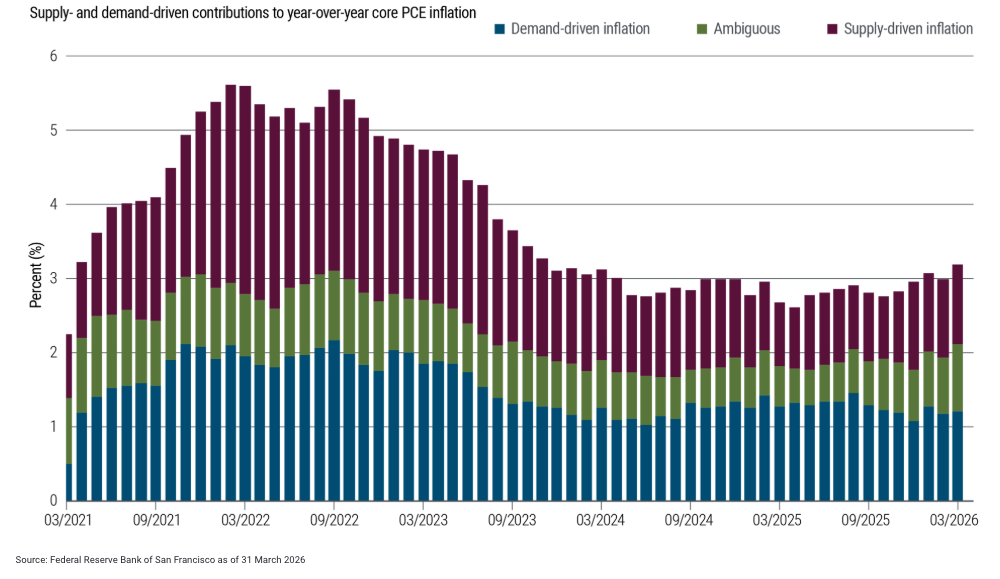
Research by San Francisco Fed economist Adam Shapiro2 finds that supply has been an important driver of both headline and core inflation since October 2025 – when core PCE inflation started to accelerate – but other more puzzling factors are also at play. His research, which is based on the correlation between unexpected price changes and consumers’ real purchases of goods and services, finds that supply accounts for roughly 20 basis points (bps) of the 40-bp and 80-bp acceleration in annualized core and headline PCE inflation, respectively. What accounts for the rest of the acceleration is what he labels “ambiguous” – i.e., the correlation between inflation surprises and changes in real consumption isn’t strong enough statistically to say one way or the other (see Figure 2).
How this ambiguous component evolves may dictate how the central bank needs to respond.
Figure 2: Research points to ambiguous drivers of recent acceleration in U.S. inflation
Implications for monetary policy
Supply shocks are clearly contributing to elevated U.S. inflation, but they are not operating in isolation. Parts of the economy – particularly those tied to AI investment and equity-driven wealth – continue to generate pockets of demand resilience, even as higher energy costs and tariffs weigh on real incomes more broadly. The potential for realized productivity gains from AI to eventually be more disinflationary is yet another layer of complexity.
This interaction complicates policy in two ways. First, it makes it harder to cleanly decompose inflation into supply and demand drivers in real time. Second, it raises the risk that monetary policy responds to the wrong signal – tightening into a supply-driven slowdown or easing into a demand-driven reacceleration.
For now, well-anchored inflation expectations give the Fed scope to remain patient, supporting our expectation that policy stays on hold through 2026. However, as long as inflation remains above target and its drivers remain ambiguous, the Fed and markets are likely to face a wider-than-usual distribution of policy outcomes.
A message from Advisor Perspectives and VettaFi: Discover something new! Click here to register for our upcoming webcasts.
Footnotes:
1 Boris Hofmann, Cristina Manea, and Benoît Mojon. “Targeted Taylor rules: some evidence and theory.” Bank for International Settlements (BIS) Working Paper no. 1234 (revised September 2025). ↩
2 “Supply- and Demand-Driven PCE Inflation.” Federal Reserve Bank of San Francisco Research and Insights (30 April 2026). ↩
Disclosures
All investments contain risk and may lose value.
Statements concerning financial market trends or portfolio strategies are based on current market conditions, which will fluctuate. There is no guarantee that these investment strategies will work under all market conditions or are appropriate for all investors and each investor should evaluate their ability to invest for the long term, especially during periods of downturn in the market. Outlook and strategies are subject to change without notice.
PIMCO as a general matter provides services to qualified institutions, financial intermediaries and institutional investors. Individual investors should contact their own financial professional to determine the most appropriate investment options for their financial situation. This material contains the opinions of the author] and such opinions are subject to change without notice. This material has been distributed for informational purposes only and should not be considered as investment advice or a recommendation of any particular security, strategy or investment product. Information contained herein has been obtained from sources believed to be reliable, but not guaranteed. No part of this material may be reproduced in any form, or referred to in any other publication, without express written permission. PIMCO is a trademark of Allianz Asset Management of America LLC in the United States and throughout the world.
Pacific Investment Management Company LLC (“PIMCO”) is an investment adviser registered with the U.S. Securities and Exchange Commission (“SEC”). PIMCO Investments LLC (“PIMCO Investments”) is a broker-dealer registered with the SEC and member of the Financial Industry Regulatory Authority, Inc. (“FINRA”). PIMCO and PIMCO Investments is solely responsible for its content. PIMCO Investments is the distributor of PIMCO investment products, and any PIMCO Content relating to those investment products is the sole responsibility of PIMCO Investments.
The information provided herein is not directed at any investor or category of investors and is provided solely as general information about our products and services and to otherwise provide general investment education. No information contained herein should be regarded as a suggestion to engage in or refrain from any investment-related course of action as none of PIMCO nor any of its affiliates is undertaking to provide investment advice, act as an adviser to any plan or entity subject to the Employee Retirement Income Security Act of 1974, as amended, individual retirement account or individual retirement annuity, or give advice in a fiduciary capacity with respect to the materials presented herein. If you are an individual retirement investor, contact your financial advisor or other fiduciary unrelated to PIMCO about whether any given investment idea, strategy, product or service described herein may be appropriate for your circumstances.
Check the background of this firm on FINRA's BrokerCheck.
PIMCO is a trademark of Allianz Asset Management of America LLC in the United States and throughout the world. ©2026 PIMCO. All Rights Reserved. Investment Products: NOT FDIC INSURED | MAY LOSE VALUE | NOT BANK GUARANTEED.

© PIMCO
Membership required
Membership is now required to use this feature. To learn more:
View Membership BenefitsSponsored Content
Upcoming Virtual Events View All












