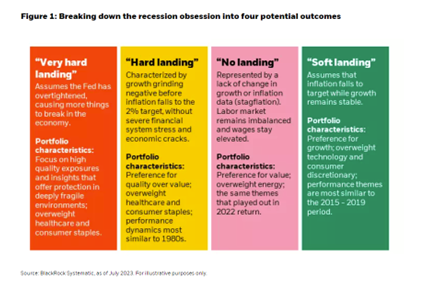
With inflation falling and growth slowly grinding lower, time is running out on many global central bank tightening cycles – especially for the Federal Reserve (Fed) that meets next week.
Karthik Narayanan, Head of Securitized Credit for Guggenheim Investments, and Tom Nash, a director on our Commercial Mortgage-Backed Securities (CMBS) sector team, join Macro Markets to discuss drivers of performance, current conditions in real estate, and where they are finding value in CMBS and in other types of structured credit.
To find the best stocks to invest in, there are more than 19,000 stocks to pick from in the US and Canadian markets alone. Consequently, how is the individual self-directed investor able to find the best stocks to meet their goals objectives, and risk tolerances?
Commodity ETFs have seen a significant dip in financial advisors' interest and YTD flows in 2023.
Multilateral development banks are the only institutions that provide the combination of expertise, staying power, low-cost financing, leverage, and knowledge-sharing capabilities needed to assist developing countries. But to help transform these countries' future, the MDBs must first transform themselves.
The Northern Trust Economics team shares its outlook for U.S. growth, employment, interest rates and inflation.
Before you say “not me” to Matthews’ jewel of introspection, you should know that at some point(s) in your life you probably did – want to be someone else. So did I. As a matter of fact, since my early 20’s I’ve always dreamed of being a rock star.
No one should be popping champagne when they see Thursday’s GDP report. The good news is that it won’t be negative.
One of the unforeseen side effects of the current travel boom has been flight delays, mostly because of staff shortages, and this has raised the issue of pilot retirements.
Money market allocations hedged investors from tumbling equity markets last year and for the first time in a long time, generated considerable interest income. While cash-like investments offer liquidity and risk management, they do have some drawbacks. What other options do investors have?
The volatility index is so low it has to go higher eventually. Such seems obvious, but this year, despite the banking crisis, higher interest rates, and slowing economic data, investors continue to abandon hedges amid bullish optimism.
Housing is by far the biggest expense for most American households. Any inflation analysis that ignores housing misses not only the elephant in the room, but the room itself.
Financial companies that help address some of the world’s most pressing socioeconomic challenges deserve attention from sustainability-focused investors.
So far in 2023, equity markets have shrugged off banking stress, recession risk, and monetary tightening in favor of a more optimistic view. While risks remain, alternative data suggests that inflation may fall faster than expected as the economy remains relatively healthy.
The Sovereign Debt Wave is at a historic peak and appears set to continue growing. With higher inflation and reduced liquidity, some countries will be able to continue to issue debt easily, while some will not.
Despite persistent inflation and elevated short-term interest rates, the economy appears to be holding up well, and we believe the Fed may deliver the “soft landing” it has been trying to engineer.
This Knowledge Leader aims to provide solutions that can help societies overcome complex challenges. For example, NEC makes biometric identification systems, video analytics systems, and digital government solutions designed to improve the efficiency and transparency of government operations.
It is no secret that the biggest virtual event of the summer is the coming July 24 Fixed Income Symposium. Here’s why advisors can’t afford to miss this event.
El Niño will test the resilience of both infrastructure and food supply chains.
An advisor’s greatest contribution to an investor’s bottom line is their guidance through volatile markets.
Economic indicators are released every week to help provide insight into the overall health of the U.S. economy. In this article, we examine indicators from the past week, such as inflation, that shed light on both inflationary trends and sentiment within the market.
Head of Franklin Templeton Institute Stephen Dover recently moderated a panel of our leading economists and asked this key question: What’s in store for investors in the second half? Here’s a quick take on their answers.
The stock market has got to be the weirdest market in existence. It is the only place where people go to buy things and hate it when those things go on sale.
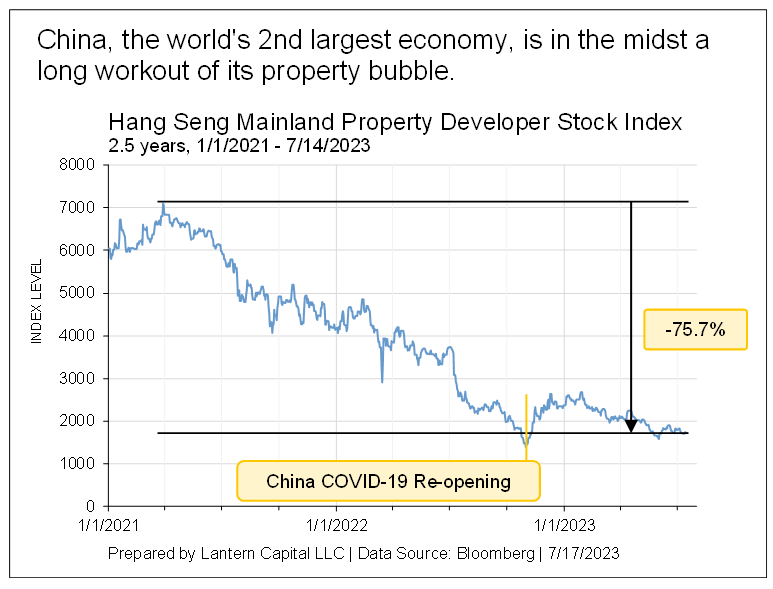
The Chinese economy’s current travails illustrate the growth challenges facing many other countries around the world. By re-engineering ineffective growth models and improving domestic economic management, developed and developing countries can avoid falling into the growth trap China now finds itself in.
Home country bias means that investors may be overlooking international bonds. Certainly, the flows into U.S. fixed income ETFs dwarf the flows into international bond ETFs. That could be a missed opportunity.
Transitioning to a green net-zero economy requires climate solutions that enable the economy to decarbonise, such as renewable energy, electric vehicles, and recycling technologies.
After stubborn U.S. inflation in the first half of 2023 kept the Federal Reserve raising rates, June’s softer inflation report suggests July may mark the end of the hiking cycle.
Markets can present challenges for investors as volatility, direction, supply, outside influences, and future expectations are continuously changing.
Corporate profits are being challenged by market forces, diminishing pricing power.
Health care’s innovation-driven growth and inherent resilience makes it a natural fit for dividend growth investors, according to Franklin Equity Group.
Amazon is the world’s largest online retailer and a prominent player in the field of cloud services, digital streaming, and artificial intelligence. This Knowledge Leader has redefined the landscape of e-commerce and technology.
The MSCI EM index is up 20% from its bottom last October, but is almost 30% below its February 2021 peak. Thus, it has lagged other major markets globally. We have seen and heard investors getting more positive on emerging equities and reallocating capital accordingly.
Appealing yields and cautious markets.
Using LOGICLY’s data and analytics platform, this article looks at the top funds in the equity asset class that have brought in the most assets YTD.
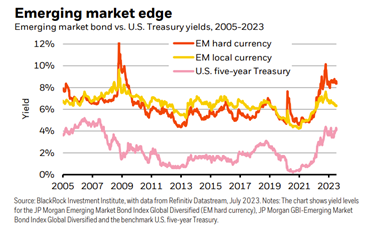
We favor emerging market (EM) to developed market (DM) assets on a brighter macro backdrop. We get granular and harness mega forces, per our playbook.
The beginning of the banking and commercial real estate crisis this year has many parallels to the start of the residential real estate crisis in 2007.
The best news last week was that inflation came in below expectations for June. Consumer prices rose a moderate 0.2% for the month, while producer prices increased only 0.1%.
Nokia Corporation is a global leader in networking. Based in Espoo, Finland, this Knowledge Leader’s mission is to bring together the world’s people, machines, and devices to realize the potential of digital in every industry.
Monetary policy infamously operates with long and variable lags, and successively navigating the impact monetary stimulus or withdrawal has on prices throughout the economy and financial markets requires a strategic mindset that is thinking and planning many moves ahead.
Even benchmark-makers are starting to address the supersized influence of heavyweight stocks. Nasdaq’s plan to reconfigure the weights of its constituents should prompt investors to think about the broader concentration risks in US equity markets, particularly in passive portfolios.
The economy has held up remarkably well despite the Fed’s tightening program, but with two more hikes likely in 2023, the risk of a slowdown remains elevated.
Climate change presents a significant source of transition risk for investors as companies face increasing pressures from regulators, consumers, and shareholders to lower their carbon footprints.
An improved income outlook for multi-asset investors, including higher yields, sharply contrasts with cloudy conditions at 2023’s start.
A high probability for an El Niño event in the second half of 2023 brings concerns of extreme weather, persistent inflation, supply chain disruptions, and market volatility.
Chief Economist Eugenio J. Alemán discusses current economic conditions.
One of the most common questions we get from clients is whether they should buy either gold OR silver. Anyone researching an investment in bullion can find good arguments for owning either metal.
The global economy remains in a fragile state. Headline inflation is above-target in almost all major economies, and core inflation is sticky and elevated.
In this video, I will be providing an overview of 26 top-rated companies in the field of artificial intelligence stocks.
The S&P 500 has generated double digit returns so far in 2023, but the gains have been narrowly focused. Heading into the second half, we will be watching to see whether the rally broadens or the market capitulates.