In the five months prior to U.S. recessions dating to the 1920s, the equity Momentum factor was the top performer, with an annualized cumulative excess market return of +6.7%, on average.
Thoughts on the current US debt challenge and the long-term implications for markets and the economy from Stephen Dover, Head of Franklin Templeton Institute.
Because exchange-traded funds (ETFs) offer a dynamic product that can serve as a buy-and-hold or buy-and-sell investment, they can offer investors the opportunity to reap long-term or short-term gains. Knowing the difference between the two is crucial, especially when it comes time for taxes.
Nick Goetze discusses fixed-income market conditions and offers insight for bond investors.
After a continued rally in April, markets largely pulled back in May. Exceptions here were the Nasdaq, which rose, and the S&P 500, which was essentially flat.
The collapse of Silicon Valley Bank and Signature Bank heightens the Federal Reserve's policy dilemma over fighting inflation while maintaining financial stability. We analyze what the crisis means for the banking system and the economy.
Leading into the weekend, when the debt ceiling had not been settled, markets were exhibiting very interesting positioning.
Inflation is one way the U.K. is paying for leaving Europe.
Artificial intelligence (AI) has revolutionized how we live and work, and it is now poised to transform the investing world. As technology continues to evolve and mature, investors are increasingly turning to AI-focused ETFs to gain exposure to this dynamic and rapidly growing sector.
The G7 countries may have set out to deter China without escalating the new cold war, but the perception in Beijing suggests that they failed to thread the needle at their recent summit in Hiroshima.
The private equity (PE) industry has been all the rage over the past 10 years.
See why we believe that market uncertainty may create opportunities for active managers to identify companies that can weather a slowdown.
Explore the recent developments in artificial intelligence, the implications for industries and our perspective on investment opportunities.
Humanity is sitting on a time bomb.
A quick PSA from RBA: Beware of the coming credit crunch. The key goal of tightening monetary policy is to reduce the flow of credit. It is also important to note that the weakest links always default first. This cycle is so far no different.
The US Federal Reserve is adrift, and it has only itself to blame. Regardless of whether its policy-setting committee announces another interest-rate hike in June, its top priority now should be to address the structural weaknesses that led it astray in the first place.
Review the latest Weekly Headings by CIO Larry Adam.
The Federal Reserve’s higher interest rates, the work from home trend, ESG distractions, increases in crime, etc., are having far reaching effects on our economy and investors.
Investors have been loading up on T-bills and money market funds this year, but according to our Total Return team, that is not a sustainable strategy as it exposes investors to both reinvestment risk and inflation while creating an asset/liability mismatch.
Inflation has proven sticky, even as growth weakens. Markets are realizing that policy rates are set to stay higher for longer. We like quality in stocks and bonds.
While markets are often efficient, the current market environment exposes a number of select areas within the bond market that exhibit less efficient behavior. Investors taking a value-oriented bond management approach may find ways to exploit the inefficiencies.
Is the debt-ceiling agreement struck between the White House and Republican Party leaders likely to be approved by Congress? Our chief investment strategist explains why we believe the answer is yes.
I received many emails and questions on “why” we are adding the U.S. Treasury bond to our portfolios. The question is understandable, given its dire performance in 2022, where bonds had the biggest drawdown since 1786.
This week, the VettaFi Voices come together for an abbreviated chat about an important topic: the debt ceiling.
The A.I. chase is making for a very narrow market.
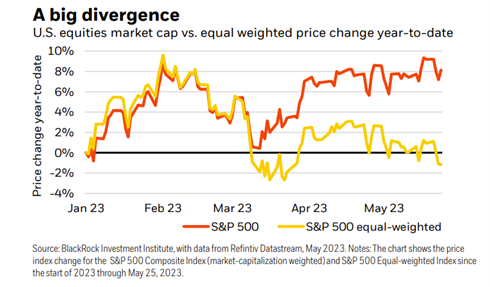
The concentration of gains up the cap spectrum isn't itself a precursor to weakness; it's the lack of participation from the "average stock" that warrants some caution.
A debt ceiling deal is within sight.
The stresses in the CRE market do not appear to pose a systemic threat to the global banking system.
Following OPEC’s surprise production cut in April that saw crude oil squeeze from $65 to $80 per barrel in a manner of days, hedge funds and the like have once again resumed selling on slowing growth and recession fears.
Transit has not made a complete recovery from the pandemic.
The stock market finished Friday on a high note, with the S&P 500 index just north of 4,200 for the first time since August 2022 and up 17.6% versus the market bottom in October.
Several key economic indicators come out every week to help provide insight into the overall health of the U.S. economy. Policymakers and advisors closely monitor these indicators to understand the direction of interest rates, as the data can significantly impact business decisions and financial markets.
Chief Economist Eugenio J. Alemán discusses current economic conditions.
As the debt ceiling fight in Washington heads down to the wire with the risk of a technical default looming, investors are growing nervous.
We live in unprecedented times. Since the COVID pandemic, the economy has been deeply influenced by a massive increase in government spending, COVID-related shutdowns, and a huge increase in the money supply.
For this edition of Bull vs. Bear, Elle Caruso and Karrie Gordon discussed the pros and cons of investing in fossil fuels.
The Northern Trust Economics team shares its outlook for major markets in the months ahead.
As other nations seek to become less dependent on the U.S. dollar, rumors of the greenback’s potential demise continue to swirl. Can the dollar remain king of the world’s reserve currency?
I originally posted a video covering the hospital REIT Medical Properties Trust on February 17, 2023, when the price was $12.96. On February 28, 2023, I did a follow-up update video after the price had fallen to $8.72.
The financial markets are giving off mixed signals of late, and credit investors may wonder whether to be downbeat or optimistic.
Like planting seeds, sometimes new investment vehicles take time to take root. David Mann, Franklin Templeton’s Head of Global ETF Product and Capital Markets, draws parallels between gardening and developing and growing new ETFs.
We've described the past several years' stock market as a seesaw in which the "market" was the fulcrum of the seesaw. On one side of the seesaw sit the highly speculative growth sectors and on the other side, sit virtually everything else in the global equity markets.
Swiss money manager Felix Zulauf is a crowd favorite at SIC. His 2022 presentation was right on target, so I asked him back to tell us what he expects for the rest of 2023 and beyond. Unfortunately, he thinks a slowdown is coming that will hit markets hard.
If you were doubting whether the age of AI has arrived, NVIDIA’s stock performance this week may have given you second thoughts.
According to the company’s investor relations page on this REIT, Simon Property Trust (SPG) is a real estate investment trust engaged in the ownership of premier shopping, dining, entertainment, and mixed-use destinations and an S&P 100 company.
Last week the VettaFi Voices gathered to reflect on a year at VettaFi under the firm’s new name. The team celebrated wins, and time spent together, and shared their favorite insights and highlights from a busy twelve months.
With a year-to-date gain of just over 60%, Tesla stock keeps rolling higher, and the company’s recent shareholder meeting could continue to appease the bulls — if the electric automaker manages to hit its goals.
While we don't expect the U.S. government to default, the uncertainty may heighten market volatility in coming days. Here are answers to some of the questions we're hearing most often.
Why not take a break from working in the world of finance by immersing yourself in the eleven best finance films of all time?
I was a math major in college. My favorite class was Probability and Statistics, taught by Dr. Wolcin. He warned us from the beginning that the final exam was the grandaddy of final exams—that it was really hard, and he would probably end up curving it.