The most interesting shift in market price action in June was the strong outperformance of value stocks compared to the broad market and tech
In light of all this, our own view is that markets remain well positioned to continue to rally over the medium term, though given their stratospheric rise of late, a bit of a pullback might be in order in the short term.
It’s likely not a bubble. Earnings are high. Prices are high because they anticipate future high earnings growth. The historical record shows that growth rate is achievable.
April saw a strong rally, which fully reversed the stock market’s losses in March. US markets set new all-time highs, and European stocks came within whispering distance of their all-time highs as well.
March 2026 was a rough month for financial markets. Broad indexes experienced large selloffs, led by international stocks, though many of these still remain up in 2026. The dollar rallied strongly, breaking its year-plus downtrend.
With apologies if this is the tenth investment piece you’ve read this week about the impact of the Iran War on asset markets, but we wanted to share our thoughts on what’s going on with our investors. First a recap. The S&P 500 is down 5.4% since the February 28, 2026 start of the Iran War.
Iran's de facto closing of the Strait of Hormuz precipitated the latest in a series of energy crises. Since the 1970s, some energy spikes were associated with weak stock markets, but some were not.
AI fatigue has taken hold of financial markets. The companies powering the AI revolution (Nvidia, Google, Microsoft) were down. The companies that are being (or might be) disrupted by AI, like software makers, were also down.
Dollar positives include relatively high U.S. interest rates and robust growth. But dollar negatives are building. The political will for a stronger dollar isn't there and valuations aren't helping.
The dollar finished the month down 1.3% for a litany of reasons, including our progressively nastier spat with Canada and the Trump administration's insistence on liberating Greenland.
With 2025 in the books, we take a brief pause to reflect on QuantStreet over the last few years. We started managing our first portfolio in December of 2021. What started out as just an idea has grown into a business serving many clients, both retail and institutional. 2025 was a year of growth for QuantStreet, and we hope to continue to build on this in 2026.
The S&P 500 is near all-time highs, leading some to question whether markets are in a bubble. A careful analysis of past bull markets suggests this is not the case.
After a "mini swoon" in November driven by AI bubble concerns, market tranquility has returned this December as investors await the Fed's widely anticipated 25 basis point rate cut and Chair Powell's subsequent remarks.
History shows that the starting points of technological revolutions are not invariably followed by large stock market selloffs. The historical precedent we draw from Carlota Perez's 2002 book, "Technological Revolutions and Financial Capital," coupled with the macrohistory.net data, provides some guidance.
October was a good month for financial markets, with a broad-based rally across geographies and sectors. Tech stocks and gold led the way, and the dollar finally had an up month. QuantStreet's strategies, across different risk levels, moved in line with or slightly exceeded benchmarks.
If gold were the perfect hedge for inflation—it isn’t—then gold prices divided by the overall price level would be constant over time. However, real gold prices (adjusted for inflation by dividing by the CPI price level) are currently at multi-decade highs.
The market is in a funny place. September was a strong month for financial markets, its typical negative seasonality notwithstanding.
Target date funds represent the investment industry's best thinking about how people should invest for retirement.
In our opinion, all of these legitimate concerns are, to various degrees, already priced into financial markets. The impact of these on the ongoing stock market rally will depend on their trajectory relative to investor expectations.
Some things change in markets and some don't. The dollar partially reversed its year-to-date decline in July, and US equities had their first moment in the sun relative to international peers thus far in 2025.
Many portfolios consist of highly appreciated, concentrated positions. Investors are hesitant to rebalance these portfolios due to concerns about paying capital gains taxes. Such hesitancy is often unwarranted.
After a tumultuous few months, June of 2025 saw a strong rally which took global markets to (or close to) new highs. The rally was broad-based, with international and U.S. markets all up strongly.
One of the enduring challenges of portfolio management is the inability to follow all news flow relevant to portfolio positions. AI and cloud-based workflows are helping us overcome this problem.One of the enduring challenges of portfolio management is the inability to follow all news flow relevant to portfolio positions. AI and cloud-based workflows are helping us overcome this problem.%MCEPASTEBIN%
If the market view on the administration's economic policies shifts and a strong dollar policy remains, the dollar could rally, and U.S. assets might see a rebound from their recent underperformance.
Amid a fair amount of market tumult, we wrote two months ago that the best course of action was to stay invested in roughly the same portfolios that we’ve had throughout, and let the market stabilize.
While the S&P 500 index was almost unchanged in April, the dollar remained extremely weak, ending the month down over 4%.
Gold has been a high-performing investment over the prior year. It has rallied on the back of falling short-term interest rates and recently increased uncertainty about global trade and economic growth.
To summarize the market action of March of 2025: U.S. stocks (SPX) did poorly, international stocks (especially Europe, VGK) did well in dollar terms, and gold (IAU) did spectacularly well. The main culprit appears to market concerns about the Trump administration’s tariff policies.
In a recent piece, I analyzed the construction of downside-protected strategies. Here, I propose a measure of the relative attractiveness of these strategies over time and examine their historical performance.
Recently, downside-protected ETFs have garnered a lot of investor attention. These products are long the stock market – via different indexes – and use options to create downside-protected payoffs.
We wrote in last month's letter that the U.S. stock market had to meet lofty earnings expectations to maintain its strong performance relative to global benchmarks, while the latter had a lower bar because of considerably cheaper valuation multiples and higher dividend yields.
The DeepSeek blip notwithstanding (our initial take on the news is here), January 2025 was a good month for financial markets. The S&P 500 was up a robust 2.7%, though Nasdaq lagged (largely due to DeepSeek, in our opinion) with “only” a 1.7% monthly return.
Are U.S. stocks in a massive valuation bubble? We don’t think so. Will U.S. stocks outperform their European and Asian counterparts over the next 10 years? Maybe.
After a strong November 2024, markets were generally down in December. The S&P 500 index was down 2.3%, while energy, small caps, value stocks, and REITs performed considerably worse.
CAPE, or the cyclically adjusted price-to-earnings ratio, introduced in 1988 by economists John Campbell and Robert Shiller, is arguably the best-known indicator of broad market valuation. And CAPE is now at an almost (though not quite) all-time high level, according to data from Robert Shiller's website.
We launched QuantStreet a little over three years ago, and our first accounts went live as of December 2021.
The S&P 500 index has had a spectacular run from its October 2022 trough to its present all-time peak, which has some (me included) wondering when the bull market will end. I approach this question in three steps.
October’s market activity can be neatly summarized in a single chart: the dollar (BBDXY) was strong and U.S. stocks (the VOO ETF tracks the S&P 500 index) meaningfully outperformed international stocks (VXUS).
U.S. stocks have handily outperformed their global peers over the past few decades, as well as in the post-World War II period. We document the scale of the outperformance and ask whether it can continue.
The major market event in September was the Fed's 50 basis point rate cut following the September 18th Federal Open Market Committee meeting. There was broad consensus the Fed would cut rates, though the 50 basis points (as opposed to 25) and perhaps the tone of Jay Powell's press conference surprised to the upside...
After a bit of an early-August swoon, the stock market came roaring back in the last few weeks of the month. The S&P 500 finished up 2.4%, though certainly in the early days of August, that did not feel like a particularly likely outcome. In client conversations a few days into the selloff, our feeling was to stay put and not tinker with the portfolios we suggested in early August.
Dollar cost averaging involves committing money to the stock market gradually, rather than all at once. This time spent out of the market leads to lower returns, but also to commensurately lower risk.
When growth slows and rates fall, what will happen to an asset class with long-dated cash flows that are not very economically sensitive? Well, it is likely to strongly outperform. Ergo the short-term outlook for growth relative to value/small caps appear to be rosy.
June of 2024 was a good month for financial markets. Leading the pack were (again) technology stocks, with the NASDAQ up 6% on the month. Close in second place were emerging market ex-China stocks, largely driven by India, Taiwan, and South Korea, all of which had large rallies in the month.
After a weak April, markets bounced back in May, with the S&P 500 staging a breathtaking rally in the final few hours of trading on Friday, May 31.
Relative to 18 developed economies since 1870, U.S. leverage is high though not unprecedented. However, unless the recent rise in interest rates reverses, the U.S. will need to cut its debt load.
From the end of March until the end of April, the market had a serious rethink about the path of monetary policy for the rest of 2024.
TIPS offer inflation protection, but at the cost of higher volatility and lower returns in bad times (when inflation is low). TIPS behave somewhere between corporate bonds and nominal Treasuries.
Many asset allocation strategies operate at the level of industry groups. Industry momentum -- buying past winners and selling past losers -- is present in U.S. data going back to the early 2000s.
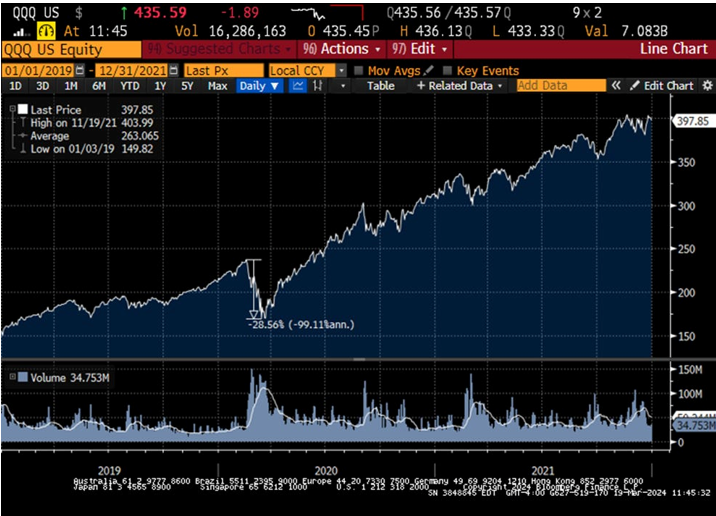
I asked Google's Gemini LLM to opine on the historical drawdowns of the Nasdaq 100. The results, though not perfect, are good enough that investors need to start paying attention.